
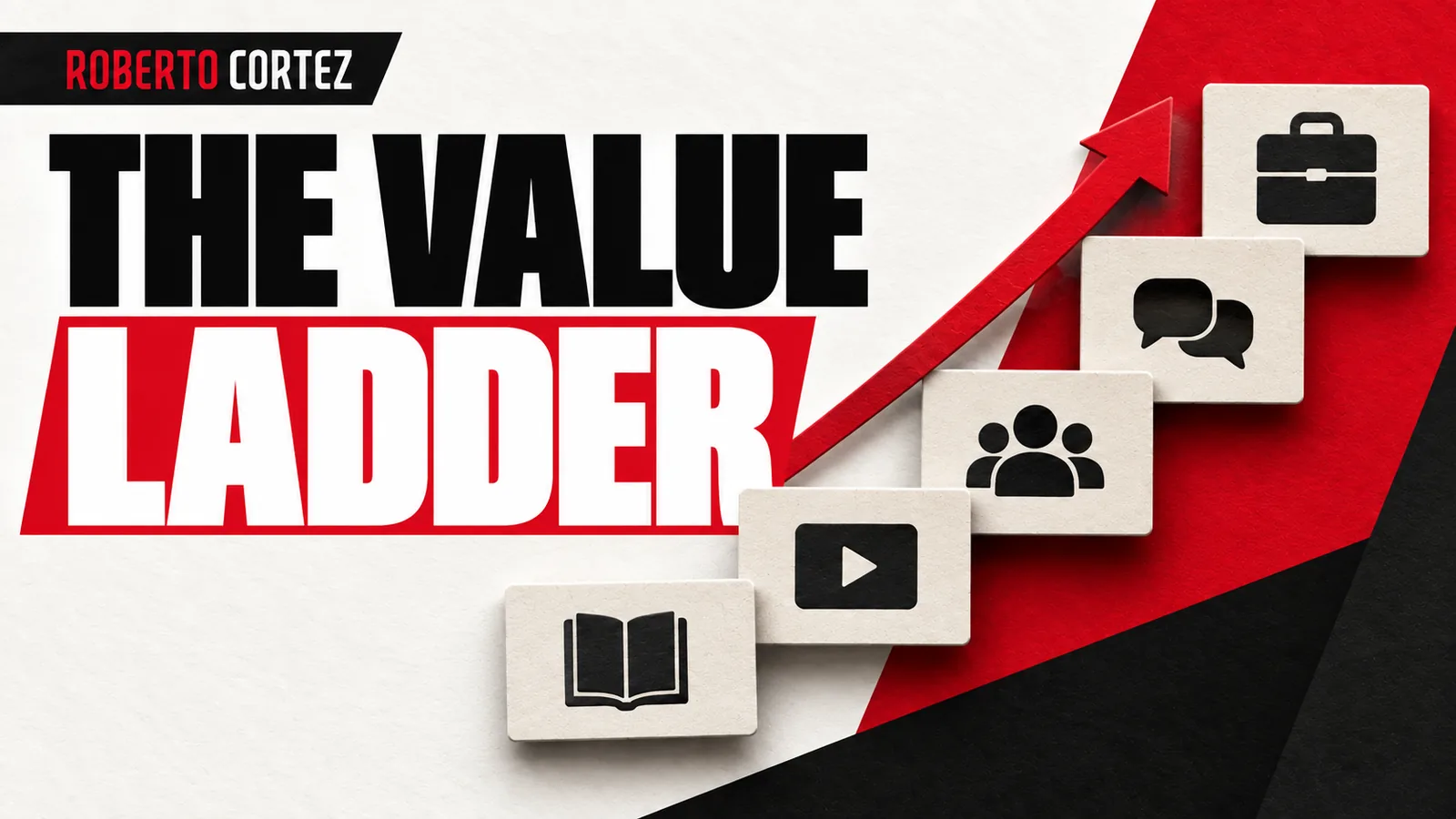
Stacking products by price is not building a ladder
The most common mistake is bundling unrelated services into a table, from cheapest to most expensive, and calling that a value ladder. If the products solve different problems, each one attracts a different audience and none prepares the client for the next.
In the class I gave the example of an agency selling an SEO ebook, then a social media management course, and at the top, landing page creation. These are three different businesses competing for attention, not a ladder. The rule I follow is simple: one pain, one ladder. If I solve lack of organic traffic, the entry product can be an ebook on that same topic, the next step an audit, and the top the implementation done by my team. The client's core problem stays the same; what changes is the delivery format.
New money and repeat money, two accounts that must close
Every healthy business must balance acquiring new clients with generating repeat sales from existing buyers. Repeat revenue matters just as much as initial purchases. Entry products can operate at zero or negative margins, provided they successfully bring profitable customers into subsequent tiers and preserve the total financial health of the company.
In class I repeated a phrase I use often: repeat money matters as much as new money. If only new money comes in, the business restarts the acquisition race every month. The complementary idea is that not every product needs to be profitable on its own, as long as the business is profitable as a whole. An entry product with zero or even negative margin can still be doing its job of bringing clients into the next tiers, and that is acceptable if the overall math closes.
The concrete example I gave was an in-person event for traffic managers, priced at ten euros, where my acquisition cost per attendee reached twenty-two, then twenty-five euros. Looked at in isolation, that was a loss. But the event warmed up an audience that had already opened their wallet once, and part of those people later moved into the follow-up program (the PAD, at the time), where the overall math closed with profit. A direct launch for that follow-up product, without that warm-up, would have performed far worse, in my experience.
Should You Start With an Entry-Level Product or a High-Ticket Service?
How to Tell If Your Offer Truly Matches What Your Client Is Looking For
Growing an online business: what I learned about margin, team, and AI
The ladder tiers: from lead magnet to continuity
A ladder needs very few tiers to function well. I recommend building three distinct levels: a free resource to generate authority, an inexpensive frontend product that covers acquisition expenses, and your primary backend offer. Alongside these steps, run an active continuity mechanism that consistently secures repeated purchases from your customers.
The base attracts and builds authority: newsletters, checklists, open classes like this one. The catch is that free content also attracts curious people with no intention to buy, which is why I do not put all my effort there. Next comes the frontend, the low-friction product meant to acquire paying customers at scale and cover acquisition cost, even at zero profit. Then the backend, the offer with real scale and profitability. At the top sits the high-ticket product, with more access and more proximity. And running alongside all of it is continuity, which ensures the client buys more than once.
Removing friction without lowering the price
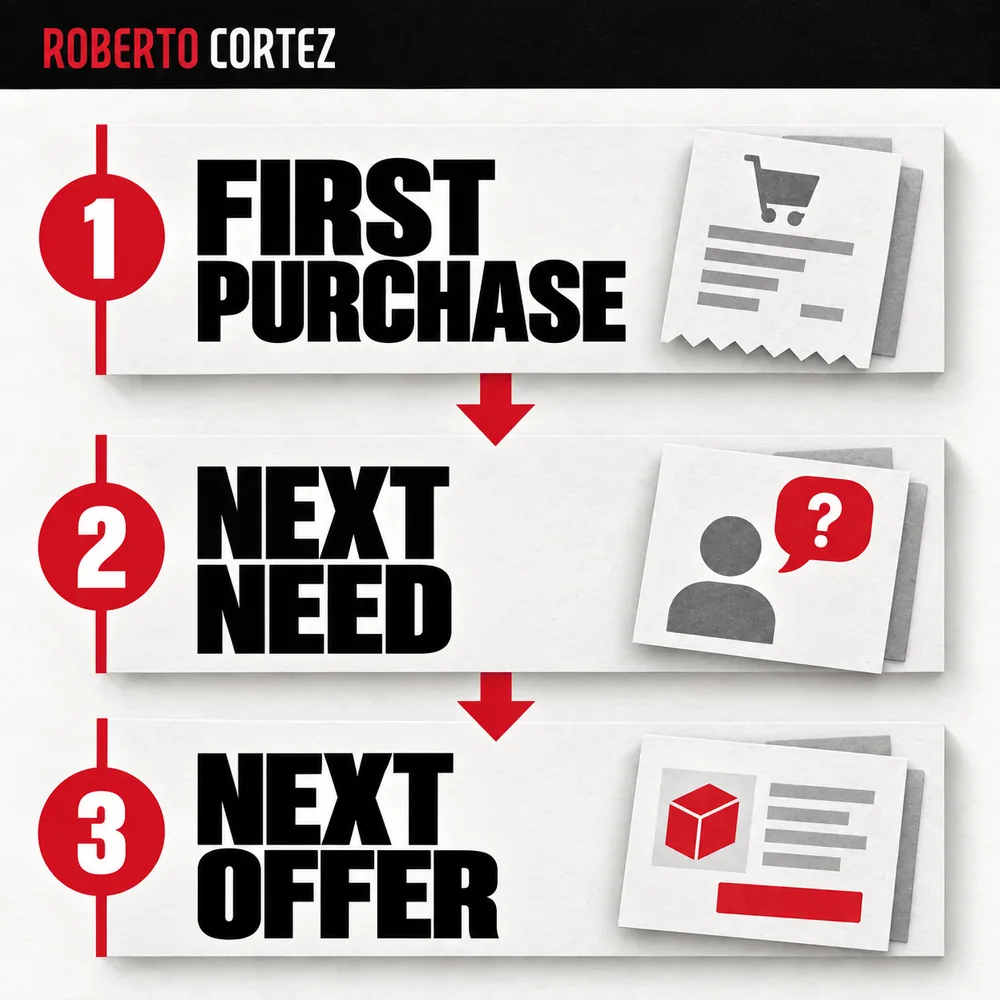
When a high-ticket service struggles with cold sales, keep the primary price unchanged. I recommend introducing an intermediate step that lowers perceived risk for prospects. A smaller paid diagnostic displays real technical competence and eliminates hesitation, turning the eventual purchase of the full service into a natural, confident decision for them.
The example I gave in class was a thousand-euro monthly contract with a six-month commitment, meaning a six-thousand-euro decision. Selling that cold, directly through an ad, is nearly impossible: the client does not know the work, does not trust the consistency yet. The alternative I propose is a paid analysis or audit, cheaper and without commitment, where I show real technical competence and point out concrete errors in the client's operation. After that, the step to the full service stops being a leap in the dark. This does not always require inventing new products: I have never run direct ads for my own highest-ticket product, precisely for this reason.
Doing the math on maximum acquisition cost
Designing an entry product requires knowing your maximum allowable customer acquisition cost beforehand. Running this entry offer at an initial loss remains profitable whenever backend conversion rates reliably cover the total expense. Without this foundational calculation established clearly, you are forced to make strategic product decisions entirely in the dark.
The example I used in class came from recruitment: a fixed fee of around a thousand euros per placement, with margin allowing up to two hundred euros in acquisition spend per client. From there, I hypothetically sketched a twenty-euro book on how to interview digital marketing professionals. As an exercise, assuming a 50% conversion rate from book buyer to main service, the math works like this: paying a hundred euros in ads per book buyer recovers twenty euros in book sales, and since half convert to the service, the real acquisition cost lands near two hundred euros, within the ceiling. It is a hypothetical exercise, not a documented campaign, but it shows the logic: losing money on the entry product can be profitable if the math at the top of the ladder is clear.
The entry message has to point at the main offer
Having a large contact list is useless if those people have no real interest in the main offer. I was direct about this in class: I cannot disconnect the entry product's message from what I actually want to sell at the top.
The example I gave was about webinars for agencies: it makes no sense to run a webinar about the value ladder concept itself to attract clients for a traffic management agency, because the topic does not match that audience's specific pain. The ad and the entry product act as a filter. If the entry promise does not logically lead to hiring the continuity service, the result is just noise in a database, with no one ready to buy.
Before designing the ladder, three simple questions
Before building new products, answer three practical questions about your operation. Check whether your calendar is full at strong prices with room to expand. Clarify how clients can sample your solution before a major commitment. Finally, verify that your cash flow can comfortably support an entry product yielding minimal upfront profit.
I do this exercise myself in a more structured way once a year, usually around Christmas, to decide what to build in the intermediate tiers for the following year. It is not a daily practice or a fixed formula, just a moment of reflection I repeat.
Sextas Ímpares #99: What is the VALUE LADDER and how can I USE IT IN MY BUSINESS?
This article is based on the class I gave in Sextas Ímpares number 99, recorded live and standing up . The traffic manager event and the follow-up product examples are historical to that session; today my ongoing mentoring work runs through SpartAds and Laboratório da IA, where I do two mentoring sessions per month. You can watch the full class here: https://www.youtube.com/watch?v=ICq8XlXPI_g