
Why selling packages turns you into a commodity
If your main selling point is packages or hours, five posts, ten posts, three hours of work, you're competing on price. The client compares your cost per unit against any other provider and the conversation always ends up about discounts.
I use the Pokémon card analogy in this example: when you sell "strategy" without explaining what that actually means in practice, the client doesn't quite know what they're buying and prefers to pay for something tangible, like a scheduled post or a set-up campaign. At the same time, if you position yourself only as the person delivering those pieces, you become comparable to any cheaper executor, or to an automation.
Continue delivering tasks while framing each execution directly as the vehicle for a result. Strategic alignment with client objectives becomes the primary criterion, replacing simple volume metrics like post counts or ad setups.
To prepare your next step, explore How to grow a service business.
Walking in the owner's shoes
Walking in the owner's shoes means asking why that person pays you what they pay, and what would need to change for them to accept paying double. If the only answer is "do more of the same," you're stuck in a fragile model.
No business owner is obligated to keep a service contract. A company hires when the return generated outweighs the cost of hiring, full stop. If a client sees you as a negative-sum game, the relationship won't last. That's why it's worth asking, before any meeting, how this person sees the business, what difficulties they've already faced, and what would need to happen in their head for the partnership to feel like a success.
This exercise doesn't replace mastering the business context. Without understanding why a given action is being taken, there's no serious way to even price a retainer.
Explore this decision further: What questions a media buyer should ask before touching ad campaigns.
Wearing the specialist's hat with professional balance
As a specialist, I evaluate and question requests to ensure they genuinely work. Blind execution and claiming I merely followed orders demonstrates poor judgment. I offer a clear professional opinion, recommend the most suitable path, and leave the final decision entirely to the client.
As a specialist, I evaluate and question requests to ensure they genuinely work rather than executing them blindly. Simply stating that I followed orders shows poor judgment. I offer a clear professional opinion, recommend the most suitable path, and ultimately leave the final decision to the client.
As a specialist, I evaluate and question requests to ensure they work instead of executing them blindly. Simply stating that I followed client orders shows poor judgment. I give a clear professional opinion, recommend the most suitable path, and leave the final decision to the client.
The balance matters: neither staying silent nor assuming you always know better than the client. The right approach is saying clearly "I believe in A, I believe in B, this path suits you best," leaving the final call to the client, while ensuring they heard the professional read they hired for.
The balance matters: neither the side that never voices an opinion, nor the side that thinks it always knows better than the client. The right point is saying clearly "I believe in A, I believe in B, and this path is the best for you," leaving the final call to the client, but making sure they heard the professional read from whoever they hired for that purpose.
This posture builds long-term relationships. The alternative, complying without any critical judgment, is a short-term relationship, because whoever only executes is easily replaced by someone cheaper or by automation.
Having funnel vision, not just your own piece
I use the puzzle image: if your piece is red and the rest of the puzzle is blue, it fits badly and ruins the whole picture. That doesn't mean executing everything yourself, but knowing what's happening in the other pieces, the website, the email sequences, the ads, even without running them.
Whoever locks themselves into their own box and says "what the client does on their site is not my problem" eventually gets replaced, because the day the client finds someone with broader vision, they'll pay that person two or three times more. The strategic professional, even working only on social media, has to be able to say "your email marketing narrative isn't consistent with what we planned for social."
In a paid traffic funnel, agree on the business objective before building campaigns, pages and creative assets. That conversation gives the team criteria for deciding what to build, what to measure and what to adjust when results arrive.
Automation and AI as accelerators, with human curation
Automating repetitive tasks isn't shameful, nor does it risk losing a client. Hiding that you use AI is flawed reasoning: an intelligent client cares about the result and the quality, not how many minutes you spent producing it. Clients deserve specific answers, checked against their context before I deliver them.
AI tends to return mediocre answers when given little context, the same way someone writing short prompts gets a response that would fit anyone. The human role is providing detailed context, filtering out those generic answers, and doing quality control over what the tool produces.
In Laboratório da IA, with live practical mentoring sessions twice a month, this kind of work with tools like n8n and autonomous agents is explored to free up time from operational work and redirect it toward analysis and decisions. That can free up minutes or hours across a week, but the real value only shows up if that time is then used to think better, not simply because it exists. The central point: it doesn't matter whether a human or a machine did it, what matters is the care put into it.
Building your own storefront and your own methods
How you present yourself to the market determines whether you're seen as interchangeable with any other provider or as someone with a distinct method. The saying about the shoemaker's children going barefoot fits here: if you sell social media management, your own profile needs to show quality; if you sell paid traffic, your own campaigns need to be well built.
Beyond the storefront, it's worth making visible your own way of thinking through a project, the sequence of diagnosis, testing, and scaling you apply. When a client recognizes that method as different from what anyone else would do, they stop comparing price per unit and start valuing the way of working.
In my own experience, working on personal branding on LinkedIn from early in my career opened doors and brought invitations, precisely because people started seeing, beyond the executor, someone who thinks about the business.
Diversifying your client base and margins to gain real freedom
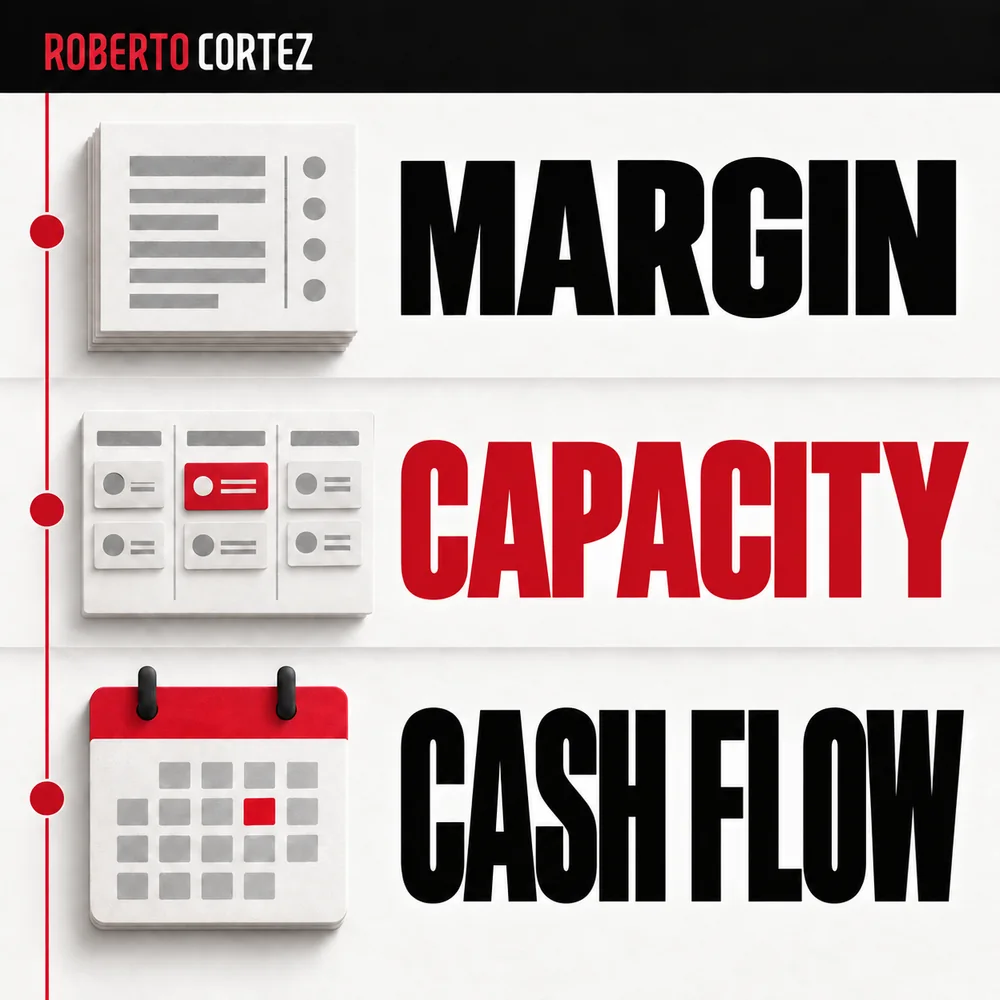
Genuine professional freedom means being able to lose an account without risking your financial survival. During a conversation I had at a recent event, someone managed four clients at 400 euros each with a full schedule, leaving no safety margin if any single project ended.
When I asked if she could lose a client without struggling, the answer was no, which showed she wasn't truly free, she was dependent.
The way out of that trap is diversifying your client base and working with margins that can absorb losing an account without derailing the month's target. It also helps to keep a prospecting pipeline always active, instead of only looking for clients when the schedule gets tight.
When your client base is diversified and margins are healthy, you gain the real ability to turn down purely mechanical work and choose only the projects where you can operate strategically.
Explore this decision further: Growing an online business: what I learned about margin, team, and AI.