
How to know whether time was actually freed
To confirm you gained usable time, compare total time spent before against the time now spent on review and error correction. If the team spends the saved hours cleaning up what the tool got wrong, nothing was actually freed, the effort simply moved elsewhere in the process.
In Sextas Ímpares #128 I worked through an example to think about this, which I described as an exercise rather than a fixed formula: a team receiving commercial inquiries that, before automation, spent thirty minutes per contact researching the company, qualifying the request, writing the message, and logging it in the CRM, at a cost of €25 per hour. Adding one euro of infrastructure cost, plus 20% for error cost from poor qualification and 20% for latency cost from slow response, the total cost per decision comes to €19.44.
With AI handling automatic company research, request summaries, and a draft reply, the salesperson spends about six minutes just validating what the machine prepared. Error cost drops to 5% and latency cost to 3%, because the response goes out faster. Cost per decision falls to €3.79. The difference, €15.65 per contact, only matters once multiplied by volume: at 500 contacts a month, that's roughly €7,825 in monthly operational savings, before other business costs.
The reasoning matters more than the exact figures, which I made clear were illustrative and adjustable to each business: measure human time, infrastructure cost, error cost, and latency cost before and after, to see whether automation is actually reducing effort or just relocating it within the same process.
To prepare your next step, explore Delegation and processes for small teams.
Distinguishing scattered minutes from usable capacity
A few free minutes scattered through the day can help with short tasks. A consolidated hour may be more useful for work that requires concentration, because someone can settle into the task without repeatedly stopping and starting. The value depends on the work the person needs to do.
Grouping mechanical tasks into continuous automated blocks is what frees up those consolidated stretches on the team's calendar, making them easier to put toward higher-value work. If someone saves three minutes filing a document and four minutes filling a form, that fragmented slack tends to dissolve into small distractions, even though it still adds up to some value across a month. What makes more difference is redesigning the workflow so tasks of the same kind are handled in batches by automation, rather than interval by interval by a person.
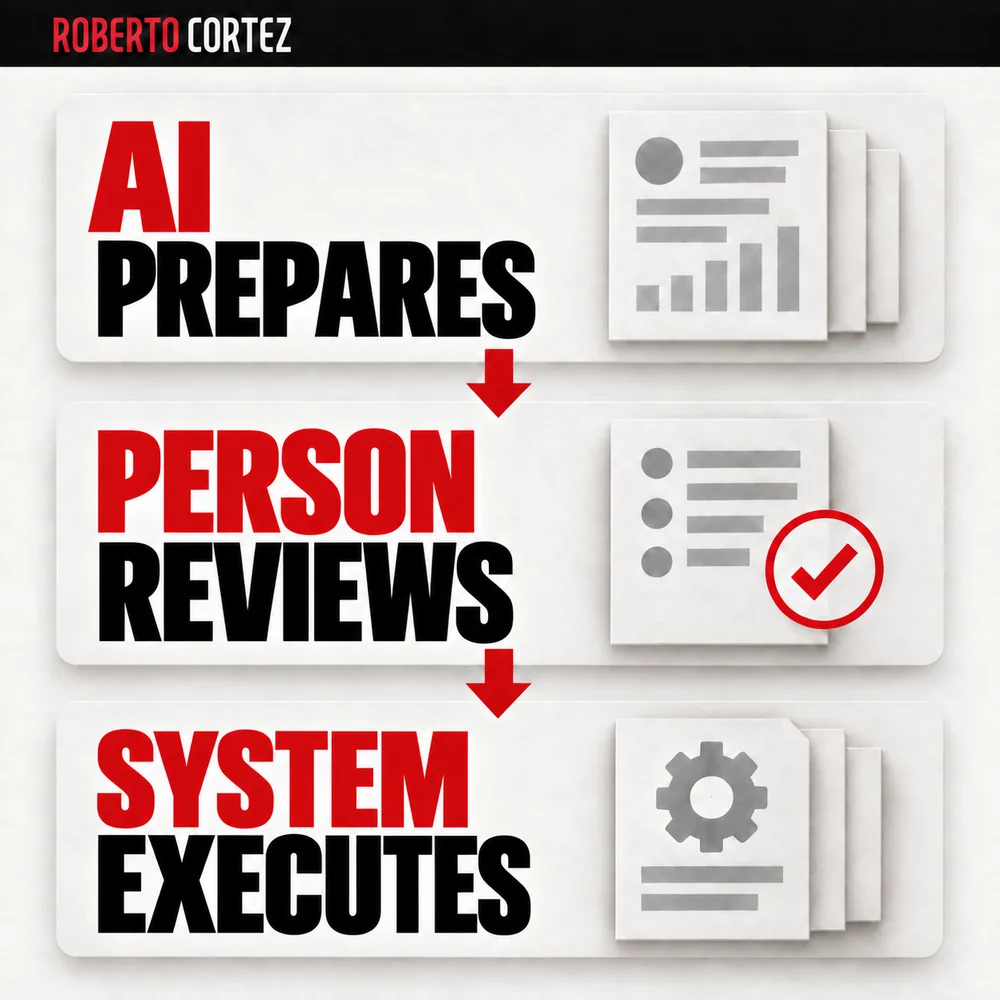
In the lead qualification example, this means the person doesn't enter the CRM contact by contact. They use a defined window of the day to validate several prepared responses at once. That concentration helps turn scattered minutes into time applicable to something else, such as deeper sales conversations or client follow-up.
Moving from execution to critical curation
The highest-value role for a team is judging whether what the machine produced is right, by comparing the generated suggestion against real knowledge of the business and its clients. That judgment, built up by people over time and something the machine doesn't hold on its own, is what ends up determining the quality of what reaches the client.
In the example from this example, the AI analyzes the inquiring company, cross-references that profile with past client history, and proposes a response plan. The salesperson doesn't write from scratch. They confirm the suggestion fits pricing policy, adjust anything requiring commercial sensitivity, and only then send it. When the tool makes a mistake in one case, the person doesn't just fix that case. They also update the instructions or knowledge base feeding the machine, so the mistake doesn't repeat.
This shift raises the bar for the team: deciding whether what was generated actually serves the client and the brand becomes the core job, well beyond clicking buttons or filling fields.
Observing, automating, adding intelligence, and scaling
I described a four-step cycle I follow when introducing automation into a process: observe what repeats, question whether it can be automated, add intelligence when it makes sense, and only then scale it. This cycle gives the team an active role in setting priorities, rather than leaving them just on the receiving end of tools decided elsewhere.
During the session itself I asked attendees to name, in the chat, which processes in their day-to-day carried the highest cost per decision. Examples that came up included replying to emails about birthday-related programs and managing ad campaigns, signs that friction points vary business to business but follow the same pattern: repetitive tasks with clear rules that consume time disproportionate to the value they generate for the end client.
It's worth setting aside time for the team itself to run this same exercise inside your business, because the people handling customer support or campaign management daily usually spot where manual effort runs excessive better than management does from the outside.
Explore this decision further: How to use AI in business beyond chatbot prompts.
Where to direct the recovered capacity
Recovered time should go toward what machines don't do: sales conversations, following up with existing clients, and decisions requiring judgment about human context. Without that explicit choice from leadership, the team tends to fill the calendar again with low-value work, quietly erasing the gain the automation produced.
I also used a conversion exercise. With 500 enquiries per month and an average purchase of €1,000, moving from a 5% to a 6% closing rate means five additional sales, or €5,000 in revenue. This is a hypothetical calculation that depends on that improvement actually happening. To assess the effect over time, you also need to consider repeat purchases, delivery costs, and the period being compared.
The logic that survives this illustration is simple: recovered time produces a return only when it's channeled into activities that increase conversion or retention, instead of being quietly absorbed by more internal paperwork.
Explore this decision further: Growing an online business: what I learned about margin, team, and AI.
Tracking results without inflating expectations
Measure the impact by tracking concrete operational indicators over several months: response time, reported errors, and the team's conversion rate. Compare those changes with the time spent reviewing the automated work. That gives you a firmer basis for deciding where the recovered capacity should go.
If cost per decision has fallen consistently and delivery quality hasn't dropped, that's a solid sign the time was well reinvested. When the team keeps spending hours fixing what the automation produced, the cause is usually the data and context fed to the tool, not the technology itself. As I pointed out without good data, artificial intelligence simply guesses.
For more practical reflections on automation and business, see online business and sales.