
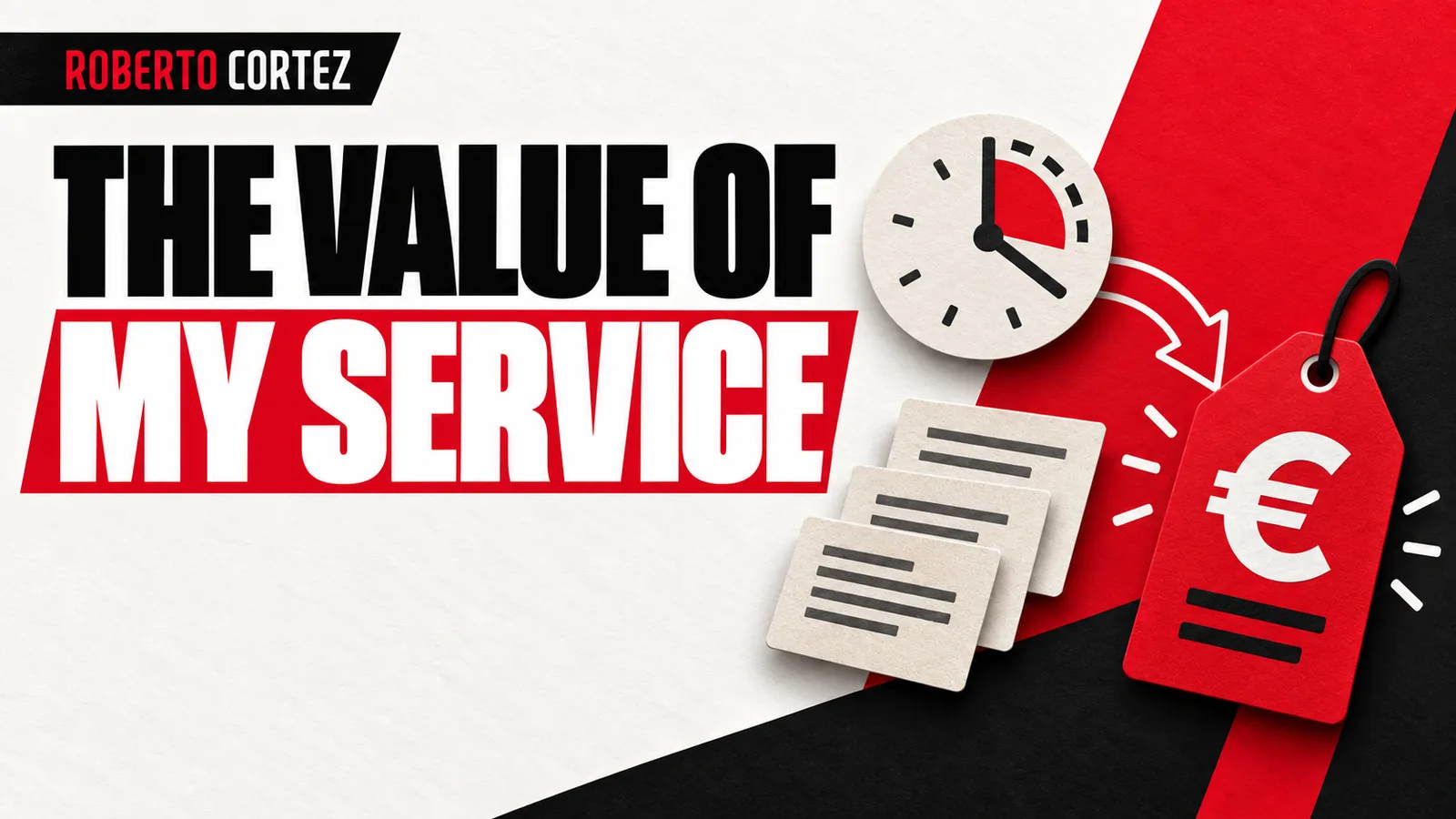
Hourly billing punishes your own efficiency
Charging by the hour reduces your earnings as your speed and experience increase while solving identical problems. In class, I stated plainly to sell value instead of time. A slower freelancer earns more under this system, penalizing professionals who work efficiently and develop faster methods through their accumulated expertise.
Accumulated experience and mastery of process are part of your edge. That productivity gain belongs to you; it is not a discount owed to the market.
The problem with selling time is that the client starts judging your work by the wrong lens: cheap or expensive per hour. If a client realizes they paid €500 for a few hours, they feel uneasy. But if they know that delivery brings them results, they consider it cheap. What matters is the result, not the stopwatch.
Defining the deliverable before talking price
There is no fair price without a clear deliverable. Before sending a proposal, you need to know exactly where your responsibility starts and ends, and what stays in place for the client. Without this, any number you present is a guess.
I was blunt about this in class: when someone tells me they still don't know exactly what they'll do for a client, the answer is clear: "there's no way to price something I don't have clarity about." Sending a proposal without understanding the client's real need is amateurish.
This means asking questions before locking in numbers: what access already exists, what infrastructure is in place, what needs to be built. When you realize you need to build landing pages, install pixels, configure tag managers and structure campaigns from zero, you are producing assets that stay with the client. That foundational work costs more because it is responsibility and production, not just maintenance.
Growing an online business: what I learned about margin, team, and AI
What I expect from a media buyer in the AI era
To design execution and handle exceptions, explore the business process automation guide.
Responsibility and risk outweigh internal effort
The central pricing criterion is not how much internal labor you spend; it is the weight of the responsibility you take on. Managing a small budget is one thing; managing investments where a tracking error can compromise a company's sales volume is something else entirely.
In class I explained that the larger the managed budget, the more employees depend on that work, and the greater the financial impact on the business, the higher the price must be: "the greater my responsibility, the more money I'm going to manage, the more impact that money has on the company's business," that's where the price sits.
Risk also enters the equation. An unvalidated business is riskier for you than a mature business with a long-term contract. I argue that immature, less stable businesses, more likely to churn early, deserve a higher price, precisely because the risk of losing the client soon is greater. When there is expected recurrence, with a signed contract and consolidated history, there is more room to be flexible in negotiation, because the value over time is already more secure.
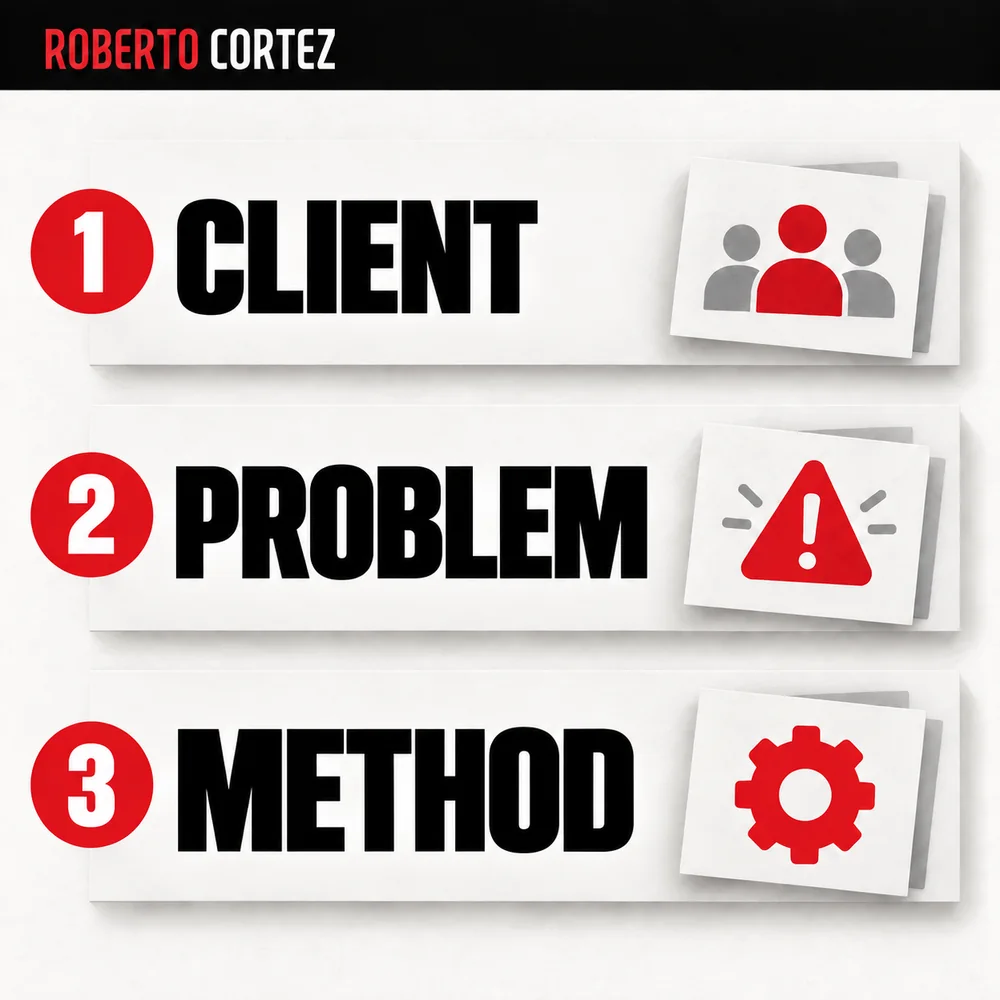
The opportunity cost of your schedule
Every client you take on occupies space that keeps another one out. When your schedule is already full, taking an extra project brings a tangible cost, regardless of how fast you deliver. Weigh the total weekly demand, including out-of-scope meetings and revisions, and set your price to reflect that overall commitment.
I use the image of working for a minority: if you already have nine good clients and are deciding on a tenth, that slot is worth more than it first appears. Before closing a contract, it's worth thinking about what that client will consume from your week, including out-of-scope meetings and revisions, and pricing accordingly, not just for the technical work.
This logic explains why I avoid selling time on recurring work, like traffic management. The exceptions I accept are specific: one-off consulting sessions, where the product is my presence during a scheduled hour, or work with unpredictable scope, like programming, where effort can't be locked in upfront.
Explaining price without entering market comparison
A common mistake is entering the comparison game: "the other guy charges €500, how can I charge more?" This is a trap. Your value is not defined by another professional's price; it is defined by the client's perception of what they'll gain from you.
If you communicate the benefit well, not just the service, the client may consider it cheaper to pay you €1,500 than to pay someone else €500, because in their mind the expected return is greater. This requires the sales conversation to focus on outcome, not tasks.
At my agency, prices for Facebook campaign management vary: from €500 up to clients where we charge over €3,000. There is no fixed market table; there is a combination of factors, responsibility, deliverable, risk, maturity, that determines each figure.
Warning signs that also change the price
Before settling on a final number, it's worth noticing warning signs in the relationship with a prospective client. A client with disproportionate expectations, placing the survival of their business on your work, or one who takes an authoritarian stance in negotiation, is a signal that should weigh on the price, or even lead you to decline the project.
When I sense that kind of signal, I prefer to raise the price in the proposal rather than refuse outright, letting the price itself filter who genuinely wants to work with me under those conditions. This protects the service provider from entering draining relationships for a price that doesn't compensate the discomfort.
Practical example: pricing the ground-up setup of an account
Imagine you sign a client who has nothing built yet: no landing pages, no pixel, no tag manager, no campaign structure. Before thinking about the monthly management fee, you need to mentally separate two phases, because they carry two different prices.
The first phase is the foundation. You will build pages, install tracking, configure conversions, structure the first campaigns. This is asset production that stays with the client even if they eventually stop working with you. This work is not ongoing management, it is construction, and it deserves its own value, usually higher than the monthly fee you will charge afterward. Charging the same rate as recurring management for this initial work is a mistake, because you are spreading concentrated effort across a price meant for maintenance.
The second phase is continuous operation, once the structure is in place and your role shifts to optimizing, analyzing and adjusting. Here the logic of selling results rather than time applies, because your efficiency no longer returns value proportional to hours spent.
If you try to fit everything into a single monthly price from the start, you run two risks. Either you undercharge for the build phase and feel like you are losing money in the first months, or you overcharge the following monthly fee without clear justification, and the client is puzzled by the jump. Splitting the two phases in the proposal, with an explicit setup value and then a separate ongoing management value, makes the price more defensible and stops the client from thinking they are paying for hours when in fact they are paying for assets that will keep working for them for years.
Source note
I wrote this article from the class I recorded for Sextas Ímpares #92, on how to price freelance work without devaluing it. You can watch the full class at https://www.youtube.com/watch?v=op8b_Q-8P_g. Worth watching from around 22 minutes, where I go through the nine pricing points, near 27 minutes, where I talk about not selling time on recurring work, and near 33 minutes, on risk and expected recurrence.