
That's the role I discussed on Sextas Ímpares #151. Automation lets you cut repetitive tasks, but it still needs someone to set the criteria and follow through on the consequences of the decisions made.
Start with the numbers the business can actually support
Before judging any ad, I need to know how much the company can afford to spend to win a customer. The price of the service is only part of the equation. Delivery costs, available margin, and how long it takes for the money to actually land in the company all matter too.
I insisted on mastering the numbers of the business before opening the ads manager. A cost per acquisition of 50 euros means different things depending on the margin and what that customer buys. Do the math with the business owner before concluding that the campaign is expensive or cheap.
The continuity of the relationship matters too. Imagine, hypothetically, a cheap entry-level course that barely turns a profit on its own, but that brings in customers who later buy much higher-value services. You only see that by looking at complete data over months or years, never just at the result from the day the campaign ran. Without that history, any judgment of success is premature.
To prepare your next step, explore Artificial intelligence in digital marketing.
Look beyond the ad and at the whole funnel
An ad can attract genuinely interested people, yet the sale still fails for reasons unrelated to the ad itself. The form may ask too much, the sales response may be slow, or the proposal may leave doubts unresolved. A traffic manager must examine this whole chain, not only the part they directly control.
If leads keep arriving at a normal volume but booked meetings drop, the problem is probably not the ad, it's the sales response. If page visits drop instead, the source is different. Lumping everything into a vague conclusion about "the algorithm getting worse" makes it impossible to choose the next step with any rigor, and it's exactly this kind of integrated analysis that separates a technical operator from someone genuinely useful to the business, a topic I develop in the article on how to build a lead funnel that the sales team can actually work with.
It's also worth cross-referencing this with how you turn that volume of leads into paying customers, something I cover in more detail in the guide on how to turn more leads into customers in a services business.
Build your own systems with clear rules
Building your own tracking systems saves you hours you'd otherwise spend duplicating ads or manually watching metrics across a dozen open tabs. The idea is simple: you define the limits and criteria, and an automation applies them without you needing to constantly watch. This doesn't replace judgment, it just frees up time for what actually requires judgment.
I showed the dashboard I use to track the campaigns for my Ad Summit event. The system checks the ads every hour through scheduled tasks, and compares each one's performance against rules I've defined in advance: how much an ad can spend without generating sales before it gets paused, and from what return the budget can be increased.
In a hypothetical example, you can set an alert for when an ad set exceeds a certain spend without hitting the target. The decision to pause it depends on the period being analyzed, the delay in sales attribution, and the agreed thresholds. Test the rule against past data and confirm who monitors the exceptions before letting it run on its own.
Separate automation from intelligent decision-making
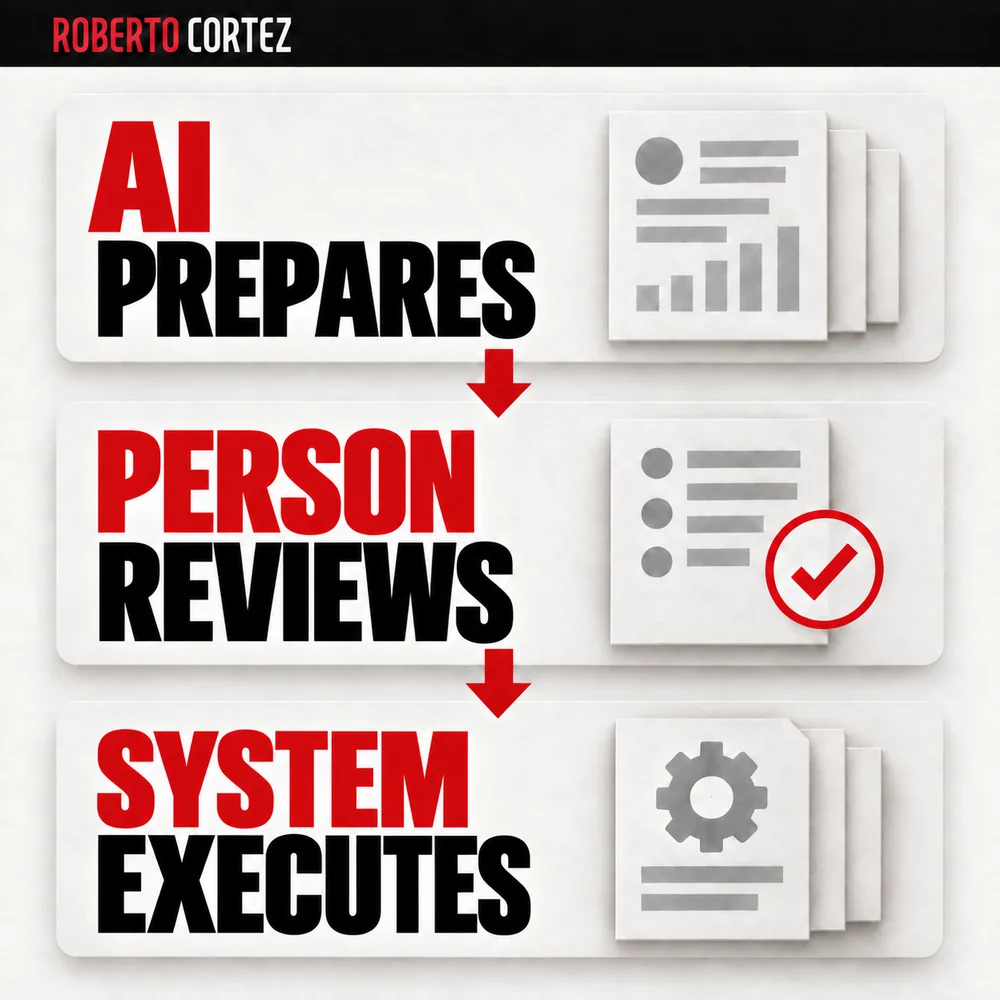
It's important to separate what's a simple automatic rule from what actually requires human reasoning. Automation executes conditions of the type "if this happens, do that" without hesitation. A generative AI model is useful for exploring hypotheses or helping with code, but it shouldn't be the one deciding, unsupervised, whether an ad stays active or not.
In the system I described the hourly check doesn't call any language model to "think" about whether to pause an ad. The numeric condition was already defined by me beforehand, and the code just applies that rule through the ad platform's API. Delegating simple financial decisions to a generative model without fixed rules introduces variability that isn't necessary when a clear rule would have sufficed.
Where AI genuinely helps is in the building phase of these systems: putting together the dashboard, coding the integrations, testing the rules before letting them run on their own. I wrote about this in the article on how to plan an application with Claude Code before you start coding, which covers exactly that preparation phase.
Explain the decisions you make
Being accountable for decisions means explaining them clearly. During the broadcast, I discussed accountability for decisions, including being able to explain why you raised a budget, paused an ad, or chose to wait for more information before acting on something.
An AI suggestion can help you formulate a hypothesis, but you need to confirm the period analyzed, the data used, and what the tool left out. If you change the campaign based on that suggestion, write down the reason and follow the result closely. Blaming the algorithm or a platform update when the plan fails solves nothing and pays no one's bills.
The same care applies to the automatic rules you create. A rule can be doing exactly what you asked and still be out of date with the business. If the offer changed, if the margin shrank, if the sales process was redesigned, the decision matrix needs to be revised, it doesn't stay correct forever just because it worked in the past.
Build sensitivity through a variety of challenges
The sensitivity to read data and business forecasts develops by facing different situations, not just large budgets where data is abundant and the choices seem obvious. Managing small budgets, where every euro counts, teaches more about judgment than managing huge accounts where there's room for error without immediate consequences.
Working with businesses from different sectors quickly shows that an approach that works well in one context can fail completely in another. A lead generation process for a corporate service, hypothetically, might need months to mature, while a direct sale of a physical product gets decided in minutes. That exposure to different contexts helps you spot anomalies in the funnel before they turn into visible losses.
After each campaign wraps up, it's worth asking: what kind of message worked best? What angle burned out faster than expected? A tool can organize tables and summaries, but reading that context still belongs to whoever followed the process closely.
Use the time you gain with well-defined alerts
Setting up direct alerts to your phone, instead of opening dozens of tabs every day, helps you stay in control without spending the whole day on manual monitoring. When you only get notified in case of a real anomaly, the free time can go toward what actually needs human attention: the offer, the message, the conversation with the customer.
I showed how I receive periodic reports on WhatsApp with the amount invested, the return against target, and the changes the system applied automatically. If an account stops spending without explanation, I get notified without having to check manually.
To organize a reasonable monitoring routine, here are a few points I usually check:
- A clear criterion for when to pause an ad that isn't generating results.
- A defined limit for how much the budget can increase per day when performance is good.
- An alert for when the cost per acquisition exceeds the acceptable ceiling for several consecutive days.
- A simple log of every change made, with the reason written down.
- Regular, transparent sharing of this data with the client, without waiting for month-end to give updates.
These habits help you explain the work: what decision you made, with what information, and what happened afterward. Keep track of that reasoning, including when a hypothesis fails. If you want to work through these decisions with guidance, check out my training and mentoring.