
You open the store report and the bestselling products look like obvious candidates for the next campaign. They already have demand, some customers know them and the team feels less hesitant about investing in them. That information is useful, but it does not yet explain the role advertising will play.
It would also be premature to choose the weakest sellers simply because they need help. A lack of sales may reflect limited exposure, insufficient presentation or an offer that does not attract interest. A campaign does not automatically correct all those situations, and products do not need equal investment merely for fairness across the catalogue.
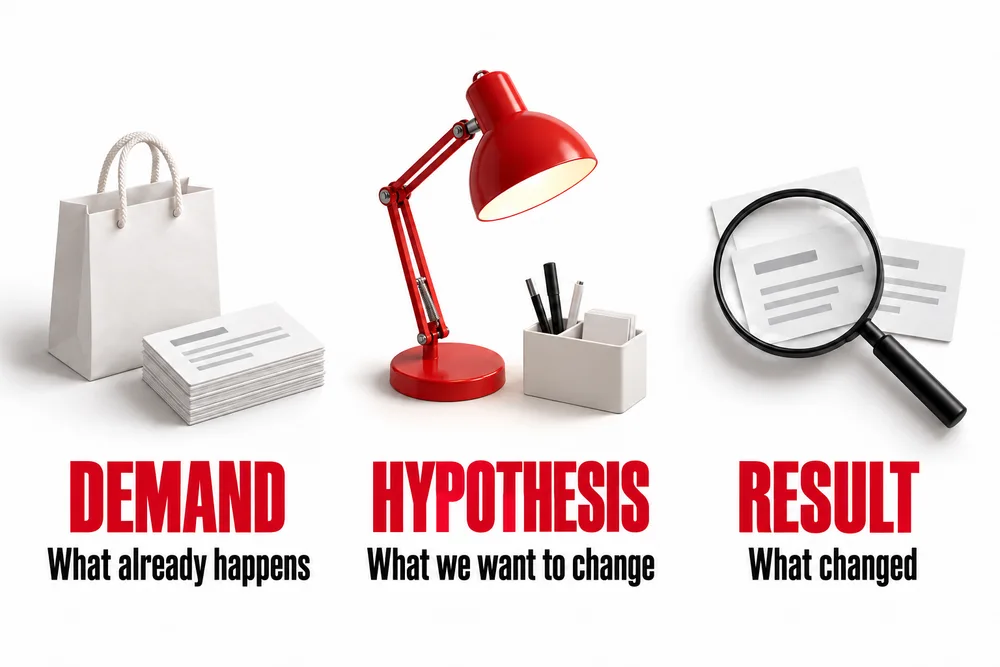
The work begins when you can say what you expect to change in each case. You might want to introduce an unfamiliar use, reach people who have not considered the category or support a choice visitors are postponing. That hypothesis should follow the product through to evaluation, without disappearing when the first figures arrive.

Define the change in behaviour you want
Before choosing products, write down what the campaign should lead the buyer to do differently. That might mean discovering a solution, considering another use or completing a choice already started. Define the buyer and their situation as well, because the same product can play different roles for people with different needs and circumstances of purchase.
In a hypothetical example, a store sells items for home workspaces. A familiar lamp already attracts searches by name, while a desk organiser is poorly understood through the available photographs. The first may need to reach new buyers; the second may need a demonstration that makes its usefulness visible to people considering the category.
You do not need to decide immediately which one should receive investment. You need hypotheses that can be evaluated. “Sell more lamps” is too broad an intention; “introduce the lamp to people preparing their first workspace” already clarifies the audience, the context and the job the communication is supposed to do.
For the organiser, the hypothesis might be that people do not understand how it separates the materials they use every day. The campaign should then show that use faithfully. If it merely repeats the catalogue photograph with a generic sentence, it may not address the difficulty that originally justified selecting the product.
This reasoning belongs to growing an online store. The catalogue supplies possibilities, but a campaign requires a commercial decision. Defining the intended behaviour helps choose the message, the destination page and the information needed to understand whether the investment brought something relevant to the business beyond its existing activity.
Check that the hypothesis does not depend on a promise the product cannot fulfil. Showing a new use requires that use to be real and understandable. If the idea only becomes attractive when you add nonexistent features or results you cannot demonstrate, the selection needs reviewing before the ads are produced.
Read existing demand without turning it into certainty
Observe how products sell before the campaign, distinguishing buyers, channels, periods and commercial conditions. Use that information to establish a reference without assuming the past will repeat exactly. Existing demand helps interpret the next result, but it can change with availability, seasonality, competition and other actions the store takes during the period you are examining.
In the example, the lamp may sell mainly when previous customers return to buy another item. In another scenario, it may attract people searching for a particular need. The totals could look similar while pointing to different promotional opportunities for the same product, because the buyers arrive with different knowledge and intentions.
Ask what the data genuinely allows you to know. A sale classified under one channel does not describe the buyer's complete history of contact with the store. Similarly, an increase over a short period does not establish a lasting trend. Keep limitations visible so a precise decision is not built on information that remains incomplete.
Record the conditions that accompanied the observed sales. Was stock replenished, the price changed, the product featured on the homepage or an email sent? Those changes may explain part of the demand and need to be considered when comparing behaviour during the campaign you are now preparing to launch.
The quality of this work depends on preparing advertising data for analysis, but also on connecting it with store operations. An advertising report and an order list answer different questions. Bringing them together requires consistent definitions, comparable dates and a way to avoid counting the same purchase as several separate results.
If the history is short, state that in the decision. You can proceed with a limited test and an explicit hypothesis, provided the commitment matches the uncertainty. What you should not do is invent a demand pattern to justify a choice that came solely from the team's preference for a particular product.
Compare product hypotheses beyond their sales ranking
Organise candidates by the opportunity they represent instead of ranking them only by past sales. For each product, identify the audience, the need and the reason promotion might change the choice. Compare those hypotheses with the available information, keeping observed signals separate from what you still hope to discover through running and evaluating the campaign.
A familiar product may have demand concentrated among customers the store already reaches well. That does not make advertising it pointless, but it does require an explanation of where additional opportunity exists. There may be another legitimate use or a group of buyers with limited exposure to the offer who need a different message.
A product with few sales may deserve attention when there are concrete signs of misunderstanding. Repeated questions about how it works or interest in a demonstration can guide a hypothesis. Those signals do not guarantee purchases, but help distinguish a communication opportunity from simply wanting to move items that have not found demand.
Avoid automatically favouring novelty. A newly arrived item has not had the same exposure time as the others and may look weak in a cumulative ranking. Comparisons should consider the conditions under which each product was available, without presenting a difference caused by the store's introduction calendar as evidence of commercial performance.
In the hypothetical example, the lamp and the organiser do not need to compete for precisely the same role. One can be introduced to people creating an entire workspace; the other can serve people who already work at home and want to reorganise their desk. Selection becomes clearer when each candidate corresponds to a specific question.
Write down what would make you change your mind as well. If the hypothesis depends on clarifying a use, what observation would show that the doubt remains unresolved? Setting a review criterion before launch reduces the tendency to defend the selected product merely because time has already been invested in campaign images and copy.
Confirm that the campaign has commercial room to work
A communication opportunity needs conditions that allow interest to become useful purchases for the business. Confirm availability, delivery, contribution after the costs considered and consequences for operations. Selection should recognise those conditions before investment, because increasing sales of a product can consume resources without improving the result the business is actually trying to achieve through the campaign.
The product may have demand while being close to unavailable in the featured variants. In that case, the campaign needs to follow actual delivery capacity. The decision involves more than picking an attractive item: it means checking that the store can accommodate the demand it wants to stimulate without contradicting the communication buyers see.
Look at the whole order where relevant. A product may be purchased with other items, change preparation costs or require more support. Those effects should enter the analysis using observed information, without turning hoped-for complementary purchases into guaranteed contribution that you cannot yet substantiate through the store's actual order behaviour.
It also matters what the campaign requires in order to work. An item that only attracts interest under a demanding commercial condition may need a different approach. Product comparisons should consider the offer genuinely needed to present each candidate, instead of assessing only their respective catalogue prices and overlooking the conditions of promotion.
The discipline of selling more online without ignoring margins and operations still applies when demand already exists. Advertising can change order volume, composition and timing. The team needs to follow those changes to understand whether the observed growth corresponds to the commercial intention originally defined for the campaign.
An operational restriction does not necessarily mean abandoning the product. It may justify a different schedule, another selection of variants or correcting a limitation before the test. Record the condition still needing attention so the next choice reflects the current situation, rather than permanently excluding an item that may become suitable again.
Distinguish attributed sales from sales the campaign added
A sale attributed to the campaign means it was associated with advertising under the measurement rules used. That alone does not demonstrate that the purchase would not happen without the exposure. Assessing additional contribution requires a suitable comparison and recognition of the evidence's limits, avoiding the treatment of an attribution report as automatic proof of cause.
A buyer who already knew the lamp may click an ad before completing the purchase. That contact provides relevant information about the journey, but does not directly reveal what the same person would do without the ad. Investment decisions should recognise the difference instead of hiding it within an apparently conclusive total.
It would also be wrong to assume that every attributed sale of a familiar product would have happened anyway. Advertising can remind someone of a need, clarify an option or reach a person who has not considered the store. Choosing the most optimistic or sceptical interpretation does not settle the question; improving the comparison is more useful.
When conditions allow a controlled test, a prepared comparison between groups helps estimate the additional effect. The design needs to fit the context and be supported by someone able to interpret uncertainty. Arbitrarily dividing buyers or comparing different weeks is not enough to conclude that the campaign's contribution has been isolated.
If the store cannot support that type of evaluation, work with partial signals and describe them accordingly. You can observe changes in purchase composition, new buyers or demand for particular uses. Those signals help learning, but should not be presented as an exact count of sales that advertising created for the business.
The useful selection question remains concrete: what evidence would justify continuing to invest in this product for this audience? The answer can support a careful decision without eliminating all uncertainty. What matters is distinguishing a choice based on limited information from a causal claim that the work performed does not actually support.
Observe whether the campaign shifted purchases across products or time
Growth in one product may come from buyers switching away from another store item or bringing a future purchase forward. Observe the catalogue and a period consistent with the buying cycle, beyond the promoted product alone. This helps explain what changed in the business without assuming that every local increase represents entirely new demand for the store.
In the hypothetical example, featuring one lamp may reduce purchases of another similar model. That change may be useful if it better matches the buyer's need or the store's commercial conditions. But the analysis should recognise the shift instead of counting one item's increase while ignoring what happened to the remaining products.
A campaign may also encourage a regular customer to buy now what they would otherwise buy later. Bringing a decision forward can be useful for the business when that is the objective and the conditions make sense. The mistake is evaluating only the immediate peak and assuming it represents growth that will continue into subsequent periods.
Choose an observation window that fits the product. A replenishment item and an occasional purchase may behave differently. There is no single period that explains every store; the analysis needs to consider the usage cycle, campaign dates and other changes that may influence when customers choose to make their purchases.
Record what happened to the combinations of products purchased as well. Communication may increase sales of a complementary item or unexpectedly change order composition. That information helps improve the next selection, provided you do not automatically attribute every change during the same period to the campaign that happened to be running.
When interpretation remains ambiguous, preserve competing hypotheses. There may be signs of both discovery and purchases brought forward. Showing that combination is more useful for deciding the next test than forcing a single explanation for the increase, particularly when the store changed several conditions while its ads were active.
Prepare an evaluation proportionate to the investment decision
Before launch, define what you will observe, when you will review it and which changes need recording. Evaluation should match the investment and the consequences of the next decision. If the aim is to choose a hypothesis for exploration, the evidence required may differ from what you would demand before making a substantially larger commitment to that product.
Start by ensuring you can identify orders and campaign conditions. Inconsistent information about dates, variants or costs can make interpretation difficult even when sales exist. Correcting that problem after launch does not always allow you to reconstruct the context that should have been recorded when the purchases took place.
Keep relevant interventions visible. If you changed the price, replaced the main photograph and featured the product by email, the result belongs to a combination of actions. You can decide that the combination is the unit being tested, but should not later claim an isolated conclusion about the ad without acknowledging what else changed.
Combine data with useful observations about the choice. Support questions, doubts about variants and stated reasons for buying may help interpret behaviour. Treat them for what they are: contextual information from people who shared it, without assuming they represent every buyer or prove a cause that the rest of the evaluation did not isolate.
Define situations requiring immediate correction, such as the promoted variant becoming unavailable or incorrect information being displayed. Distinguish these from the planned hypothesis review. This prevents the team retaining a known fault merely to wait for the test to finish, or constantly changing direction because every daily fluctuation seems to demand another product choice.
The decision to increase advertising spend while continuing to monitor profit should use that evidence. A favourable initial result may justify further learning, but does not show that any increase will preserve the same conditions. The next step needs to consider what has been observed and what still requires clarification.
Use the result to choose the product's next role
At the end of the review, decide whether to retain the hypothesis, correct the presentation, change the audience or remove the product from that campaign. Record the reason and the strength of the supporting evidence. The result should guide a specific choice without turning a limited test into a permanent judgement of the product's commercial value.
The lamp may continue to deserve investment in one buying context while attracting little interest in another. The organiser may need a clearer demonstration or information the catalogue does not yet provide. Learning helps distinguish those possibilities, preserving the connection between the product, audience, message and commercial conditions under which it was presented.
If you decide to withdraw an item, explain what would need to change before reconsidering it. Availability, evidence of use or a sufficiently distinct communication hypothesis may be missing. That note prevents the next team repeating the same test without resolving the gap that made the earlier experience less useful for decision-making.
When retaining the product, record the scope of that decision as well. Are you repeating the test under the same conditions, exploring another buyer group or increasing commitment to an observed hypothesis? Those choices require different follow-up, even when the item and its main image remain exactly the same as before.
I would neither choose products only because they lead sales nor exclude them because demand already exists. I would seek to understand what the campaign could change and which information could evaluate that change. Selection improves when it corresponds to a commercial decision the team can explain and review, instead of simply a contest for a place in the catalogue.