
A project can begin with a clear agreement and lose predictability during delivery. A text adjustment arrives, followed by another version for a meeting, an extra export and a change to something already approved. Each request seems small when considered separately; the team keeps accepting them without looking again at the complete delivery.
When the agreed date arrives, work remains unfinished and there is little capacity left to complete it. The client has received positive responses, so expects the plan to remain valid. The team feels it has done far more than expected but struggles to explain where the commitment changed. This accumulation is where intervention becomes useful.
Look at the requests together, including everything already added
The impact of a request depends on the work already added, the stages it reopens and the capacity still available. Assess the whole before responding to another adjustment. A small change may be manageable on its own and become impractical after several others have used the same remaining allowance for completing the project.
Imagine a project to build a campaign page. The client asks for the arguments in a different order, a second image option and a file to present internally. This is a hypothetical scenario: the requests may be reasonable and useful, but each involves preparation, execution, checking and some communication.
The time required extends beyond the visible alteration. Someone needs to recover the context, establish which version is current and confirm that the change has not affected another part. If the team interrupts its main work for every message, it also loses continuity on the delivery it had already committed to completing.
Review the cumulative effect at the project's regular checkpoints. Ask what has been added since the last review and which work stopped progressing while those changes were being made. The answer helps establish whether the plan still reflects the actual project, without turning the conversation into an argument about who sent more messages.
This tracking can remain lightweight. In a small team, a shared list and a short review may be enough. Match the level of detail to the complexity: the purpose is to reconstruct decisions that changed delivery, rather than build a system whose administration takes longer than the work it is meant to clarify.
Record each request alongside the delivery it changes
A useful record connects the request to the affected delivery, identifies who made it and shows whether it is being assessed or has been accepted. Add the expected consequence and the decision taken. The team can then combine related changes without confusing suggestions, necessary corrections and commitments someone has actually made to the client.
Avoid a list made up solely of phrases such as “adjust page” or “check with client”. Those descriptions leave the actual change unexplained. In the campaign example, “prepare a page version with another offer for an internal presentation” reveals a new content combination and the need for a separate review.
Keep a link to the original request or a faithful summary of what was agreed. If the decision happened in a meeting, confirm it in the project record. You do not need to copy whole conversations or retain information that does not help delivery; you need to prevent an incomplete memory from defining next week's scope.
Status matters. A request under assessment is not yet a promised task, and a proposed swap does not mean that the previous delivery has left the plan. Anyone looking at the project should understand what is confirmed, what awaits a decision and who needs to respond before the team can proceed.
Start with a tool the team can already maintain. A spreadsheet or a simple board can work, provided there is a recognised place for the final decision. If the record sits outside daily work and nobody consults it, it stops helping people assess the accumulation that prompted its creation in the first place.
Update the estimate of the work still to be done
To establish whether the project remains viable, compare the effort already used with an updated estimate of the remaining work. Include execution, review and known dependencies. The original estimate remains a useful reference for learning, but today's decision must account for current conditions and what the team will still need to complete.
A common mistake is to look only at time spent. Knowing that the team has used much of the planned availability does not, by itself, reveal whether the project is close to completion. There may be a short check left or an entire stage that depends on content the client has not yet approved.
Ask the people doing the work for a concrete assessment of what remains. What is the next verifiable delivery, which work needs to be redone and where is there uncertainty? Where information is missing, use an estimate with explicit limits and identify the confirmation that would refine it, instead of presenting precision nobody can support.
The internal project budget can track effort and costs without turning the service into an hourly sale. The client buys work with a defined scope and responsibility; the business still needs to understand the resources that work requires. This distinction matters when considering service pricing and profitability.
Reassess the availability of the people needed as well. A short adjustment may depend on someone whose schedule is already committed to another delivery. Adding up only the team's total hours hides this constraint and encourages a date that the resources actually available at that moment cannot support in practice.
Make the point at which the plan needs review explicit
Define signals that require a plan review before accepting more work. These might include reopening a stage, adding a dependency or losing the availability reserved for completion. Each signal should trigger an assessment with a named owner, allowing the team to act before a deviation becomes a delay that is difficult to resolve.
There is no universal number of additional requests that works for every service. One change may transform the entire project, while several simple adaptations may fit within the planned work. Choose signals connected to your delivery method that the team can recognise without asking the founder for permission in response to every message.
In the page example, reopening discussion of the offer after content approval could be one such signal. The new decision affects copy, presentation and validation. Even if it is the right choice for the client, it deserves a plan update because it reopens work the team had considered complete and ready to move forward.
Another signal is postponing tasks already promised to accommodate requests that arrived later. The priority has changed, even if nobody has announced it. Unless the team brings that change into the conversation, the client will continue to expect all the deliveries together within the original timeline, without knowing that a trade-off has occurred.
The review should come with enough information to decide. Show the affected work, the current forecast and the available alternatives. Simply saying that the project is becoming difficult communicates concern, but it does not let the client understand what they need to choose to make the project executable again with the available resources.
Bring concrete alternatives to the client conversation
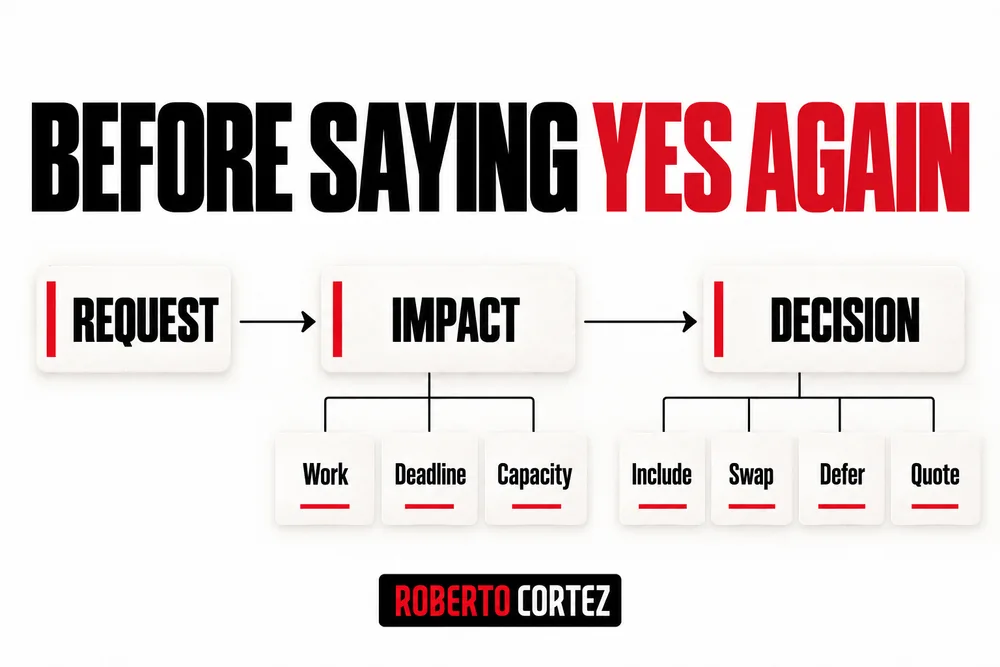
When the accumulation changes the plan, present choices the client can compare: keep the current delivery, replace a task, defer a request or add work under agreed conditions. Explain each option's effect on the outcome and date. The conversation should make it possible to choose a viable combination with sufficient information about the consequences.
Return to the reason for the request before choosing an alternative. The second page version may only be needed for an internal discussion; a shorter presentation might support the same decision with less work. Confirming its purpose can prevent an unnecessary delivery, provided that simplification does not remove something the client actually needs.
If you propose swapping tasks, identify what leaves the plan. “We can prioritise this” is incomplete if the team remains responsible for everything else. The swap needs to be understood by the person deciding on the client's side and by the people delivering on yours, so both work from the same commitment.
If additional work needs a quote, clarify its scope before starting. The client needs to understand the commitment being made, and the team needs to know whether it can reserve capacity. The desire to help does not replace that decision, especially when the request affects other deliveries that have already been accepted.
There will not always be an alternative that preserves the initial date. Say so on the basis of real dependencies and explain what can still be completed. A working relationship benefits more from a forecast the team can defend than from a quick confirmation that needs to be corrected again the following week.
Give the team decision criteria and escalation limits
The team should know which adjustments it can accept within planned work and when a decision needs to go to the project owner. Define those limits through impact and the authority required. Whoever receives a message can clarify the request without automatically committing the whole team to a new price, date or priority.
If only one person can respond to any change, the process creates waiting time and concentrates small decisions. If everybody can promise anything, the project accumulates incompatible commitments. Distribute authority according to experience and knowledge of the context, with escalation conditions that people understand and can apply consistently while the project is running.
For example, the person responsible for copy can correct a typo or apply a preference already covered by the review. Changing the campaign offer requires a different decision. The distinction depends on the effect of the change, rather than who sent the message or how easy it seems to respond with an immediate yes.
An interim response can also be clear: confirm that the request has been understood and state when the assessment will be available. This keeps communication moving without pretending the work has been accepted. The response date should be realistic and owned by someone, so assessment does not become a permanent state without an answer.
These responsibilities work better when client context is available. The diagnosis before accepting a project helps identify decisions affecting the main objective. During delivery, update that information when the business's priorities change, rather than leaving the team to rely on assumptions made at the initial meeting.
Own estimating errors and shortcomings in your delivery
Before attributing a deviation to additional requests, separate client changes, estimating errors and work required to correct your delivery. Each cause needs a different response. Tracking deserves trust only if it also reveals team mistakes and ambiguities the business left unresolved when it defined the initial commitment and the conditions for completing it.
If an essential task was omitted from the estimate, discovering it during the project does not automatically make it a new request. If the delivery fails an agreed requirement, the correction needs to be recognised as such. Classifying all unplanned work as extra may protect an internal calculation while damaging the client relationship.
Responsibility for an ambiguous interpretation may also be shared. Recover what was written, listen to each party's understanding and look for a proportionate solution. The purpose is to continue with an agreement everyone understands, without turning a communication gap into an argument about who should have guessed what information or work was missing.
Use the record to learn from the cause of the deviation. An insufficient estimate may require a better diagnostic stage; repeated quality failures may require a method review. A constant flow of new ideas calls for change management, and those responses should not be combined simply because all of them consumed time during delivery.
This transparency helps the team too. People doing the work need to be able to identify a real difficulty without fearing that every deviation will be treated as poor productivity. The analysis becomes useful when it distinguishes improvements to the process from changes to the work the business originally agreed to deliver.
Treat an exception as a decision with a defined reach
If you choose to absorb an additional request, record what was accepted, why and where that decision ends. Explain the adaptation to the client and update the team's plan. A conscious exception can make sense in a commercial relationship, provided its cost is understood and it creates no permanent commitments that nobody decided to assume.
There may be a valid reason to make an adaptation without changing the price: facilitating an important stage, resolving an ambiguity or accommodating a small need. The problem arises when the business does not know it has made that decision. The team executes, the client expects the same availability and the exception disappears from tracking.
You do not need to present every gesture as a favour. Clarify what is being included in that situation and confirm its consequence for the plan. If the change uses the availability that would have supported another review, make that choice visible so the project does not accumulate expectations that cannot all be fulfilled.
Look at the pattern across clients as well. If exceptions go only to whoever insists most, the team may end up penalising projects with more organised communication. The criterion should connect the decision to the need and service, while preserving the capacity to meet commitments already made to other people and projects.
Tracking these choices is part of customer retention in a service business. A lasting relationship needs availability and consistency. The business must be able to explain what it can adapt without relying on permanent extraordinary effort or on promises that the operation can no longer realistically support.
Use recurring requests to improve the next offer
Similar requests across several projects may reveal a need the current offer describes poorly or consistently leaves out. Review the pattern before changing the service. Decide whether to include that delivery, present it as an option or clarify its exclusion, considering its usefulness to the client and the resources it requires from the business.
If almost every buyer needs a file for an internal presentation, perhaps that use should be discussed during diagnosis. The lesson might change a commercial question or add an option to the proposal. It does not require including the delivery free of charge in every future project, regardless of its scope or purpose.
Look for requests created by the way the business sells, too. An overly broad description can make clients expect support the team never allowed for in the price. Improving the operational record then solves only part of the problem; the offer also needs to become more precise before the next sale is made.
Delivery speed can also change expectations. When rethinking a service as AI reduces execution work, decide how to use that efficiency. Producing a version faster may release capacity for another task, but it does not make analysis, validation and responsibility for the whole unlimited, or remove the need to agree on priorities.
Close the review with an observable change. It might be a briefing question, an example of a delivery or a rule about approvals. If the lesson remains a conversation about demanding clients, the next team may face the same accumulation without any improvement in the way the business sells, plans or delivers its work.
Start with the project where accumulation is already apparent
Choose an active project, gather the requests accepted since the last agreement and review the remaining delivery. Identify decisions that changed work, timing or capacity and prepare an update proposal. This first application should produce a plan understood by the parties, with owners and next steps, rather than merely a history of problems.
You do not need to reconstruct every minute since the start. Begin with requests that changed the expected result or reopened completed work. Confirm what is still needed and remove commitments only when the people authorised to decide have explicitly replaced or abandoned them, so nobody silently loses something they still expect to receive.
Bring the review to the client before the team spends its remaining availability trying to fulfil everything. Explain what you observed, recognise your own part and present options. After the decision, update the record the team actually uses for work, so the agreement does not remain isolated in a message that others miss.
Control of small requests improves when the business can see the complete project while it is still happening. That tracking supports considered service adaptations, preserves trust and improves estimating. The important decision is understanding what you are accepting, which resources it requires and which commitment the parties are making in return.