
Combining products is a decision about the offer. It can help someone find a useful selection without researching every component, but it can also add items that person does not need. Before thinking about the bundle's name or discount, understand which of these situations you are actually creating for the person making the purchase.
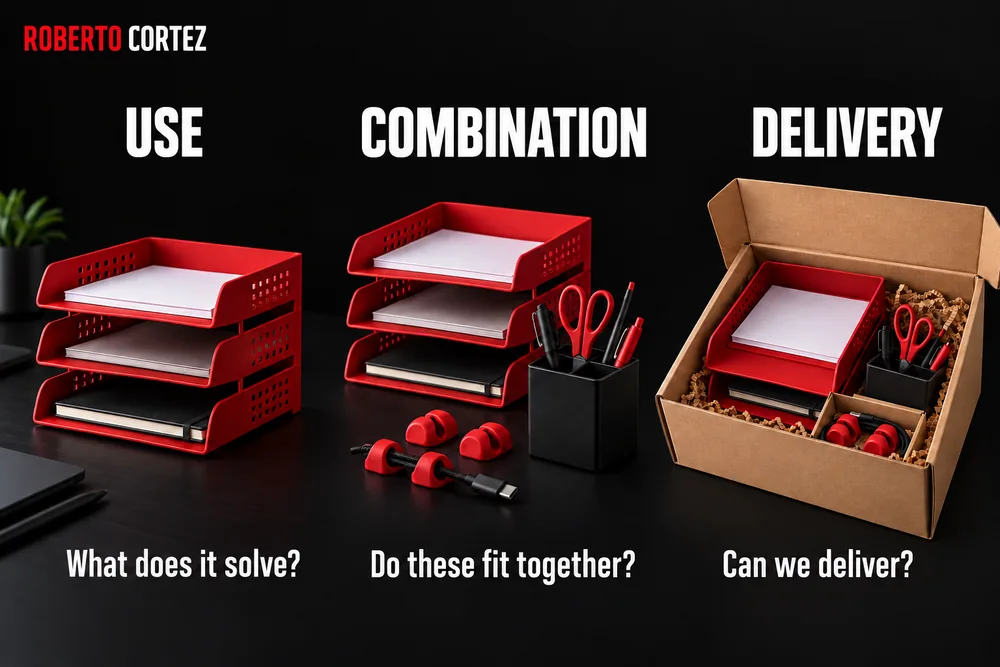
Imagine a fictional store selling desk organisation products. A bundle might include a document tray, a stationery holder and cable organisers. The connection seems plausible, but needs checking: what desk is the person organising, what problem do they want to solve, and which parts of the combination do they already have at home?

Start with the use that connects the products
Define a specific situation in which the products are used together and the difficulty that the combination helps address. The connection should be understandable to the buyer, beyond simply belonging to the same category. This definition guides component selection and lets you explain the offer through its intended use before presenting the price of the complete combination.
In the hypothetical store, “organising a small desk for work” describes a clearer situation than “a special selection of accessories”. The first requires you to consider available space and each item's function. The second could bring products together simply because they share a colour or because the store wants to sell them in the same campaign.
Look for signs of that use in buyers' questions and choices, using information the store is entitled to analyse. Requests for help with compatibility or questions about what else needs buying may reveal an opportunity. Two products appearing together in an order provide a clue, but that alone does not explain why the customer combined them.
Ask what the person can do with the bundle that would be harder to arrange when choosing the items separately. It might help them find a compatible setup, avoid forgetting a necessary part, or reduce the research required. That benefit must correspond to the actual products, without turning convenience into a promise to meet every need in that category.
You should also identify who the combination does not suit. Someone who already has a good stationery holder may prefer to buy only the cable organisers. Recognising this helps you present the offer clearly and retain alternatives, instead of treating every individual purchase as a missed opportunity to increase the value of the shopping basket.
The chosen use should fit into a short explanation the team can repeat. If every person describes a different purpose for the bundle, its composition may still be too vague. Clarify the need and reassess the components before investing in images, advertising or a commercial page that spreads this uncertainty to more potential buyers.
Choose components that work well together
Check each component's compatibility, dimensions, quantities and conditions of use before presenting the bundle as a coherent solution. Confirm what is missing for its use and what is already included. The selection should reduce relevant uncertainty while keeping visible the conditions that buyers need to check in their own circumstances before deciding whether to purchase the combination.
In the fictional example, a tray might fit on a desk but occupy the space intended for the stationery holder. Two items that match in style can compete for the same physical space. Assemble the combination under the conditions you intend to communicate and check whether the proposed use still makes sense when the products are actually side by side.
Quantities also need a reason. Several cable organisers may be useful for a setup with multiple devices, but unnecessary for another person. Explain the quantity supplied and its intended use, so the buyer can judge whether the bundle fits their situation without later discovering that they paid for components they have no reason to use.
Distinguish essential items from optional ones. If the bundle is intended to enable a particular use, any missing essential component needs to be identified. A photograph containing props may suggest that these are also part of the purchase; the visual composition and the list of included items must tell the customer the same story.
Test the variants you will sell, as well as the simplest combination. A different colour, dimension or version can change availability or fit. If customers can choose between options, check how the store prevents incompatible combinations and explains restrictions before the order is completed, without relying on customer support to correct the problem afterwards.
A small, coherent combination can be more useful than a large bundle. You do not need to fill the box with everything available in the category. Every component should have a role in the chosen use, helping the buyer understand the offer rather than increasing the amount of information they need to interpret before deciding.
Decide how much choice the bundle should allow
Choose between fixed contents and configurable options according to the buyer's needs and the store's capabilities. A fixed selection can simplify the decision, while some choices allow adjustments for compatibility or relevant preferences. The format should help people buy without creating combinations that are difficult to understand, prepare or support after the products have reached the customer.
In the hypothetical store, allowing the tray's size to be selected while keeping the other items fixed might make sense. That option addresses a specific difference in available space. Allowing every component to be chosen freely may increase variety, but can also remove the simplicity that justified presenting the bundle as a selection already considered by the store.
Ask which choices affect usefulness and which merely add detail. Colour and size can have different importance depending on the purchase. Do not establish that hierarchy solely around what is easiest to configure in the platform; understand what customers need to control and which decisions they can accept as part of a selection proposed by someone who knows the products.
Check how choices appear on the page and in the basket. Buyers should be able to identify their selected variant, quantity and any effect on price or availability. An option that only becomes clear after the bundle is added can generate questions and support work that a more understandable presentation could have prevented earlier in the process.
Retain individual purchasing options when they are part of the store's offer and meet a legitimate need. A bundle can be a useful recommendation without replacing every other way of buying. If someone needs just one component, helping them find it may be more appropriate than insisting on a combination that does not match their situation.
Online store growth depends on connecting the offer, communication and operations. The choice between fixed and configurable contents belongs within that connection. Before adding options, check whether the team can prepare them correctly and whether the information presented allows buyers to recognise exactly what they are ordering in each available configuration.
Explain the contents and price clearly
Present the bundle's components, quantities and conditions consistently on the page, in the basket and in the communication leading to the purchase. If there is a price advantage, explain the comparison in a verifiable way. Clear information should let buyers assess the offer through its contents and usefulness, without relying on savings they cannot check for themselves.
Start with a concrete list of what will be delivered. Generic names such as “complete kit” can mean different things to different people. In the fictional example, identify the tray, holder and organisers included, with their relevant variants; if the photograph shows a computer to illustrate the use, make clear that it is only a prop.
Use images that show scale and the relationship between items without hiding important conditions. An attractive composition can help present the intended use, but cannot replace information about dimensions or quantities. Check that text near the image lets people distinguish what they receive from objects used to explain how the bundle could work in practice.
A discount can be part of a useful offer. Its presence does not remove the need for the products to fit together, or mean the combination is automatically better for everyone. When comparing the price with separate purchases, use a genuine basis and equivalent conditions, avoiding a reference value invented simply to make the advantage appear larger.
If the bundle has no discount, explain the usefulness it offers: compatible selection, a simpler purchase or contents prepared for a specific need. You do not need to suggest nonexistent savings to justify that proposition. Buyers should be able to decide whether the convenience makes sense at the price shown and for the selection work it saves them.
Keep the same contents in advertisements and on the destination page. Changing a variant or removing a component requires reviewing communication that still presents the previous version. Consistency helps you sell more online without ignoring margins and operations, because a clearly explained sale must correspond to what the team actually prepares and delivers.
Calculate what remains after preparing the bundle
Assess the bundle's contribution using actual component, preparation and packaging costs, along with other relevant variable expenses. Compare scenarios using the same definitions of revenue and costs. A higher order value can coexist with less contribution remaining, so the decision needs to consider the additional work and resources required to assemble and deliver the proposed combination of products.
Start by identifying what changes when the items are sold together. There may be different packaging, more preparation time or a change in shipping. Some costs may fall while others rise; use operational information to understand the effect, without assuming that a single order is always cheaper to deliver than items bought separately under different conditions.
In the fictional store, the tray may require a larger box than the other components. Adding the holder might not change the packaging, but could require extra protection. The calculation should reflect that specific preparation, including cases in which a particular variant changes the weight, volume or work needed to ensure that the order is delivered carefully.
Distinguish contribution from profit. The amount remaining after the variable costs considered may still need to support overheads, acquisition and other expenses, depending on the definition used. Writing down what is included in the analysis lets you compare the combination with alternatives without giving the same label to values calculated using different criteria in different situations.
Do not justify an unsustainable combination solely through the hope of future purchases. The logic behind a low-margin entry product needs follow-up on what happens afterwards. If the bundle serves that purpose, identify the hypothesis and observe buyers' behaviour, keeping value already realised separate from expectations about a future relationship with those customers.
If the contribution does not support the stated objective, review the contents, conditions or price. A component may add cost without helping the intended use, or the packaging may be unnecessarily demanding. Base the decision on those specific differences, instead of retaining a bundle simply because average order value looks more attractive on the sales dashboard.
Confirm that the components can be delivered together
Check each component's availability and how the store reserves, prepares and confirms the contents sold. A bundle is available only when the promised conditions can be met for every required item. Define how shortages or unavailable variants will be handled before promoting the offer, avoiding silent substitutions or accepting orders that the operation cannot prepare as described.
If a component is also sold individually, availability needs to reflect both uses. The store might display the bundle as available while a separate sale consumes the final unit of an essential item. People managing the catalogue and preparing orders should understand the relationship between products, avoiding different interpretations of the same stock available to the business.
Ask for an explanation grounded in how the store actually works. Does the bundle exist as its own product reference, as a combination of references or through another arrangement? You do not need to choose the technical implementation alone, but should confirm how a sale affects available quantities and how the team identifies everything that needs to go into the order.
Test preparation using the list received by operations. Can the person identify the components and variants without returning to the commercial page to interpret the offer? If memory or a conversation is needed to complete the order, there is a gap between what was sold and the information used to carry out the delivery.
Define how to communicate unavailability before the purchase decision is completed and handle a later issue through the store's actual conditions. A substitution can change the intended use, even when the item has a similar price. Any decision about different contents needs to be clear to both buyer and preparer, without presenting it as exactly the same offer.
Include customer support in preparation. The team should know how to find the contents purchased, distinguish versions and understand the conditions applying to the order. That history makes questions about a specific item easier to resolve, without relying on the current page when the bundle has changed since the customer made that particular purchase.
Test a buying hypothesis alongside basket value
Define what you expect the bundle to improve and which observation will help assess that hypothesis. It might make compatible products easier to select or reduce uncertainty about what to buy. Track use of the offer, contribution and operational work, without concluding that things improved simply because some people started buying more items within the same individual order.
Choose an initial combination with a clear use and known delivery conditions. This lets you observe questions and difficulties without mixing several new offers at once. The test's scale should suit the business and the consequences of a failure, retaining enough capacity to correct what the experience reveals about how people understand and buy the proposed selection.
Observe the alternatives people choose too. If many buyers mentally remove the same component and look for the items separately, that behaviour may point to a problem with the contents. It does not necessarily mean rejection of bundling; it may reveal a different need or an option that should be explained differently before the person makes a decision.
Track questions received before and after purchase. Repeated questions about quantity, size or contents show information that needs to become clearer. Connect those questions to the version of the offer the person saw, so you do not change the catalogue based on an old image or an advertisement that was still presenting a different combination.
Compare results in context. A period of higher demand, a more intensive campaign or a change in availability can alter sales without demonstrating that the bundle caused the effect. Record those conditions and preserve the limitations of the comparison, avoiding attribution to the combination of everything that changed during the period when it was prominently displayed.
Before increasing advertising spend, check whether the offer is working for buyers and operations. Promotion can provide more information about demand, but also amplify uncertainty about contents or a preparation failure. Use what you have already observed to choose the next test around a specific question that the business needs to answer.
Keep, adjust or withdraw based on observed usefulness
Review the bundle when information shows that its contents, price or delivery no longer meet the chosen need. Distinguish communication difficulties from a genuine problem between components. The decision should preserve what helps buyers and correct what adds effort, cost or confusion, without maintaining the offer solely because work has already been invested in bringing it into existence.
If people understand the intended use and buy a suitable combination, check whether the store can continue delivering it under the same conditions. Changes in suppliers, packaging or availability may affect that answer. An offer that worked needs attention when the elements supporting it change, even if the commercial name remains exactly as it was before.
When explanation is the problem, improve the information before changing all the contents. An image showing scale or a clearer component list may be missing. When the intended use repeatedly requires the same item to be replaced, the offer probably needs revision, instead of asking support to keep explaining a combination that does not fit well enough.
Keep the previous version and the reason for changing it. This helps make sense of older orders and compare observations without treating different bundles as the same product. People preparing, selling and supporting the offer should know what changed, when it changed and where to find the contents applicable to each purchase already completed through the store.
Withdrawing a combination can also be useful when the items make more sense separately. The learning can still improve recommendations and product presentation. You do not need to invent another campaign to justify keeping something that increased complexity without demonstrating sufficient usefulness for the buyer or the business that has to prepare and deliver it.
I want choosing a bundle to be easy to understand and correspond to a real use. Suitable components, clear information, known costs and consistent delivery support that proposition. A discount can be part of it, but the decision to keep the offer should explain what the person receives and why those particular items make sense together.