
Not every product needs to be profitable on its own
I believe, and it's something I build my own businesses on, that not every line in my spreadsheet needs to generate profit. I can have products with less sales friction, cheaper products, products with better conversion rates, without that meaning higher direct profitability. And that's fine, as long as the whole works.
When I work with larger budgets, I usually put the larger share of ad spend into entry products or products where I face less sales friction. Not because they are more profitable on their own, but because that's where I grow the customer funnel. The customer comes in through the easiest door, and then I build recurring revenue through a ladder of different products and services.
The entry product as a door into the funnel
If the point of the entry product is to open the door, the criterion for judging it can't be its standalone margin alone. I need to look at what comes after: does the customer who enters through this product come back?
Do they buy something more profitable later? If so, the entry product is doing its job, even with a thin margin.
The class doesn't give me a fixed formula to measure this, and I won't invent one. But if you want to apply this reasoning to your business, I would start by tracking, in a basic spreadsheet, who bought the entry product in a given month and seeing, over the following months, how many came back to buy something else. It's a practical way to test the hypothesis, not a guarantee of results.
Does Increasing Your Ad Budget Still Increase Profit?
Should You Start With an Entry-Level Product or a High-Ticket Service?
Growing an online business: what I learned about margin, team, and AI
The mistake of cutting without looking at attribution
A mistake I see often is looking only at each product's standalone profitability and cutting based on that number alone, without considering whether that product helps sell others. When working with a larger budget, I try to look at the result as a whole, not product by product.
This doesn't mean ignoring the numbers, it means understanding whether some products or campaigns don't sell much on their own but assist sales of other, more profitable products. If an entry product doesn't sell well when advertised directly, but its presence on the shelf drives more sales elsewhere, it justifies itself even with a thin margin. Looking at attribution models, instead of automatically cutting what looks unprofitable in isolation, avoids this mistake.
Not becoming a hostage to the spreadsheet
I use this exact phrase in my classes: don't become a hostage to the spreadsheet. When working with larger budgets there's room to diversify the funnel instead of concentrating everything on a single product, platform or message. Concentrating everything on one variable increases risk; diversifying reduces that risk, even if it means accepting uneven margins between products.
In the daily work of managing ads, the struggle is always to find where the waste is to cut it and where the opportunity is to scale it. But that search has to include the question of assistance between products, not just each line's direct profitability.
Testing with large and small budgets
With larger budgets I have more capacity to generate data and more critical mass to compare hypotheses with some consistency. That doesn't mean any amount spent proves anything statistically, it just means there's more information available to support the decision.
With small budgets, I choose more carefully where to bet, because I can't test everything at once without losing the ability to draw clear conclusions.
This logic also applies to the entry product: before deciding to cut it for looking unprofitable, I make sure I have enough data on what it generates downstream. A hasty cut, based only on direct margin, can eliminate the entry door that sustains the main sales.
The sweet spot: when to stop investing
There is a point, in any campaign or product, beyond which returns become decreasing. I usually call it the sweet spot. I give the example of my own book: at first I spent between 40 and 100 euros a day on ads.
After I had already sold to a good part of my audience, I reached a point where I made exactly the same sales with 10 euros a day as I did with 20 or 30. Doubling or tripling that budget stopped generating more return.
That point isn't fixed, it changes over time and with campaign fatigue. The way to find it is to raise and lower the budget and measure profitability over time, not to assume it's already optimized. This same sensitivity-testing logic can be applied, with the necessary adaptations, to the decision of whether to keep an entry product in the lineup.
What to decide when the hypothesis fails
If you look at the data and realize the entry product generates neither satisfactory direct sales nor visible assistance to other sales, that's reason to rethink it. You don't need an elaborate set of cutoff criteria. Just ask yourself honestly, looking at your own numbers: does this product still bring in customers who buy afterward?
If the answer is consistently no, it's worth changing the positioning, the price, or replacing the offer.
Calculate by customer group
To apply this reasoning, you can track people who entered through the same product during a defined period. Record acquisition cost, the value of their first purchase and subsequent purchases you can associate with that group. Use an equivalent observation window when comparing different groups.
Imagine one group bought a year ago and another bought a month ago. The first has had much more time to purchase again. Comparing their accumulated revenue directly could make the recent campaign look worse even though you have not yet allowed an equivalent follow-up period.
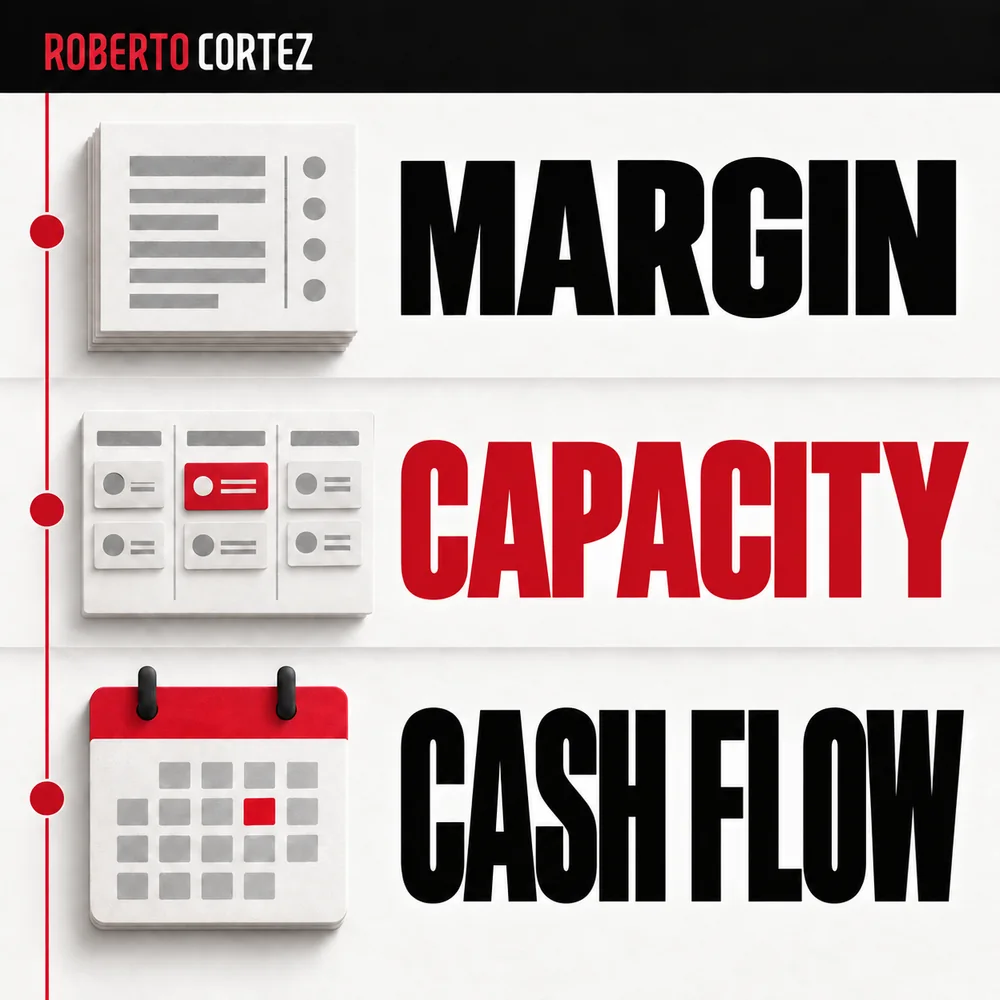
Include the cost of serving those customers too. An entry product requiring substantial support time can consume the margin that appeared available for acquisition. Before increasing the budget, check whether subsequent sales are happening and whether the team can support new customers at the promised standard. Looking at those elements together helps you decide how much you are prepared to invest in the first relationship.
Source note
This reflection comes from the class I gave on Como Gerir Grandes Orçamentos em Anúncios, Sextas Ímpares #91, starting around the 11-minute mark, where I talk about entry products and about not becoming a hostage to the spreadsheet, and further on, around the 23-minute mark, where I use the example of my own book to explain the sweet spot. You can watch the full class here: https://www.youtube.com/watch?v=SrJOaLpJG28