

Why generic suggestions fail without context
Without a history of what you've published and clearly explained criteria, you can easily get generic suggestions. The model lacks information about your business, your customers' questions, and the kind of writing you would choose to publish. You end up making those choices afterwards, correcting each response.
128 of Sextas Ímpares, discussing automation and decision-making, I said: "Se eu não tiver um bom bons dados, bom contexto, a inteligência artificial torna-se burra. É tão simples quanto isso." When you ask for content ideas without showing what you've already done, what worked, and what you reject, the model falls into what I called guesswork, a statistical opinion with no roots in the business.
This applies whether you're asking ChatGPT for five quick post ideas or building a more elaborate content analysis flow. In both cases, what's missing before you ask for the answer is concrete data and explained criteria, showing approved examples, rejected examples, and the reason behind each choice.
To prepare your next step, explore Artificial intelligence in digital marketing.
Treating AI like a new team member you're training
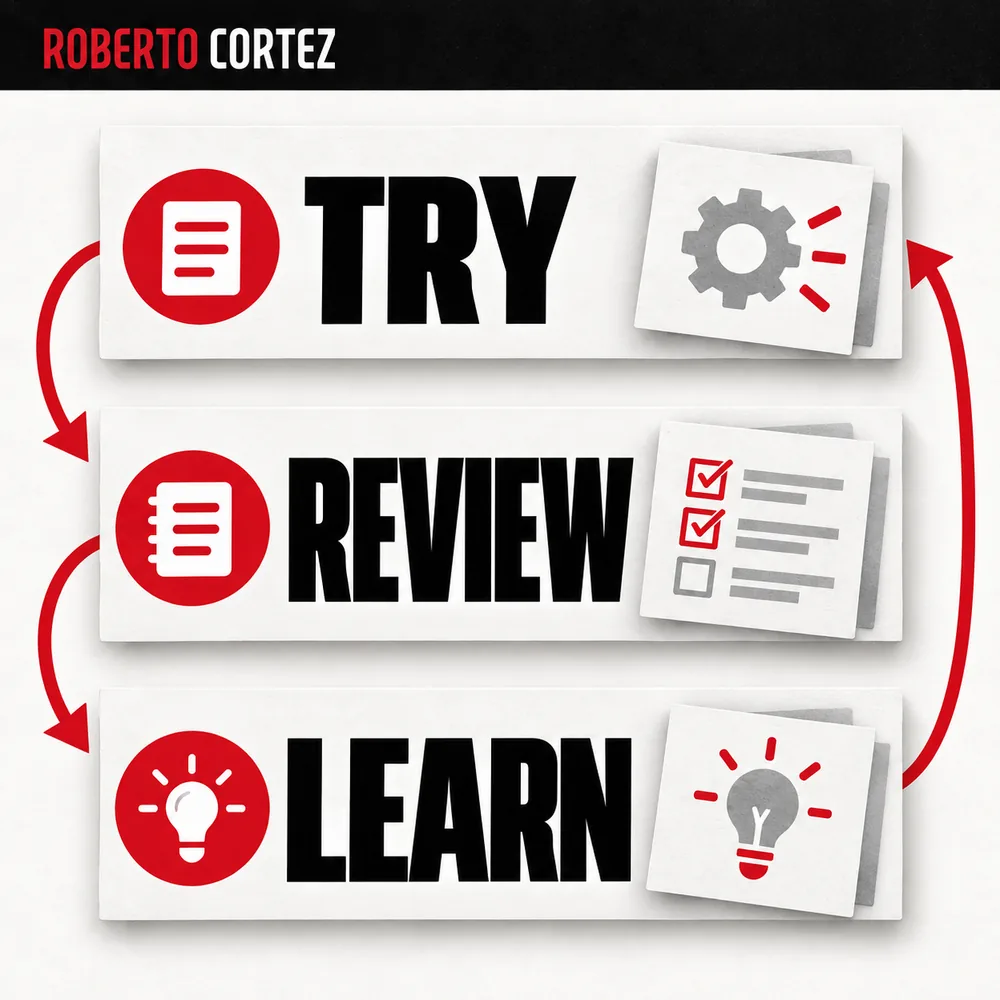
Giving feedback to AI works better when you treat it like training someone who just joined the team: explain the reasoning behind each decision, not just the verdict, and repeat that explanation until the pattern of choices becomes clear to whoever, or whatever, is learning from you on the other side.
I compared this directly to onboarding someone new: "Isto é quase como treinar um humano, como treinar uma pessoa. Eu funciono assim, nas minhas redes publico isto, não publico aquilo e por aí vamos. Portanto, isto é treino, minha gente." If you only say yes or no to an idea without explaining why, the person or the machine keeps repeating the same mistake.
If you reject a topic because it's too generic, say so. If you approve an idea because it starts from a concrete business fact, say that too. That explained reasoning, repeated over time, is what shapes the pattern of suggestions you get afterward.
My Stories example: a metric that teaches what to repeat
The concrete example I used was analyzing my own Instagram stories, where I defined in advance the exact metric that matters to me, instead of deciding by gut feeling what to repeat, and then asked AI to look for patterns tied only to that metric.
I put it this way: "Para mim uma métrica crítica nos stories é aquelas pessoas que fogem. Aquela pessoa que tá naquele story e decide saltar para o perfil seguinte em vez de ver o meu próximo story." With that explicit criterion, an automation feeds Instagram data into a spreadsheet, and the analysis that follows looks for patterns tied to that specific behavior, not a vague impression of what went well.
I mentioned N8N for building that agent and a platform for the automatic collection of stories data into Google Sheets. What made the difference there was defining in advance which metric mattered to me, before asking for any analysis; without that definition, AI analyzes data but doesn't know what to look for, and hands back correlations that aren't practically useful.
Weak data produces weak suggestions, even with good technology
If data collection is flawed or history was never recorded, the analysis that follows will be weak, even with the most advanced model available. AI works on what you gave it, and has no way of guessing criteria that were never explained.
You can have access to the newest tool on the market and still get suggestions that don't sound like you, because you never gave it good raw material to work with. It's worth checking what feeds the model first, before switching tools looking for better results.
It's worth starting by gathering a small history of what you've published, with a note on what worked and what didn't, before asking for new suggestions. This requires no advanced technique, just discipline in recording decisions and reasons over time, even in a simple spreadsheet.
Explore this decision further: How to turn real customer objections into better content.
The limits of automatic feedback and the role of human review
Even with good context, one step I made clear as non-negotiable: human review before publishing or sending anything AI-generated. Technology can prepare, summarize and suggest, but the final decision still belongs to a person with judgment about the brand, and that person decides whether the suggestion makes sense before it moves forward.
In the example I gave about leads and automated replies, the same principle applies to content: "A revisão e disparo feito pelo humano... O humano só tem que chegar lá, ver a lead, ver o que pediu, olhar para a interpretação da IA e o texto da mensagem que a IA criou e perceber se aquela resposta que a IA deu faz sentido ou não... Editar, se for o caso, e depois disparar."
The same reasoning carries over to editorial content: AI can prepare a draft, a summary of patterns, or a topic calendar, but you decide whether to publish, based on the sense you have for timing and for the brand, something AI still can't judge on its own.
How to start, in practice
If you want to try this approach, start with something simple limited to a single channel, so the process doesn't get complicated before you've tested it. Pick one channel, it could be your stories as example, and first define which metric actually matters to you.
Then gather a small history of what you've published with a note on the outcome. Only then is it worth asking AI to analyze patterns or suggest new topics, because now it has something concrete to compare instead of guessing.
Without that base, any suggestion is just a generic internet average dressed up as a personalized recommendation. You can genuinely save time with this process, but the value depends on how you use that saved time afterward; some tasks free up isolated minutes, others free up larger blocks of work, and both can matter, just differently.
This way of working connects to the broader reasoning about AI and automation use in business: technology helps consistently when fed real context and explained criteria, not when used as an oracle for loose ideas.
Explore this decision further: How to use AI in business beyond chatbot prompts.