
One sentence that changes the direction of your messaging
In an interview with someone deciding whether to join the Prolança programme, I heard this: they believed freelancing was only for people who couldn't get work anywhere else, a last resort. That sentence changed how I thought about messaging, because the real barrier wasn't price, it was the stigma attached to the career itself.
If I try to guess the audience's objections from behind a desk, I almost always end up talking about product features. When I actually listen to people directly, I realise resistance often comes from a belief about the world, not about the specific service. That distinction is the starting point for everything else here.
For anyone working with paid traffic and content, this kind of listening connects to the value-proposition work covered in the AI and digital marketing hub.
Where real objections actually show up
The most useful objections don't come from formal surveys, they show up in ordinary daily conversations with customers and prospects. That's where, without any script, people speak without a filter about what's really holding them back before deciding to buy.
The central example here comes from an interview with someone deciding whether to join a mentoring programme. It was in that interview, not a form, that the belief about freelancing as a last resort surfaced. Asking direct questions and listening carefully, without already having the answer ready in your head, is what lets you capture that kind of revealing statement.
The same logic applies to other contact points: sales calls, support messages, comments on social media posts. Whenever several people repeat the same doubt or fear across different contexts, that is a signal worth recording, not dismissing as noise.
How to explain an AI service's benefit without selling a list of tools
The Brief You Need Before Asking AI to Write a Sales Page
How to build a lead funnel that the sales team can actually work
The customer's exact words carry more weight than internal jargon
The raw vocabulary a customer uses to describe a problem usually communicates better than any technical term used internally. For someone working as a freelancer, the phrasing I hear often is this: the person feels alone, with no one to validate ideas with, no one to ask for help when stuck.
That phrasing, I feel alone, I have no one to share ideas with, carries more weight than saying professional isolation. The practical suggestion here, and I want to be clear this is my own recommendation rather than a technique from a specific class, is to write down these phrases exactly as I hear them, in a simple document, whenever they come up in real conversations. Before sharing that material with any team or tool, it's worth removing names and identifying details that aren't mine to share, out of respect and care for sensitive data.
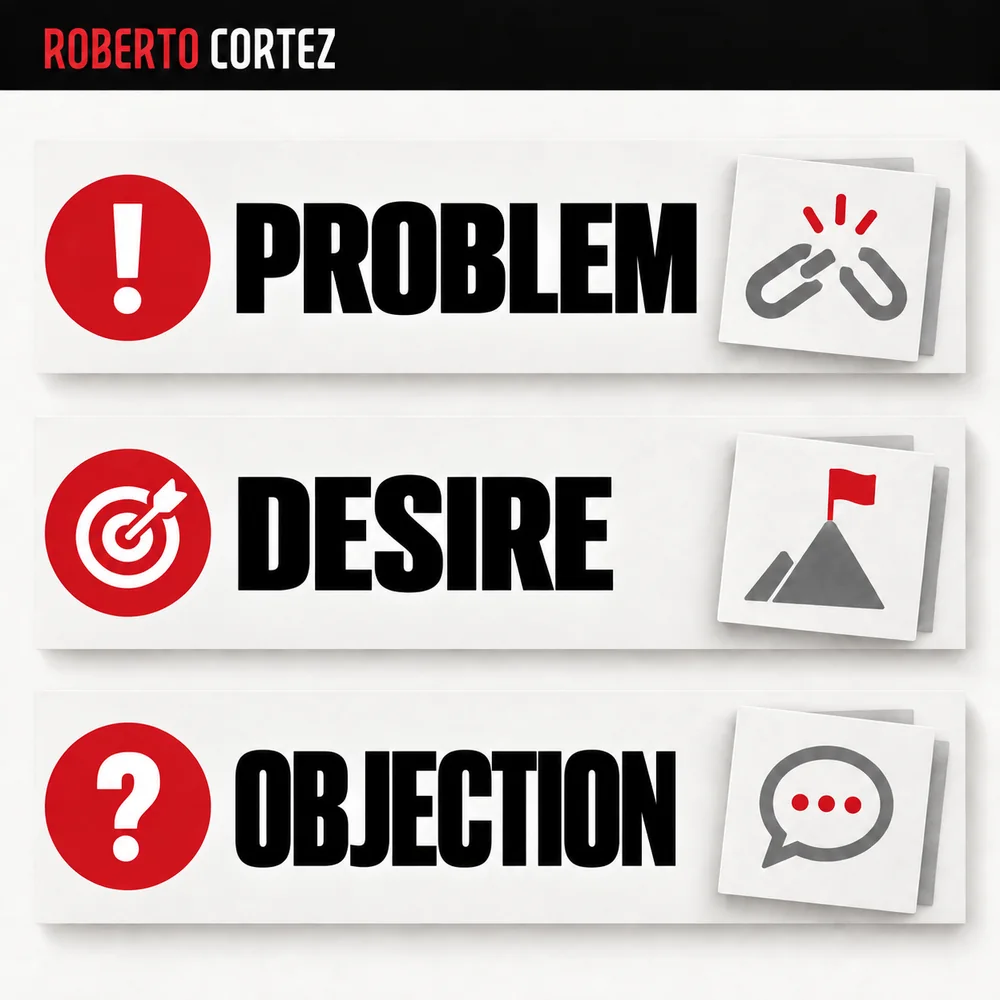
Separating the pattern from the isolated case
Hearing a striking sentence in a single conversation doesn't mean it represents the whole market. The value of this kind of listening lies in repetition: when the same story comes up again and again across different conversations with different people, that signals a real pattern, not one isolated opinion.
Many people believe their problem is unique, but talking to several customers reveals the same difficulty repeating constantly, almost word for word. It's that repeated pattern, not one customer's isolated sentence, that should shape a sales page or ads. If a poorly-matched customer complains about price because they were never the right audience, that isn't a reason to change the core value proposition.
Using identified beliefs to dismantle objections
Once you've identified a repeated belief, the next step is to address it directly in your messaging, without pretending the product solves everything instantly. Understanding what people think about their own situation is what lets you write a response that actually reaches them, instead of leaving them indifferent to the text.
In the case of freelancing as a last resort, the answer isn't to argue about price or programme features, it's to show, with concrete examples, that freelancing can be a deliberate choice rather than a professional defeat. Show real people who chose that path on purpose. A concrete proof point, a real case, a documented outcome, works better than any enthusiastic adjective about the product.
One possible way to organise this work with AI
As the number of conversations and notes grows over the months, organising every collected phrase by hand becomes hard to sustain. Here's a practical suggestion of my own, not something I described in a specific class: you could gather anonymised customer phrases and ask an AI tool to group them by theme.
For example: fear of wasting time, doubt about one's own ability, or distrust built from past bad experiences with other providers. This organising step doesn't replace your judgment about what's relevant. You decide which patterns are real and deserve a response in your messaging; the tool just helps tidy the volume of information collected. It's worth starting with a small batch of conversations before trying to automate the whole process. This kind of task can save time compared with organising everything by hand, but that alone doesn't guarantee any sales outcome, it just tidies the raw material.
Validating before you change your core message
Before rewriting a sales page based on a single sentence heard once, I confirm whether it represents a visible pattern across several independent conversations over time. If the customer can't say where their hesitation comes from, I start there, with simple direct questions.
Only then do I decide what changes in the text. This discipline stops one occasional complaint from a single customer from becoming a permanent messaging rule for the whole company, and keeps the value proposition consistent over time, without constant reversals caused by isolated noise.
Class source
This article draws on Sextas Ímpares #69, "Como Escrever Copy que Converte com Método e Clareza", available at https://www.youtube.com/watch?v=4LG6aLFN2wA. Around minute 19-20 I work through writing down what the potential customer feels before speaking to them. Around minute 22 I share the example of the belief that freelancing is a last resort, heard in a real interview. Around minute 35-36 I also cover how customers' problems repeat in patterns, even when each person thinks their situation is unique.