
Sales wants more contacts, operations wants time to organise delivery and marketing wants to prepare a campaign. Meanwhile, a tool needs configuring, a proposal needs reviewing and a service idea looks interesting. Everyone can present a valid reason for receiving attention first, even though the business cannot start every improvement at once.
When the owner responds to those requests in arrival order, the calendar starts making decisions for the business. The latest issue takes space, work already started remains unfinished and the priority changes without an explicit conversation. There may be plenty of activity while the condition limiting the result remains unresolved.
I have been one of those constraints in my own business. At one stage, I kept the sales process concentrated around me and left opportunities unworked while defending the importance of delivery. I still value service quality; what changed was recognising that looking after one area did not resolve the dependency I was creating elsewhere.

Decide which result needs to improve now
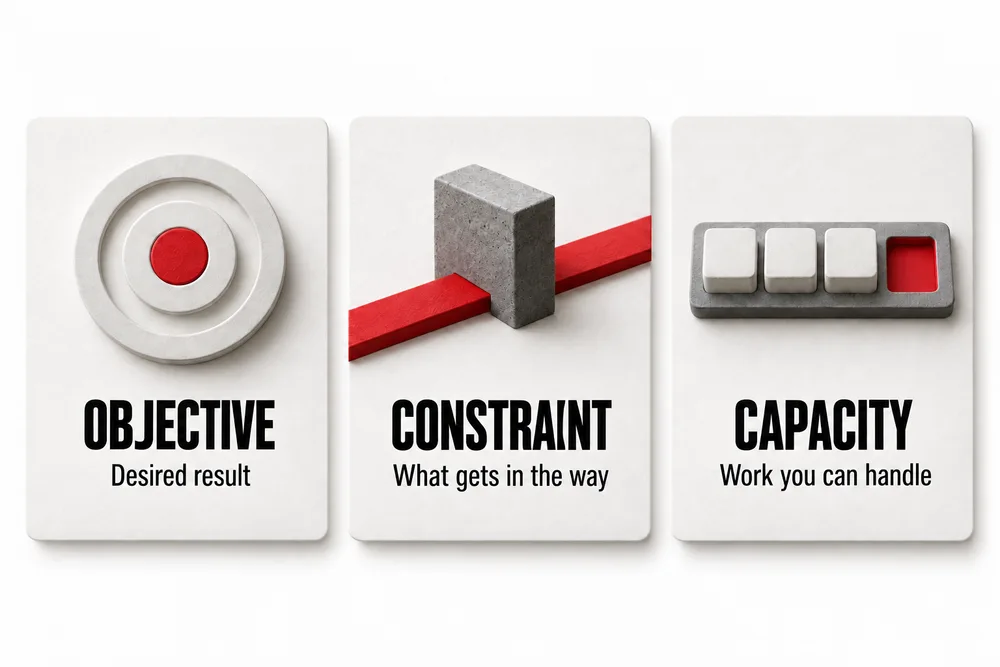
A priority only makes sense in relation to a result and a decision horizon. Clarify whether the business needs better sales responses, reliable delivery, improved contribution or additional capacity. Avoid combining every intention in one generic sentence, because different projects can look equally important while nobody defines what the business needs to achieve first in the current period.
There have been stages when I mainly pursued growth and others when I paid more attention to improving the result. A change of objective changes how opportunities are evaluated. An initiative that increases volume may not answer the current need if operations already struggles to deliver or costs are absorbing what comes into the business.
You do not need to turn the choice into an extensive plan before starting. You need a formulation that allows proposals to be compared. “Improve the business” does not distinguish an information handover problem from a content idea; “reduce contracted work waiting for the conditions needed to start” already gives the analysis a useful direction.
In a hypothetical example, a service business receives suitable enquiries and wins projects, but accumulates delays between the sale and the start of delivery. The immediate objective may be to make that start more predictable. A campaign promising more enquiries could still be useful, but needs to be evaluated against that situation.
Confirm the horizon within which the decision should produce information. An improvement needed for the next delivery cycle cannot be compared without context with an investment whose effect will only be observed later. Both may deserve a place in the business; the question is which one needs the capacity available now.
This is a starting point for strategic planning in a small business. The objective should make everyday choices clearer. If any initiative can be presented as an answer to the same sentence, the result probably still needs a more precise definition before it can usefully guide the team's priority.
Find the constraint in the work actually happening
Follow a concrete business journey and identify where work waits, loses quality or requires repetition. Use observed cases to distinguish symptoms from causes still needing confirmation. The priority should address the constraint relevant to the chosen objective, instead of relying only on the area reporting the most difficulties or presenting the most attractive proposed solution.
In the fictional business, operations may request another tool because projects do not start on time. Following the cases could reveal missing scope decisions and materials that were not requested before the sale. A tool may help track state, but cannot replace the decisions that remain unresolved between the people involved.
My sales experience also showed me that distinction. Outstanding work could not be resolved simply through a greater desire to respond. People, processes and tools needed reviewing so that relationships with potential clients stopped depending on my mood and my availability for each conversation that happened to arrive during the day.
Collect enough information to test the explanation without trying to observe the entire business in detail at once. Select representative cases, follow handovers between owners and ask what was missing before work could proceed. A concrete sequence of events makes the cause more useful to discuss than a list of impressions about the team.
When making a diagnosis before proposing a marketing plan, understanding the business beyond the channel matters too. More demand does not necessarily resolve a sales handover that leaves requests unanswered. Analysis should connect each area's work to the complete journey that produces the intended result for the business.
Keep the constraint hypothesis open to review. Finding a real problem does not demonstrate that it carries the greatest weight at that moment. Compare its effect with other cases and check whether resolving it would allow progress, or whether work would still wait for another condition that has not yet been considered.
Compare the consequences of acting and waiting
For each candidate initiative, describe what could improve if it proceeds and what might happen if it waits. Consider reach, frequency and the possibility of correcting the decision. This comparison helps separate an important opportunity from apparent urgency, without reducing every choice to a score that conceals differences between existing commitments and expectations about future benefits.
In the fictional business, improving the handover between sales and operations may affect every project entering that journey. Revising an occasionally used presentation may have a different reach. The comparison does not declare the presentation useless; it clarifies the consequence of occupying the same people now with one task or the other.
Look for observable costs of waiting. Work may be stalled, clients may be requesting clarification or people may be recreating information that already exists elsewhere. Record what can be verified and keep possible consequences separate. A predicted loss remains a prediction until there is sufficient evidence to present it as something more definite.
Also consider the cost of acting. A change may interrupt a functioning routine, require learning or occupy the person currently keeping delivery on track. The decision is incomplete if benefits are assigned to the new initiative while its implementation is assumed to take no time or attention away from existing work.
Avoid making personal discomfort the only criterion. A task that bores you may be minor for the business; a difficult decision may have an important effect despite being less pleasant to face. The comparison should make the priority explainable to other people without requiring them to share your own preferences.
When two options remain close, identify the information missing for a choice. You may need to confirm the extent of a delay or someone's availability. Resolving that uncertainty could be the most useful next step, rather than starting both projects to postpone a decision the team still needs you to make.
Distinguish an improvement priority from essential commitments
Choosing an improvement priority does not mean suspending the commitments that keep operations running. Identify the essential work that must continue and the capacity it requires. Then decide which change receives additional attention, so the choice is not interpreted as permission to abandon clients, deliveries or responsibilities the business has already accepted and still needs to fulfil.
In the fictional business, organising project starts does not remove the need to support projects already in delivery. The team needs to know how capacity is divided between continuity and improvement. If the new priority only fits when essential work is left undone, the plan needs reviewing before it is announced as a settled decision.
Also distinguish an occurrence requiring an immediate response from an initiative that can follow a planned sequence. Correcting a specific failure and preparing a structural improvement are related but different jobs. The first intervention may contain the observed effect, while the second addresses the condition that allows the difficulty to keep recurring.
Define who maintains continuity and who leads the change. Some people may take part in both, provided their participation has real space in the calendar. Giving everyone the same new priority without removing or reorganising tasks can increase the load and create the impression that the project failed through insufficient effort.
The discipline of growing with margins, a team and processes requires attention to concrete capacity. An improvement objective does not create additional hours or remove existing commitments. The decision needs to show which work will be reorganised to make change possible, including the effects of that reorganisation on the other areas involved.
Explain what “priority” means in this situation. It may mean protecting one person's time, resolving a dependency first or postponing a competing initiative. The clearer its effect on work allocation, the less each owner needs to interpret an overly broad direction alone and decide which existing responsibilities are supposed to move.
Check dependencies before announcing the choice
An initiative can be relevant while remaining blocked by a decision, access or skill that does not yet exist. Identify those dependencies before reserving capacity. The priority needs an executable path, with owners and conditions for progress, so the team does not start work that will immediately stop while waiting for another person or essential information.
In the fictional business, reorganising the handover from sales to operations may depend on clarifying who confirms the scope sold. If nobody can make that decision, designing a more complete form is insufficient. The first action may be resolving ownership, giving the remaining work a shared criterion and a way to produce the intended effect.
Ask whether the initiative depends on another change that has not been assessed. A new routine may require information the business does not collect or an integration that is not ready. Those conditions do not invalidate the idea, but change the effort, sequence and point at which it can become usable in daily work.
Avoid confusing a named owner with execution capacity. That person needs time, access and authority proportionate to the work. If every routine choice requires permission, the dependency may remain with the founder even though the plan names someone else as responsible for the initiative and expects that person to keep it moving.
Knowledge can also be a missing condition. In that case, define the question needing an answer and how to clarify it before making the full commitment. A small investigation or demonstration can support the decision, provided it has an expected conclusion and does not become preparation that continues indefinitely without resolving the uncertainty.
Then organise the sequence around what enables progress. The first task does not have to be the most visible or produce an easy result to show. It should resolve a condition required for subsequent work, with an explicit connection to the objective that justified giving the initiative priority in the first place.
Limit work in progress and make postponement explicit
A priority needs protected capacity and visible choices about what will not start now. Limit simultaneous improvement work to what the team can follow through and complete. Record postponed initiatives, the reason and their review condition, so postponing means neither forgetting them nor allowing everyone to continue them informally in parallel with the work already selected.
In the fictional business, improving project starts may compete with a new campaign and an internal document reorganisation. If the same people are needed on all three fronts, starting everything may prolong all of them. The decision should consider that overlap instead of adding projects as though each had independent capacity available.
Choosing a priority does not require the entire business to perform the same task. Areas with sufficient capacity and independent work can continue progressing. What needs limiting is the set of commitments competing for the same resources or depending on the same decisions, while keeping the work coherent with the intended result.
Make postponement concrete. State that the campaign will be reviewed once a usable project handover exists, or when the relevant condition has been clarified. Such wording gives the team a criterion; “we will see later” leaves the initiative free to reappear in every conversation and compete for attention without any new information.
The cost of making the same decision every day appears here too. If the priority is not recorded, every request reopens the previous choice. The team spends time rebuilding context and the owner may contradict the original decision simply because a later conversation took place at a different moment.
Keep a simple way to receive new information. A postponed initiative may become more relevant through a genuine change in context, but that change should be presented explicitly. Reviewing the priority then becomes an informed decision, instead of a series of exceptions that dissolves protected capacity without anyone acknowledging that the plan has changed.
Define how you will know whether the priority is working
The priority should have an observable result, a review point and conditions that justify adjusting the approach. Follow its effect on the process as well as task completion. A finished document or configured tool demonstrates execution, but does not confirm that the selected constraint has stopped obstructing the result the business needed to improve during that period.
In the fictional business, you can observe whether new projects reach operations with the decisions needed to start. It also matters whether they keep returning to sales because information is missing. Those observations connect the change to the original problem and help identify real improvement, even while the process still requires adjustment.
Choose signals the team can follow without creating disproportionate measurement work. Recording reasons for waiting and checking a set of cases may be enough. What matters is that definitions are understood and the same state does not mean something different to each person participating in the evaluation of the changed process.
Include unexpected consequences in the review. The handover may become more complete while requiring work that delays proposal preparation. That does not automatically invalidate the change, but must enter the decision. Improving one point in the journey should not hide a new problem created because the workload shifted to another area.
Define what would justify stopping or reducing the initiative as well. A hypothesis may prove wrong, a dependency may make the plan unworkable or business conditions may change. Review criteria help recognise those situations without defending the project simply because it has already been presented to the team as the main priority.
Compare what you learned with the original reasoning. If the constraint disappears and the result still does not improve, look for what remains misunderstood. The next priority should emerge from that learning, rather than automatically repeating the same solution with more effort because the team has not yet achieved what it expected.
Communicate the decision and protect its execution
Finish the choice by explaining the intended result, the observed constraint, the initiative proceeding and what is postponed. Identify owners, reserved capacity and the review point. Communication should allow the team to make coherent everyday decisions without returning to the owner whenever a request appears that competes with the work already chosen for the current period.
A brief explanation can be sufficient when it contains the right elements. In the fictional business, the decision might name project starts as the improvement priority because observed cases show waiting for sales definitions. The team then understands why this handover receives attention before a new campaign intended to bring further demand.
Check that the calendar matches what was communicated. If you continue assigning competing tasks to the same people, the formal priority loses its effect. Protecting execution includes reviewing new requests against the choice already made and explicitly acknowledging a decision to change the plan, rather than expecting the team to absorb everything without consequences.
At the review, ask what changed in the process and which decisions became easier. Also observe whether postponed work still deserves the same position or whether learning has changed its importance. The sequence of priorities should follow business reality while preserving the reasons that supported each choice and the conditions under which it was made.
I want to be able to explain why I am giving attention to a particular part of the business now. When the choice rests on a clear objective, an observed constraint and real capacity, acting and correcting become easier. The priority guides the team's work, leaving room to learn without changing direction with every new request.