
In odd Friday session number 111, my guest was Ana Rocha de Paiva, who spent eleven years at Google and now co-founds the agency Bardo Creative Ground. We talked about what to do when a new client shows up with concrete requests, like "I want ads" or "I want you to manage my social media", before even thinking about execution.
Ask questions before promising results
I begin by stepping back to ask questions about the client's internal staff, past agency experiences, and available budget. Evaluating these factors beforehand allows me to understand their context properly before drafting any proposal. Without this groundwork, I risk designing a strategy for an organization that lacks the capacity to execute it.
Ana described a meeting with a new prospective client (a hotel) where the entire session was just questions. She had already looked at the site beforehand and had notes, but wanted to hear first how the client saw their own business. A shared point: a client burned by past agencies arrives already skeptical, and that requires extra care aligning expectations so a normal testing dip isn't mistaken for a trust crisis.
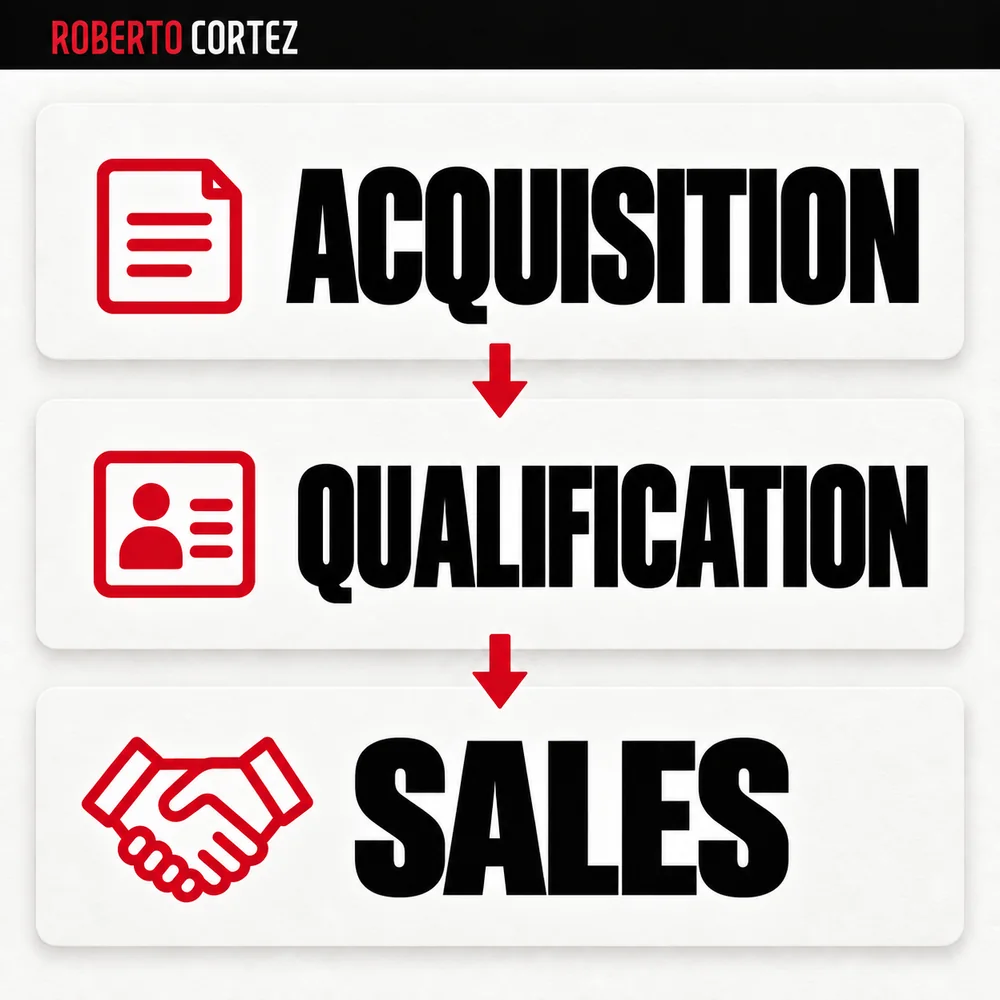
You also need to ask if there's a team that follows up on generated leads. If the company has nobody answering the phone or replying within a reasonable time, driving traffic is pointless. As I said during the conversation, in digital marketing our success is directly tied to the client's success: if the sales process fails on their end, whoever generated the traffic is usually blamed first.
Check if the site meets the minimum bar (MVP)
A site is only ready for traffic if it fulfills its core function, whether generating leads or selling, without serious barriers that block the visitor. It doesn't need to be beautiful or perfectly designed. It just needs no bottlenecks that stop real conversion from happening.
Ana shared a concrete example from a meeting she'd had that same day: the main banner on a hotel's website covered the booking engine on mobile. That's critical and has to be fixed before any campaign, regardless of whether the banner looks good or not. She also mentioned using the Lighthouse extension in Chrome to check performance and Core Web Vitals, especially on mobile, since in many industries most traffic is mobile.
The test we used was simple: ask what, on this site right now, could be critically hurting conversion. If you find that point, it jumps to the top of your priority list. If nothing is catastrophic, you can move forward with testing and leave cosmetic tweaks (colors, prettier copy) for later. As Ana put it, the bag might not look pretty, but if it's not torn, you can still work with it.
Another example she shared: in a meeting with a company launching a new site, she asked if they held a sales call before sending a quote. The commercial director said yes, the marketing director said she wasn't sure. If the sale depends on a call, the site's main call-to-action needs to book that call, not request a direct quote. Marketing and sales need to be aligned on how sales actually happen.
What Metrics I Track to Know if the Business is Actually Improving
How to build a lead funnel that the sales team can actually work
Growing an online business: what I learned about margin, team, and AI
Look at the offer through the eyes of someone who knows nothing about the business
A clear offer speaks to the client's problem and the concrete transformation, without jargon that only insiders understand. Ana called this the parent syndrome: whoever built the product knows it so well they stop seeing the flaws in their own messaging.
The strongest example from the conversation was a pediatric development clinic supported through the Supervisão program. The founder wasn't sure how to explain each therapy (occupational therapy, speech therapy) on her site, because she used clinical terms that confused parents. The suggestion was simple: don't explain the technical service, explain the problem it solves. Better school performance, more conversation at the dinner table, less screen dependency. That's what a parent recognizes and acts on.
Ana also talked about writing in "Fernando Pessoa language": beautiful text, full of adjectives, that doesn't tell the client what they'll actually gain. Many businesses that explain themselves well in person write poorly online, because they unconsciously shift register.
Understand the market before choosing channels
Strategic planning requires knowing whether a category is growing or shrinking, and whether there's seasonality that shifts demand across the year. Tools like Google Trends and Keyword Planner, or paid options like Semrush and Ubersuggest, give you that picture without relying purely on gut feeling or guesswork.
One example we discussed: gyms see a large demand spike in January and September, the "restart" months. Knowing this helps decide where to concentrate budget and when.
On competition, Ana shared the example of a CRM startup that, entering a market dominated by Salesforce and HubSpot, picked an extremely narrow niche: life insurance agencies. It dominated that niche before expanding into broader financial services. As she put it, this works because when you speak to everyone, you speak to no one; positioning specifically makes you the obvious reference in that space instead of one of many.
It's also worth viewing competition more broadly than just whoever sells the same product. As Ana explained, there's always an opportunity cost: someone who invests time and money in one course doesn't have that same time and money for a different course, even if they aren't direct competitors.
Split investment between existing demand and stimulation
The right channels depend on whether active demand for the product exists. Ana shared her more than ten years at Google, managing accounts for brands like FedEx, PSA, Vimeo, Tinder, and the New York Times, and said that even inside Google there was awareness that certain categories performed better on social media than on search.
If there's strong natural demand (a dentist, for instance), Google tends to perform better, because the person is already actively searching for a solution. If the product requires creating desire or awareness, networks like Instagram, Facebook, or YouTube work better. I shared my own example of a €7 Meta Ads course that I sold mainly through social media, with over seven thousand sales in about fifteen months; if I had relied only on Google search, I estimate I would have sold far less, maybe around two hundred units, because there isn't enough active search demand for that specific term.
Not putting all your eggs in one channel is also a form of protection. Ana pointed out that even inside Google there was awareness that algorithms change and can meaningfully affect a site's organic traffic overnight, with no warning and no easy way to reach whoever makes those decisions.
Refuse clients who aren't ready
Accepting a project knowing in advance that the offer, the website, or the budget aren't in place is a recipe for conflict. Ana mentioned having declined to run campaigns for clients with dysfunctional websites, because promising results under those conditions turns the professional into the messenger of bad news.
I follow the same principle in my own projects, including SpartAds. If a client isn't willing to fix obvious flaws in their site, no ad budget will fix that. In those cases, the right move is pointing out the groundwork the business needs to do on its own, even if that means losing the immediate project.
That upfront diagnosis, built on honest questions before any proposal, is what separates a grounded strategic plan from an empty promise.
Source
I wrote this article from odd Friday session #111, recorded with Ana Rocha de Paiva about building a strategic plan. You can watch the full conversation here: https://www.youtube.com/watch?v=vb819OJI91k