
Why trying to fix everything in week one backfires
If I spend ten or twelve hours a day on one client because my schedule is still light, I'm building a pace that won't survive my own growth. Going from two or three clients to twenty means attention has to spread out, and a client used to that initial pace reads the return to normal as a loss of interest.
I describe this from my own agency experience: early on, with few clients, I had a tendency to put in more energy than was reasonable, invent meetings, try to solve everything right away. I say plainly, in class, that you shouldn't try to solve every problem in week one, because that sets up an expectation you can't sustain over months.
The comparison I use is a romantic relationship: at the start you take your girlfriend to the cinema every week and bring flowers; two years later that becomes rarer, and it's normal. The problem is when the client keeps that early pace as a fixed reference point and feels a loss when things settle into something sustainable.
That mismatch between the initial pace and the real long-term pace is, for me, one of the costliest mistakes for anyone starting out with clients. Slowing down after an intense start is normal in a long-term partnership; what matters is having warned upfront what that real rhythm would be.
What to ask before touching any campaign
Before adjusting ads or automations, I need to understand the client's business in depth, including the value proposition, the flagship product, and the typical sales journey. Without that foundation, any technical intervention runs blind and risks wasting budget the client couldn't spare in the first place.
I split these discovery questions into blocks: the business (how they serve clients, which product sells best, who the typical buyer is, what objections come up before purchase), the metrics (margin, customer acquisition cost, break-even CAC, LTV, average order value), and the digital ecosystem (which channels have been tested, what budget exists for coming months, what ROAS is expected).
Many of these questions go unanswered on the client's side, and it's the team's job to help get to those numbers before moving forward. Without that foundation, the risk is celebrating results that, from the client's financial view, look like a disaster. That's the example I give, in class, of a project where the team looked at revenue while the client was looking at ROAS: we hit revenue records and the client was unhappy because margin was being eaten up by the operation, a communication gap that nearly cost the relationship.
What I need to know about a client before taking on a marketing project
How to convert more leads into clients in a service business
Growing an online business: what I learned about margin, team, and AI
Auditing the house before sending traffic to it
Before spending budget on campaigns, it's worth checking whether the site, tracking tools, and checkout process are in minimally decent shape. Sending paid traffic to a slow, confusing page with no Pixel installed burns the client's money regardless of how good the campaign itself is.
The specific points I mention in class are: whether the site is secure and fast, whether it works well on mobile, whether the main message and call-to-action buttons, like the add-to-cart button, are visible, whether the Pixel and Analytics tools are installed, and whether there's friction in the checkout process. The result of this review becomes a document with concrete recommendations, not a loose set of complaints raised in conversation, so it's clear from the start which side is responsible for what.
A phased plan instead of everything at once
After diagnosis and expectation alignment, I split the work into stages, with clear goals for each phase and meetings scheduled by real need rather than a fixed weekly calendar slot. That protects the technical team's time and avoids meetings with no agenda or purpose.
I say, in class, that it's normal, at the start of a project, to need two or three meetings in the same week to unblock access, approve materials, or align on diagnostics with the client. But that frequency spaces out as the work progresses, and after a few months one monthly meeting can be enough to keep track of the project.
The central point I stress is that every meeting needs a defined objective before it's scheduled. I say, in class, that whenever there's a meeting there has to be a real reason for it, as opposed to meetings booked simply because they were on the weekly calendar, with nothing specific to decide.
How to handle a heavy initial setup request
When diagnosis shows there's a lot of cleanup work before starting, like fixing the landing page, setting up business accounts, installing pixels, or configuring Analytics, there are two fair ways to protect the engagement without overloading the team for free. I address this directly in class, drawing on my own past mistakes.
The first option is charging a separate setup fee, which can run up to double the normal monthly rate, to compensate for the extra effort of putting the house in order before any campaign launches. The second is negotiating a longer contract, such as twelve months, in exchange for not charging that setup separately, spreading the initial effort across a more stable partnership.
I'm honest about a mistake I've made myself: taking on projects with a huge initial workload without securing either of these protections, and then watching the partnership end after a few months due to the client's business lacking traction. I say plainly that most unvalidated businesses will fail, and that has nothing to do with the quality of the team's work. Protecting upfront pay is realism about a risk present in any new project, not distrust of the client.
Consistency matters more than over-delivering at the start
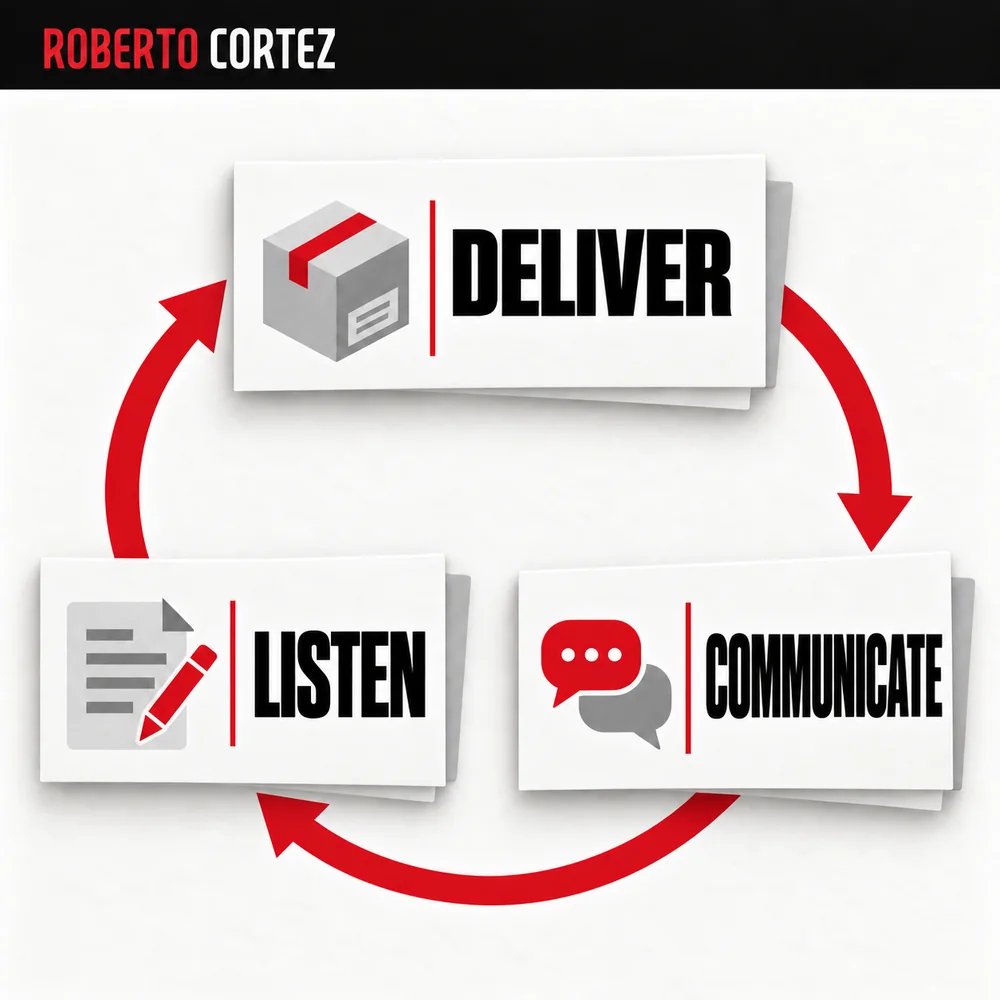
What builds trust over time is keeping a fair, sustainable pace from the first day through the last month of the contract. A client feels more secure with someone consistent than with someone who starts at full speed and then slows down without warning.
This idea comes up explicitly in class when I connect it to client retention: I lose more clients due to lack of feedback or misaligned expectations than due to lack of actual results. I've had cases of exponential growth where the relationship still deteriorated from a lack of constant communication throughout the process, and cases with much more modest results where ongoing alignment kept a client for twelve, eighteen or twenty-four months of partnership.
This logic isn't limited to traditional marketing agencies. It applies just as much to anyone structuring business process automation workflows: structure and predictability matter more, in the medium term, than concentrated, unsustainable effort in the first weeks of any project.
Source note
This article is based on Sextas Ímpares #89, "Processo de Onboarding de Clientes de Marketing" (https://www.youtube.com/watch?v=LEAed-8P2is). The part on setup fees and contract trade-offs comes up around the 28-minute mark, and the example about meetings without a purpose comes up around 32 minutes.