
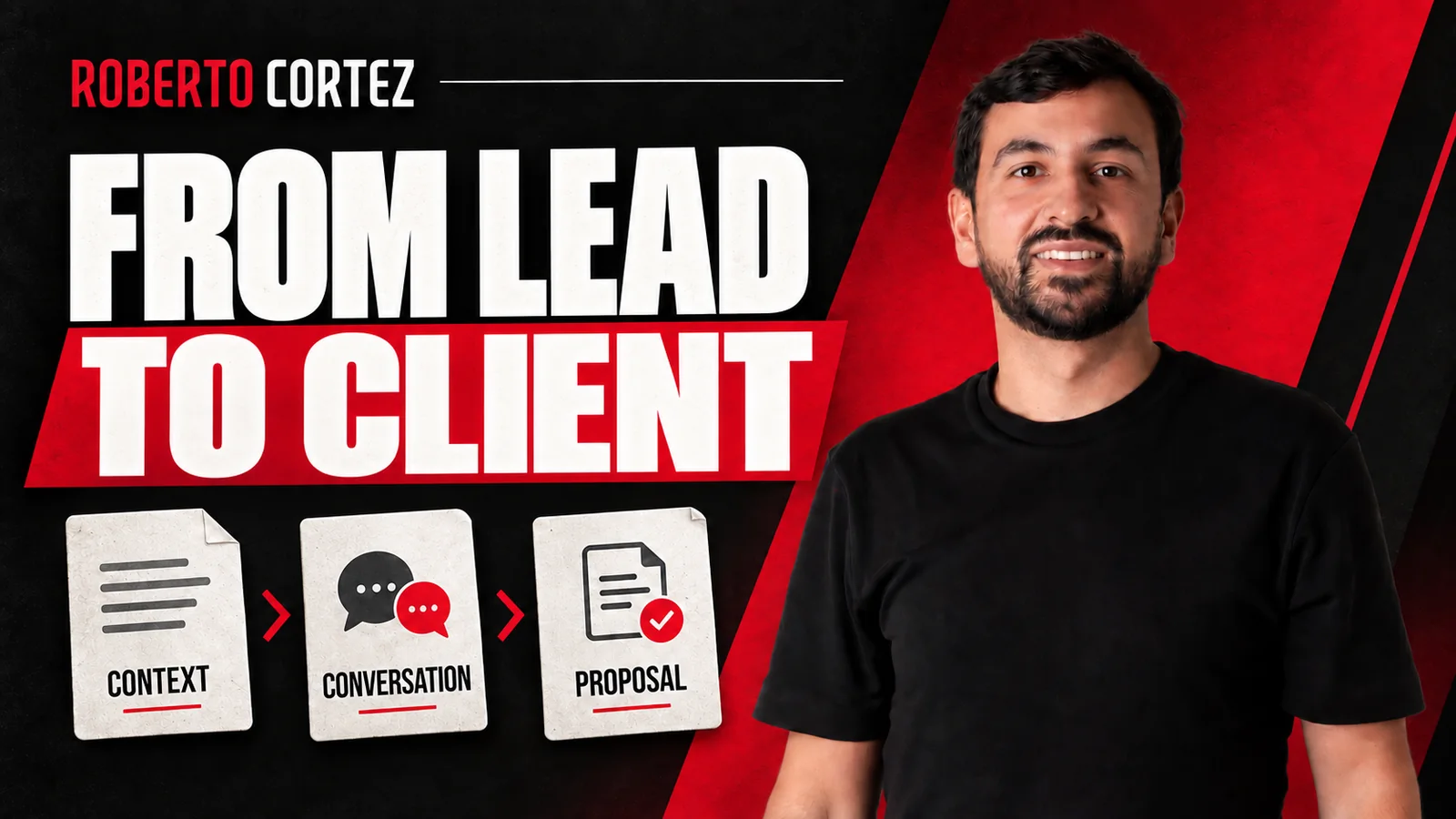
In Sextas Ímpares #144, I talked with Beatriz Teixeira, who runs sales at our companies, about this exact work. For the first years of the agency, sales always stayed in the background, behind technical delivery. From the moment we started prioritizing this area, the pace of the company changed visibly.
One unanswered call isn't enough to disqualify a lead
Dropping a contact just because they didn't answer the first call is a common mistake. Beatriz was clear on this point: a missed call only shows the person wasn't available at that exact minute, not that they lost interest. It's worth following up through more than one channel before archiving anything.
If someone filled out a form asking for help, they took an initiative. Reducing that to a single phone attempt wastes the effort put into lead generation and distorts your funnel numbers, because an unanswered contact is not the same thing as an unqualified one.
To organize this follow-up routine without overdoing the insistence, it can make sense to combine different channels: an initial call, followed by a WhatsApp message if there's no answer, and later a direct email confirming whether the topic is still a priority for the company. Only after these attempts is it reasonable to consider the contact as unresponsive, rather than lumping it together with someone who was actually disqualified. Building a lead funnel your sales team can actually work requires exactly this clear distinction between different states.
To prepare your next step, explore The B2B sales process.
Responding fast matters, especially while the request is still fresh
Reaching out to someone while their interest is still active helps a lot with conversion rates in services. Someone looking for an agency or a consultant rarely asks just one company for a quote. We talked about the importance of response speed in services and what that means in practice.
When someone fills out a form, use that moment to follow up on the request. If you let several days go by, the person may already be talking to another company. Speed matters because it lets you enter the conversation while the need is still present.
To achieve that speed without always depending on one person's availability, the request needs to reach whoever is going to make contact already organized, with a notification alerting them to the new lead and the form's context already available. After that, someone has to take responsibility for calling or writing. It's worth measuring the gap between when the request comes in and the first response, to understand where the real delays are happening.
A script helps you not leave the conversation without the data you need
A script helps you gather the information you need to prepare the proposal. Use it to guide the conversation and adapt the questions to what the person answers. Before wrapping up, confirm what's still unclear and agree on the next step.
Beatriz argued that flexibility only works when it rests on a base of qualifying questions. Over the years of working with freelancers and small agencies, I've repeatedly come across requests for help calculating proposals when the person still didn't know what the client wanted to solve, what budget was available, or what internal structure existed. Without that data, any proposal ends up being a guess.
During a diagnostic call, it's worth walking away with clear answers to at least four questions: what is the concrete goal of the project and how does the company measure success; what has already been tried before and why it didn't work; what amount is set aside to invest; and whether there's an internal team capable of following through on the work after it's delivered. If, over the course of the conversation, you realize the investment capacity or the structure to make use of the service is missing, it's better to say so clearly than to force a commitment nobody will be able to keep.
Knowing how to say no is part of qualifying well
Disqualifying an opportunity means concluding, with judgment, that a given prospect doesn't have the conditions to benefit from the service at that moment. This decision should rest on objective criteria, not a vague impression from the call. Taking on projects outside that framework tends to create wear and tear for both sides.
In our case, a paid traffic generation service only makes sense for a company that has a validated business model, margin to invest continuously in ads, and the capacity to follow up commercially on the leads generated. If any of these elements is missing, taking on the project tends to result in wasted money for the client and wasted effort on the team's side.
Instead of closing contracts just to hit revenue targets, a salesperson who knows the operation well knows how to steer the conversation honestly: in certain cases, it's better to recommend a different path, even if that means not closing the deal at that moment. This protects the company's reputation over time, more than any single contract would.
Explaining the benefit helps justify the price being asked
When a client says a proposal is too expensive, they usually still haven't understood what they'll get in return for the amount being asked. If the perceived benefit doesn't clearly outweigh the presented cost, the person hesitates or looks for cheaper alternatives. It's the sales presentation's job to clear up that imbalance.
Beatriz mentioned that we often close clients who had already received several cheaper proposals than ours. What usually makes the difference isn't an immediate discount, but the clarity with which the delivery is explained. If the proposal is just a technical list of tasks, the client compares on price; if it explains what each stage solves, the conversation shifts axis.
A hypothetical example helps illustrate this: imagine a client who only wants to invest two hundred euros a month in ads, expecting an immediate return. Instead of refusing outright or accepting conditions that would hardly bring results, it makes sense to explain industry metrics and the slower, more variable nature of returns in digital advertising. Faced with a price objection, it's worth avoiding giving up margin at the first sign of hesitation, asking what reference point the client is comparing against, and tying each deliverable to a concrete result for their business.
The volume of proposals matters more than it seems
Selling services consistently depends, to a large extent, on keeping meetings and proposals active every week. Waiting for the business to grow without continuously putting new proposals on the market slows down any agency or consultant. The sales team needs to track its numbers with some detachment, without getting discouraged by isolated rejections.
In our experience, the volume of proposals grew very sharply from one year to the next, and that increase in pace went hand in hand with growth in closed clients. If the conversion rate is around twenty percent, you need about ten proposals to close two projects. It's worth tracking the number of qualification meetings, the volume of proposals presented, the conversion rate, and the average value of closed contracts, to understand where to adjust the pitch or the qualification process.
Dealing with rejection is part of the routine for anyone in sales. It's not a good idea to change strategy because two or three opportunities in a row didn't move forward: you need enough volume before drawing any conclusion about how effective the approach is.

AI can help prepare and log conversations, without replacing the relationship
AI tools help reduce administrative tasks and free up attention for the conversation itself. Automatic summaries, transcripts, and gathering context about a company ease the manual workload. But the decision to listen, negotiate, and build trust remains a human one.
Beatriz showed in the conversation how AI can help organize sales information. Using transcription tools in meetings lets you skip the notepad during the call and keep your attention on the person, knowing the important points will be recorded for later. These tools can also help with prior research into a company's positioning and competitors before the first contact, and with drafting proposals that better reflect the points raised during the diagnostic call.
That said, no automation replaces the connection built in a human conversation, especially in service sales where trust matters as much as technique. In Growing an online business: what I learned about margin, team, and AI I develop this idea of technology serving efficiency without replacing the human side of the work. It's also worth exploring AI in B2B prospecting: how to qualify opportunities before reaching out, which covers the preparation that happens before contact.
If you want to review the sales follow-up process in your service business, check out our services for online business and sales.