
Look for a consistent change across the journey
Observe how attention, page visits, enquiries and commercial results develop across comparable periods. Look for signals that reinforce one another and consider the available volume. An isolated indicator may fluctuate for several reasons, so it should not automatically receive the label of creative fatigue without further investigation of the surrounding evidence.
If response to the advert decreases and fewer suitable opportunities arrive, there is a change worth investigating. If clicks remain stable but enquiries stop arriving, the difficulty may sit after the creative. Locating the drop helps determine where to seek explanations before producing replacement pieces.
Also consider the interval between first contact and sale. A recent week may look weak because opportunities are still being followed up. Comparing that group with one whose sales process is complete can create an apparent fatigue signal that disappears when the information reaches similar maturity.
The campaign manager's boredom is not evidence of audience boredom either. The team sees the same piece every day, under different conditions from the people receiving it. Wanting to change the design may be reasonable, but that preference needs to remain separate from the performance diagnosis.
To prepare your next step, explore Artificial intelligence in digital marketing.
Check what changed outside the creative
Before attributing a decline to the message, review changes to the offer, page, measurement and sales follow-up. Also check significant spending changes and contextual developments. Creative renewal may form part of the response, but it does not automatically fix a broken form, an outdated promise or enquiries left without attention.
Imagine a hypothetical campaign that retains the same advert while delivery times increase. Visitors may remain interested and then leave after discovering the new condition. Replacing only the image would leave the possible cause of the conversion decline unchanged while making comparison with the previous period harder.
A budget increase may also change the conditions in which the creative is shown and the people reached. You do not need to assume a particular technical mechanism to recognise that the comparison is no longer identical. Record the change and assess performance alongside the other observed conditions.
If you identify a concrete fault, correct it and monitor the effect before attributing the result to the next piece. Maintain a record of dates and versions. Otherwise, a new image may receive credit for an improvement that actually came from the page or sales response.
Turn the history into a refresh brief
A useful brief identifies the previous message, situations that generated a response, observed objections and the hypothesis for the next version. State what should remain and what deserves changing. Renewal gains direction when it answers a specific commercial question instead of merely requesting a visual that looks more recent.
Consult relevant comments, incoming questions and reasons for lost opportunities. If several people interpreted the service as a one-off delivery when you sell ongoing support, there is a clarity issue to address. A new piece can explain continuity without abandoning the benefit that already attracted interest.
You can also test different evidence, a more specific situation or a clearer demonstration of the process. Each alternative should correspond to a plausible reason for improving comprehension or enquiry suitability. Avoid accumulating changes that prevent you from identifying which question you are actually investigating.
The process of preparing advertising variations with AI should receive that brief, including promise boundaries and available real material. Faster production helps when new pieces explore distinct hypotheses and remain faithful to the offer, the brand and what the business can substantiate.
Prepare alternatives before depending on them
Maintain a small set of hypotheses ready for production and define who prepares, reviews and delivers each piece. The objective is to shorten the interval between identifying a need and testing a response. You do not need to publish every alternative immediately or refresh at a universal frequency unsupported by evidence.
A simple queue can distinguish ideas awaiting development, pieces under review and variants ready to use. Include the hypothesis and required material, such as a real demonstration or service explanation. The team then knows what remains to produce before it reaches a point where an urgent replacement becomes necessary.
Also define what makes a piece usable: legible text, an appropriate format, an accurate promise, a coherent destination and a functioning next step. A new variant that fails these checks introduces another problem. Review needs to happen before you pay to observe its commercial effectiveness.
The number of pieces must fit the observation budget and analysis capacity. An archive full of versions is not equivalent to a renewal plan. Prioritise hypotheses addressing the most important uncertainties in the history, leaving the rest until conditions allow them to be evaluated properly.
Preserve versions and comparison conditions
Save the text, image, destination and date of each version alongside relevant campaign changes. When a change is substantial, analysis must distinguish previous performance from subsequent performance. Preserving history means keeping the conditions under which each result was obtained and recorded interpretable for whoever reviews the campaign later on.
You do not need a universal rule about duplicating campaigns or assigning one creative to each ad set. Implementation depends on the context and available tools. The management requirement is being able to answer later which message and which offer were active during the period being compared.
If several conditions change together for operational reasons, record that limitation. You can assess the intervention's overall result but have less basis for assigning the improvement solely to the new creative. This prevents a successful refresh from turning into a technical recipe that may not be repeatable.
Also confirm whether the variant had sufficient budget to be tested. A new piece receiving minimal exposure remains a poorly observed hypothesis, even if the report assigns it a cost per result that appears extremely high or extremely low.
Decide adoption through the quality of the outcome
A refresh deserves to continue when it improves the relevant outcome under the observed conditions and maintains a healthy connection with the offer. Track opportunity quality, sales effort and sales contribution. Visual novelty may increase attention without improving what the company can actually deliver and collect payment for in practice.
If the new message produces more unsuitable enquiries, review what it is suggesting to people. The earlier piece may have been clearer about scope despite receiving fewer clicks. Diagnosis should allow you to preserve that clarity while testing another way to attract attention, without confusing volume with commercial progress.
When a variant shows favourable signals, define the next increase or replacement as a limited, monitored step. The reasoning about increasing the budget without ignoring the economic outcome still applies during renewal. Initial performance does not guarantee that the creative will remain equally efficient with more spending.
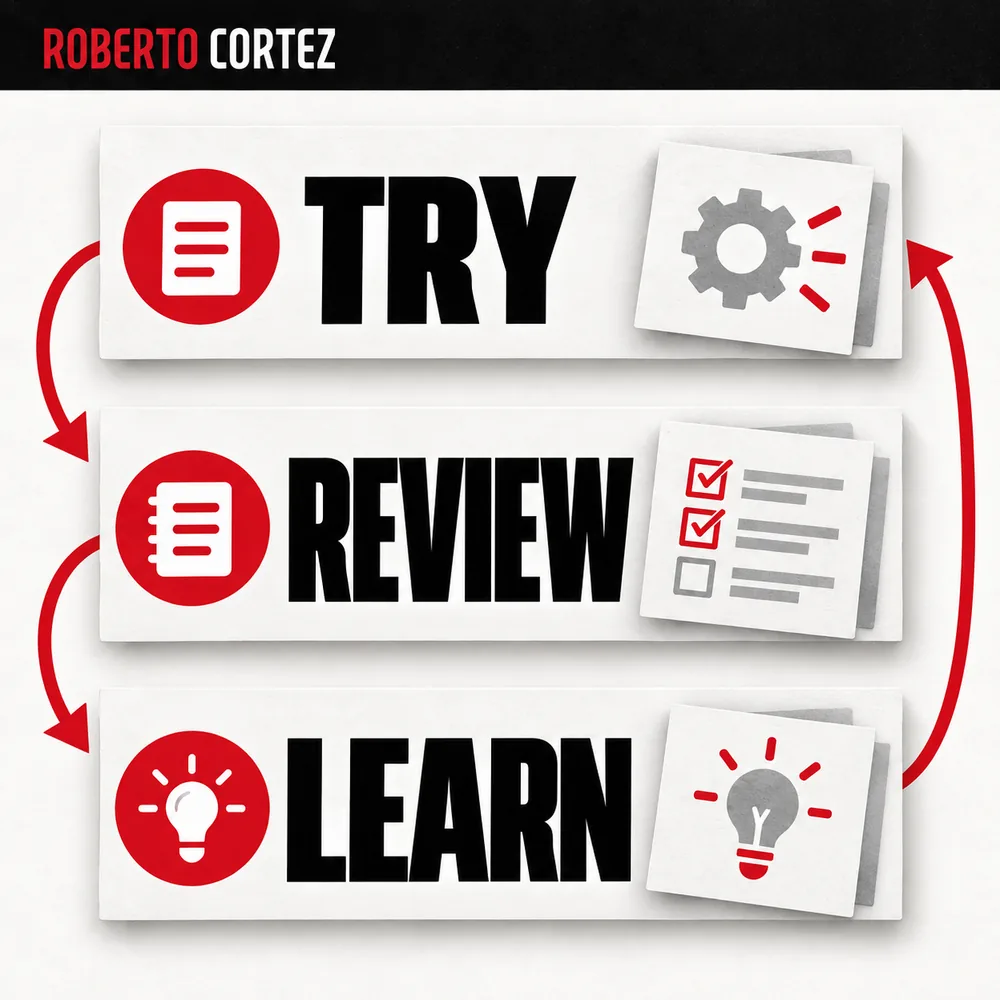
Close the cycle by recording what was preserved, what changed and what remains unresolved. Preparing renewal means having alternatives and criteria available before urgency arrives, with enough history for every new piece to add useful learning to the next campaign rather than simply replacing the previous design.