

I once believed that if something was going to be done properly, I had to do it myself. That belief makes building a team difficult: you hand over tasks but keep every decision, leaving people waiting for your involvement before they can move forward.
As that dependency grows, hiring can seem like the immediate answer. Expanding the team may be necessary, but you need to know exactly which responsibility you want to transfer. Otherwise, the new person joins the queue of people who need to ask you what to do next.
Make an inventory of the work before designing a role
Start by recording tasks, frequency, approximate time, required information and why each task still depends on you. Separate recurring execution, exceptions and decisions with significant consequences. This inventory helps you identify coherent areas of responsibility, instead of creating a role made up of everything that no longer fits into your schedule.
Over a representative period, observe the work that actually happens. Include informal requests, corrections and approvals that interrupt other activities. A list written from memory tends to highlight the most visible tasks while overlooking small dependencies that consume a substantial part of the day when they recur.
In a hypothetical example, a service business might find document requests, proposal preparation, status updates and discussions of commercial terms on the same list. That does not mean one person should take on all of them. Some tasks require similar context; others need different skills or authority to be handled well.
The inventory to make before your company's first automation also supports this analysis. Knowing who starts a task, which data it uses and how it ends helps you decide whether to remove, simplify or automate it, or assign it to someone with the time and preparation to carry it out.
To prepare your next step, explore Delegation and processes for small teams.
Transfer responsibility with clear completion criteria
A responsibility can be delegated when it has an expected outcome, access to the necessary information and criteria for judging completion. Handing over only a sequence of clicks leaves someone dependent when circumstances change. Explain the purpose of the work and the situations in which they should stop, seek help or choose another approach.
Consider proposal preparation in the earlier example. The responsibility might include confirming the request, gathering missing information and preparing a document within approved terms. Completion means more than having a file: the proposal must be complete, consistent with the request and ready for the agreed review stage.
Document a normal case and a few frequent exceptions. Show where to find current information and how to record a question that has no answer yet. Documentation should make work possible; it does not need to anticipate every imaginable situation before the transfer of responsibility can begin.
This reveals the cost of making the same decision every day. When a rule is defined and accessible, the team can apply it without reconstructing the conversation. When a rule is missing, a question becomes an opportunity to decide and document, instead of an interruption that produces no lasting learning.
Decide which decisions stay with you and why
Keep decisions that require your accountability or specific knowledge, but make the reason explicit. For the others, define limits of authority that reflect their impact and how easily mistakes can be corrected. The team needs to know what it can decide, what requires prior approval and how to handle an exception.
Your preference about the order of information in a document does not necessarily carry the same weight as changing the agreed scope of a service. If both are decisions reserved for the founder, you create waiting where a quality standard might suffice. Distinguishing their impact helps you focus attention on what needs review.
The limits must be understandable to the person receiving the work. Instructions such as use common sense are inadequate when people do not share the same experience. You can define permitted changes, situations that require contact and the information that should accompany a request, without turning every task into an endless set of permissions.
Avoid authority that exists only in words. If you correct every choice because of personal taste, even when it meets the agreed criteria, the team learns to seek permission for everything. Review outcomes against the agreement and explicitly change the criteria when you discover that they were incomplete.
Separate AI assistance from the person's responsibility
AI can help prepare information and drafts for suitable tasks, but responsibility still needs to belong to someone. Define who reviews the result and which actions a system is authorised to perform. This separation lets you assess human capacity without assuming that a tool will, by itself, solve a poorly defined process.
In the proposal example, an assistant might organise notes and prepare an initial version using approved terms. The responsible person would check the request, figures and scope before any authorised delivery. This is a possible way to arrange work, rather than a promise that any tool can fulfil that role without preparation.
Before counting that assistance as available capacity, include the time needed to prepare context, correct outputs and handle exceptions. If reviewing requires redoing everything, reduced effort has not yet been demonstrated. Limit data and access to what the task requires and what existing permissions allow the people and systems involved to use.
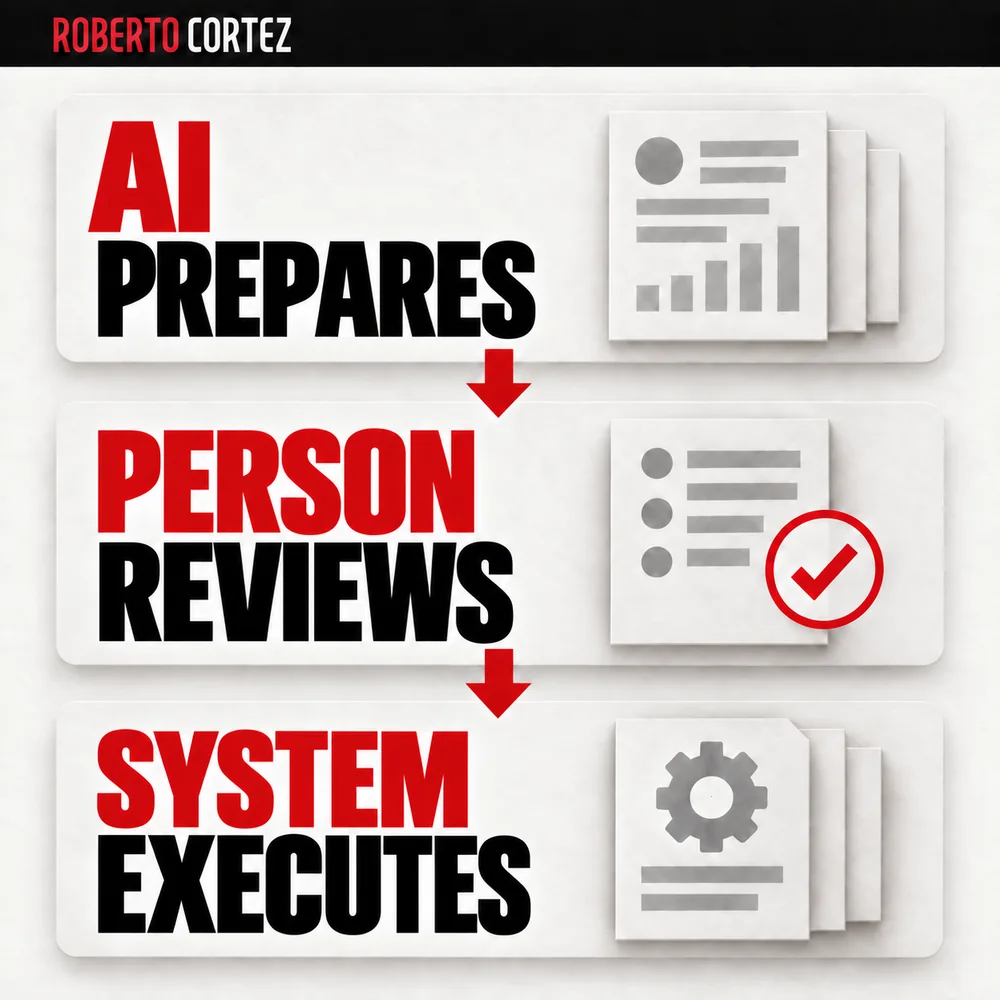
That distinction helps you design the missing role. You may need someone who interprets requests and supports clients, with automated preparation assisting them. The work may still require specialist execution. A tool should become part of an understood responsibility, with someone able to assess when its output can be used.
Assess the transfer before concluding that you need to hire
After defining the responsibility, observe workload, execution time, reviews and available capacity. Include the initial effort required for learning and support. Hiring becomes a clearer decision when you can explain which work remains unaddressed, how often it arises and which skill is missing from the team that needs to perform it.
Learning can take longer than performing a task with prior experience. If you immediately take the task back whenever someone is slower, you preserve the dependency you wanted to reduce. Allow time to explain and observe, distinguishing normal learning difficulties from a process that lacks information or a workload that cannot reasonably be accommodated.
Set a review point and concrete criteria: complete deliveries, significant mistakes, repeated questions and work that still returns to you. Check whether other tasks were removed or priorities adjusted for the person receiving the responsibility. Delegating to someone already fully occupied may simply move the delay to another part of the operation.
When relating the decision to margin, team capacity and business growth, compare the full cost of the role with the work that needs to be covered. Freed hours create value only if there is a useful way to employ them; they do not automatically become additional sales or profit.
If the need remains, you can now describe a role with an identifiable purpose, outputs, authority and skills. If the inventory revealed unnecessary work or decisions that could be clarified, address those issues too. A sound basis for hiring is knowing which responsibility needs to exist and creating the conditions for someone to genuinely take it on.