
Write the commercial hypothesis before producing anything
A commercial hypothesis should identify the customer, the difficulty, the deliverable and why someone would consider paying for it. This description allows you to choose a test that addresses a specific uncertainty. Without that preparation, you could spend weeks building materials and still not know which part of the idea actually needed validation.
“I want to launch a course” describes a format but says little about demand. A more useful hypothesis identifies who needs to learn what and in which situation they will use that knowledge. Only then does it make sense to choose duration, materials and the support format.
Consider a hypothetical offer helping small teams organise commercial proposals. The uncertainty could be whether those teams recognise the problem, want to solve it now or would rather hire someone to do the work. Each question calls for a different conversation or presentation.
Avoid grouping every uncertainty under a single expression such as “validate the business”. Start with the one that could make the remaining work unnecessary. If nobody recognises the difficulty as important, producing more modules is unlikely to be the most informative way to decide the next step.
To prepare your next step, explore Validating business ideas.
Choose people who can assess the offer in context
The first conversations should involve people who face the difficulty described and can explain how they currently address it. Ask about specific situations, alternatives and consequences before presenting your solution. The aim is to understand the purchasing decision, including reasons why someone might prefer to continue without buying what you propose to deliver.
Friends may provide useful feedback on clarity, but their goodwill does not prove demand. Someone who does not experience the problem may like the idea without having any reason to buy. Record that distinction so that you do not count every compliment as an equivalent commercial signal.
Asking “would you buy this?” tends to produce answers that are hard to interpret when the offer still lacks defined conditions. It is more useful to understand what the person has tried, what has consumed their time and who decides on a change. Those answers help prepare a proposal that can be assessed realistically.
The principle of diagnosing before proposing a marketing plan applies here on an initial scale. Before choosing channels and tools, you need information about the offer, market and available resources. A conversation should reduce uncertainty rather than merely confirm the enthusiasm you started with.
Present a small but complete deliverable
The first test can use a limited delivery, provided it fulfils an understandable promise that is useful in its own right. Reduce scope, quantity or personalisation to fit available capacity. Explain the format and conditions transparently, without presenting as complete something that still depends on development or decisions that have yet to be made.
In the commercial-proposal example, you could test a working session with preparation and review of one document. You would not need to build a platform with a library, community and several pathways before observing whether someone wants that help. The small delivery must nevertheless enable the work that was presented.
If the first version requires extensive manual work, record that effort instead of hiding it. The test may reveal demand while also showing that delivery needs to change. Those are two different lessons, and both matter before you repeat the sale at greater volume.
When starting a business with AI support, you may reduce preparation time, but you still need a carefully chosen promise. A quick demonstration proves that you managed to produce something. A purchasing decision helps reveal whether that thing interests someone under the conditions presented.
Distinguish compliments, interest and commitment
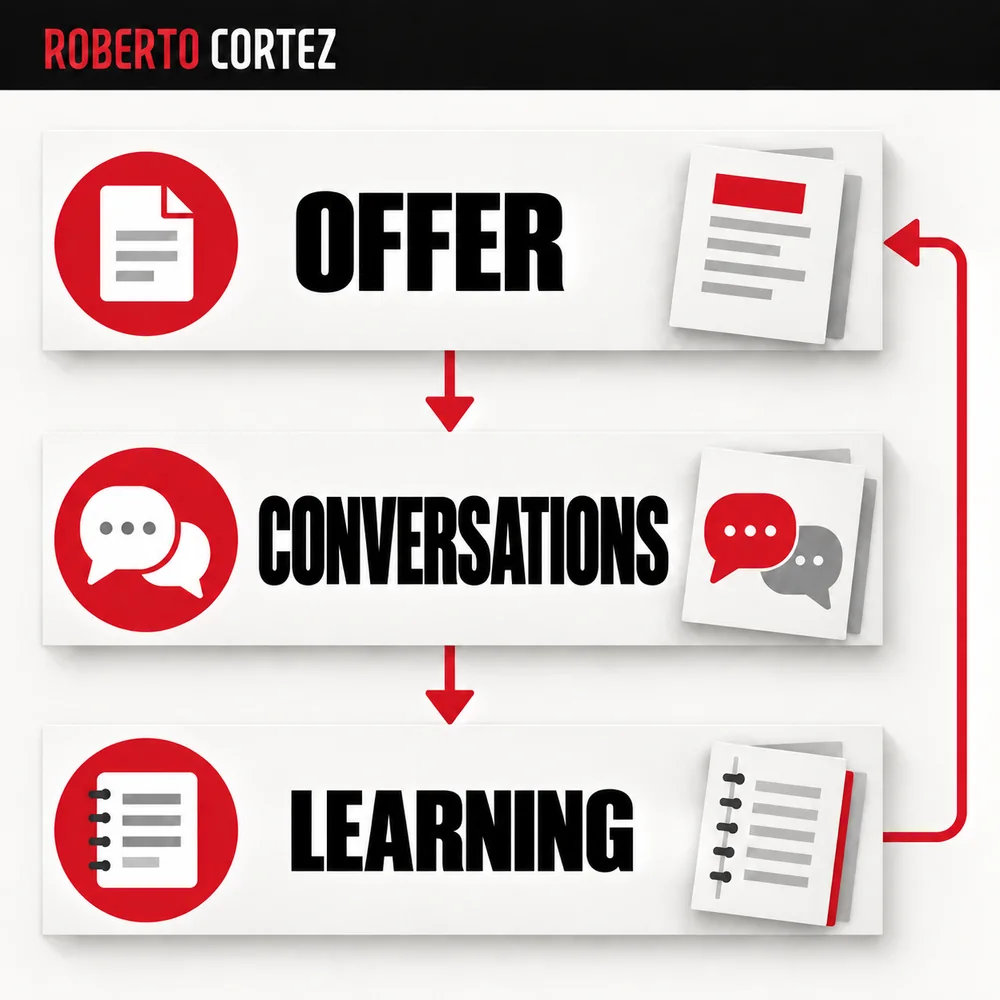
Demand signals have different strengths and should be recorded separately. A compliment shows a reaction, an enquiry reveals interest and a purchase involves a more concrete commitment. None demonstrates, on its own, that the offer can grow profitably; each signal answers only part of the commercial decision that you are currently trying to understand.
Someone may request details out of curiosity, to compare alternatives or because they need to buy. Find out which situation applies. If every enquiry ends when you explain the format, that suggests a different uncertainty from enquiries that reach a discussion about timing and payment.
A first sale also deserves context. Was it made to someone who already trusted you, with exceptional support or conditions you cannot repeat? Those factors do not invalidate the purchase, but they limit what you can conclude about other people and the future operation.
Keep a simple record of the conditions presented and the response observed. Include who had the need, which objection arose and what decision followed. When reviewing several cases, you can look for patterns without turning one memorable conversation into an explanation for the entire market.
Give the test a chance to answer its question
A test needs enough exposure to the intended audience and a clear way to present the offer. Define resources and duration around the question you want to investigate, recognising the limits of observation. If almost nobody relevant saw the proposal, the absence of purchases tells you little about its suitability as a commercial offer.
There is no universal number of visits or conversations that validates every offer. A complex purchase may require more context and decision time than a simple delivery. What matters is being able to explain who received the proposal, under which conditions and what you still need to understand.
When using advertising, the test also depends on the message reaching appropriate people and helping them understand what is available. Asking whether an ad failed to sell or lacked enough budget to be tested helps prevent conclusions stronger than the evidence allows. Clicking and buying remain different behaviours.
Define in advance how much time and money you are willing to use to learn. That limit does not turn a weak result into a definitive conclusion, but it prevents continued spending without a new question. When observation is insufficient, record the test as inconclusive and explain why.
Decide the next stage from what has changed
After the test, decide whether to keep the offer, change part of it, gather additional information or stop development. Connect that choice to observed evidence and the cost of the next stage. Building the entire operation only makes sense when you understand what additional work you are justifying and which uncertainties will still remain afterwards.
If people recognised the need but rejected the format, you can test a different delivery. If purchases happened but support consumed too much capacity, review the operation. If the difficulty seems unimportant to those experiencing it, persisting only with changes to presentation may not be the best use of your time.
Also record what you decided not to conclude. A small test cannot guarantee steady demand, future margin or easy acquisition. It allows you to move forward with a better question and a decision less dependent on opinion. That is a useful basis for building only the part of the business that the next lesson requires.