
A customer may like the proposal and ask to buy only implementation, only diagnosis or one part of ongoing support. Understand the request before treating it as a price objection. Work may already exist internally, another team may be involved, or the need may be narrower than you understood during the initial conversation with that customer.
I try to understand a service's usefulness to the customer before concentrating on its features. I also consider it important to recognise what the company can deliver through its processes and resources. Applying those criteria to a smaller proposal means examining the purpose of the selected part and the conditions that make its output usable.
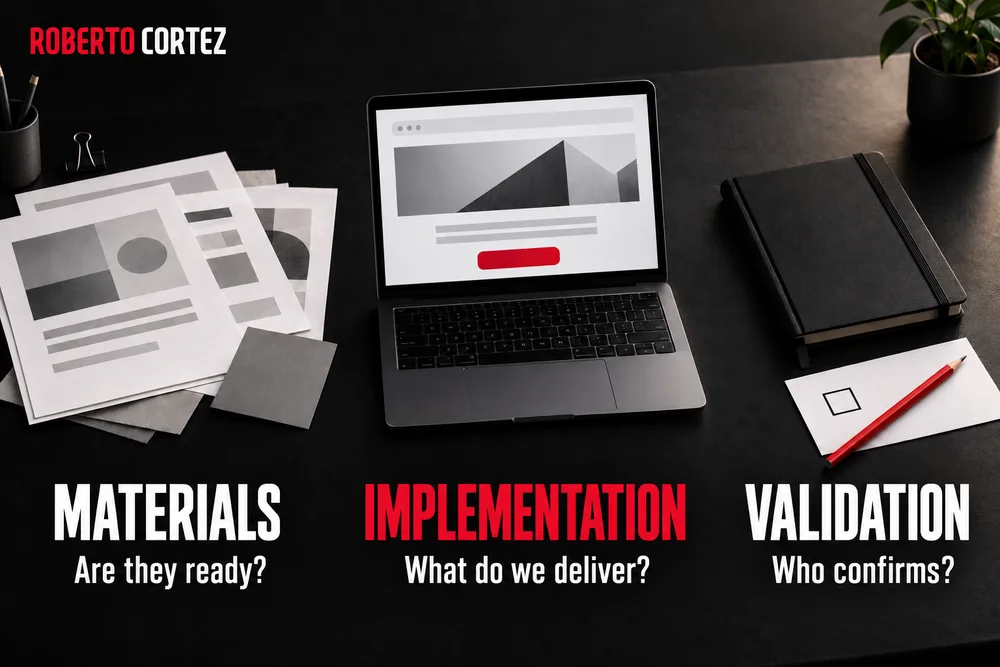
Imagine a fictional company wanting to buy only page implementation because its team has prepared the message and design. That internal work may provide the basis for implementation. Confirm whether the materials are ready, whether implementation can be bounded and who decides when a question arises that crosses the responsibilities of the two teams.

Understand why the customer wants to remove that part
Ask what the customer wants to solve and why they consider a smaller intervention sufficient. Distinguish work already covered, resource constraints, execution preferences and uncertainty about the initial proposal. The answer should guide a new configuration, avoiding a defence of the complete service before confirming whether all its parts are necessary in that customer's particular buying context.
In the fictional company, the internal team may have prepared content and design with knowledge of the offer. A request for implementation alone then has an operational reason. If the materials do not yet exist and the customer merely hopes to prepare them, the proposal must acknowledge that dependency before giving a start date as though everything were available.
A budget constraint can also be real. Understanding it does not oblige you to accept the same outcome with less work or insist on the original proposal. It lets you seek an intervention that fits the customer's conditions and remains useful, or conclude that the problem cannot be addressed adequately through the reduction currently being suggested.
Sometimes the initial proposal exceeds the need. A customer may require one concrete delivery and receive a set of services including support they do not need. Recognising the difference improves the commercial conversation and allows the proposal to be revised without making defence of the original scope a matter of professional pride for the person who prepared it.
There may also be a misunderstanding about a stage's purpose. If the customer wants to remove review because they confuse it with an unnecessary meeting, explain the work it secures. Understanding what was included may change the decision, but that explanation should rest on concrete responsibilities without artificially magnifying risk to preserve the sale of the complete service.
The B2B sales process should help reach that understanding. A proposal responds to a need and may need to change as you learn more about the context. A useful conversation ends with an identified reason to reduce, retain or reformulate the service, instead of remaining a dispute about how many lines disappear from the quotation.
Identify the smaller intervention's own usefulness
Describe what the customer receives by buying the chosen part and how they can use it. Confirm that the work has a recognisable finishing point even without the remaining services in the initial proposal. The smaller intervention needs a clear purpose so both parties can assess fulfilment without depending on a promise that belongs to the complete package.
In the fictional company, implementation may produce a functional page following agreed materials and specifications. That differs from taking responsibility for the offer's entire definition, acquisition strategy and subsequent commercial results. The proposal should state the selected delivery while retaining the technical conditions needed for it to be used in the way agreed with the customer.
A part can be useful even when it prepares future work. A diagnosis may support a decision, and a set of materials may enable another team to implement. What matters is that usefulness is understood and someone can use the result, without presenting a preparatory stage as if it solved the whole business problem by itself.
Ask who will receive the delivery and what they need to use it. A document requiring specialist interpretation may suit an experienced team and be insufficient for a customer without that capability. The difference can change the format, explanation needed or decision to accept the isolated intervention, even when the content originally planned appears to be identical.
Define completion criteria connected to the chosen scope. For the hypothetical page, this may involve checking functionality, presentation and access handover according to the agreement. Assessment should not depend on sales targets implementation alone cannot control; it also cannot ignore faults in the delivery itself merely because the service being provided has become smaller.
If you cannot explain usefulness without referring to the rest of the proposal, revisit the division. A knowledge handover, validation or another necessary condition may be missing. A different first phase with its own outcome might be the answer, rather than removing components until the price fits and later discovering that nobody can use what remains.
Distinguish an optional delivery from an essential condition
For each removed part, check whether it is an independent option or a necessary condition for the remaining work. Another team can secure a condition when capability and agreement are clear. Avoid removing an essential activity from the proposal while continuing to assume the delivery will function as though that activity were still guaranteed by someone in the project.
In the fictional company, writing the message can be excluded from implementation if final content is supplied. Receiving usable text remains a dependency, however. Excluding writing does not remove the need for content or make the implementer responsible for creating it when materials fail to arrive or do not support construction of the page that was agreed.
Apply the same reasoning to validation. The customer may have someone who approves the message while the implementation team checks the functionality it assumed responsibility for. These are different responsibilities and both may remain necessary. The proposal should show which review belongs to each party and where a joint decision needs confirming before work can be finished.
Do not confuse a familiar tool with a mandatory condition. There may be another route to delivery using the customer's materials and processes. Ask what function needs securing and whether the alternative fulfils it, instead of requiring the customer to reproduce your entire working method simply to purchase a more limited intervention from your company.
The diagnosis before proposing a marketing plan helps reveal dependencies like these. A scope-reduction decision needs enough knowledge to distinguish something dispensable from something supporting the chosen work. Without that analysis, reduction can look straightforward in the document and create difficulties as soon as the team begins trying to execute what was agreed.
When an essential condition is unsecured, present it as a prerequisite for proceeding. Materials may need to arrive, an owner may need confirming or preparation may need finishing before a date is accepted. If nobody can take responsibility for that part, reformulating or declining may be appropriate, making clear that the limitation concerns executing the delivery agreed between the parties.
Check the readiness of whoever handles the remaining work
Verify who performs excluded parts, which materials they will provide and under what conditions they can deliver them. Assigning tasks to the customer or another supplier creates a solution only when that responsibility can be fulfilled. Confirm readiness and availability before basing your scope on an external contribution that exists merely as an intention expressed during the initial sales conversation.
In the fictional company, “we have the design” may mean a final approved file or an idea still under discussion. Request enough information to understand the actual state, without demanding unnecessary access to confidential materials. The decision depends on knowing whether implementation receives something usable or must still participate in definition work that was formally excluded from the proposal.
Confirm who can decide questions about the materials. If several people intervene without a recognised final decision, implementation may wait for contradictory instructions. The customer does not need to adopt your internal structure, but collaboration needs a clear route to resolve questions preventing the chosen work from advancing consistently towards the result both parties agreed to deliver.
Ask about that person's availability during execution too. Having someone with the necessary skill does not guarantee they can respond when the team needs them. If their contribution will be ready later, adjust the sequence or starting point instead of assigning people to work on assumptions that may change when the definitive information finally arrives.
The information needed before accepting a project includes these collaboration conditions. The purpose is to prepare a feasible delivery without judging the customer by similarity to your way of organising work. What matters is whether responsibilities and materials support the scope that both parties intend to contract and expect the company to fulfil.
If significant uncertainty remains, a bounded initial check of the materials may make sense. Explain what that check can establish and which work it excludes. Avoid promising implementation at a definitive price and deadline when you still need to understand whether the supplied basis enables the team to execute what the customer is asking it to do.
Define how work passes between the teams
Agree necessary materials, the handover format, who answers questions and how changes are confirmed. The boundary between teams should let work advance without constantly reconstructing context. A partial proposal needs to include the coordination you assumed, distinguishing planned clarification from new tasks while preserving responsibility for correcting faults within your own delivery rather than transferring them to another party.
In the fictional company, implementation may receive text, designs and guidance about the page's behaviour. Establish which version is approved and where changes are recorded. If materials change in several places without a shared reference, teams may work from different versions and only discover the divergence when the time comes to validate the resulting page.
Define what happens when received materials do not allow work to proceed. The team should identify the question, explain its effect and request a decision from the responsible person. That differs from silently correcting the message or redesigning an entire section, taking on unagreed work and creating an expectation of broader intervention in future requests.
Distinguish a planned technical adaptation from a change of intent too. Adjusting presentation to function in agreed formats may belong within implementation. Changing the offer or adding functionality may need another decision; derive the distinction from the actual commitment instead of using task labels to classify every difficulty encountered during execution as additional work for the customer.
If your delivery contains a fault within the scope assumed, retain responsibility for correcting it. Other teams' involvement does not make every problem external. Analyse the case using available materials and decisions, explain what happened and seek to resolve the handover without turning every occurrence into a contest about who can attribute the problem to someone else.
A partial proposal may require more coordination than it appears to need. Account for that coordination in preparation and working arrangements at a scale appropriate to the case. Reducing deliverable count does not automatically remove the need to clarify interfaces, check materials or support the final handover to the person who will actually use the resulting work.
Recalculate the work instead of cutting price proportionally
Assess the new configuration's effort, including preparation, coordination, execution, review and delivery. Some costs disappear when a part is removed; others remain or change form. The smaller intervention's price should match the work actually assumed, avoiding an automatic percentage reduction that stops accounting for activities needed to fulfil the revised scope with sufficient quality and clarity for both parties.
In the fictional company, removing writing may reduce content production while still requiring the team to understand the structure and check supplied materials. The calculation needs to reflect that distinction. You do not need to defend price through excessive technical detail, but should understand internally what changed so the proposed terms remain sustainable when the company executes the work.
Identify preparation still necessary for a small job. Access, context, file organisation and final handover may remain. This does not mean automatically charging the complete proposal's price; it means assessing remaining work and explaining the revised configuration honestly, without pretending that every task shrinks in the same proportion as the deliverables removed from the initial agreement.
Consider variation in external materials too. A complete, approved basis may support predictable execution; an incomplete basis may require further diagnosis before estimation. If the distinction matters, present entry conditions and how extra work will be decided, instead of hiding uncertainty inside a price that the team will later reinterpret while trying to complete the delivery.
Do not use the partial proposal simply to force a sale of the remaining service later. A useful subsequent phase may exist, but should depend on need and a new decision. The current intervention must be viable and honest in its own right, without deliberately leaving a gap that forces the customer to keep buying to use the result.
When rethinking a service with AI, responsibility and delivery method also matter. Performing an activity faster can change effort, but does not independently resolve the dependencies of a partial proposal. Commercial terms should follow what you will actually execute and validate, with limits understood before work begins rather than reinterpreted after a problem emerges.
Write a new proposal for the decision being made
Present the smaller intervention as a choice with its own delivery, conditions, responsibilities and criteria. Identify what changed from the previous proposal and confirm that the customer understands those differences. Give the team the final agreed version so nobody executes the complete promise while someone else considers only one part of the service to have been contracted.
Deleting lines while leaving the rest of the document unchanged is insufficient. A reduction can alter purpose, schedule and who supplies information. Review statements describing outcomes and support, because they may still suggest broader responsibility than you now intend to assume through the revised configuration being offered to the customer as a separate choice.
In the fictional company, the implementation proposal should identify supplied materials, what will be built and how delivery is validated. If it excludes offer definition or campaign support, that distinction needs understanding. Clarity does not require a list of everything outside the service, only the boundaries relevant to the particular purchase decision the customer is making.
Confirm understanding through a concrete situation. Ask how a change to approved text or uncertainty about expected functionality would be resolved. If customer and team answer differently, clarify responsibility before starting, while the agreement is still being defined and nobody is relying on an interpretation the other party does not know exists or has not accepted.
Keep the decision with the project and identify the valid proposal. An older version may continue circulating among people who missed the final negotiation. The sales handover should include changes and their conditions, so operations does not have to reconstruct context from scattered messages when the team has already started executing the work that was sold.
Accept or decline according to what you can deliver responsibly
Accept when the smaller intervention has usefulness, secured dependencies, execution capacity and a clear finishing point. Reformulate when a missing condition can be resolved through another configuration. Decline when the division removes something necessary for fulfilment or leaves incompatible expectations, explaining the concrete limitation without treating every preference for a smaller service as an error made by the customer.
In the fictional company, implementation alone may be a good choice if materials are ready and the teams can collaborate. In another case, design may need clarification before work can be accepted. Both responses can be appropriate; the difference lies in verified conditions rather than a rule that the complete package must always be sold to everyone.
After delivery, observe what the division made easier and where it created uncertainty. That information can help structure a smaller offer for similar needs without turning an exception into a permanent service before understanding the effort involved. Preserve what worked well too, so the configuration is not judged solely through difficulties encountered while the team was executing it.
I want customers to buy the work they need and to be able to explain what I assume responsibility for in delivering it. Selling one part can serve that aim when usefulness and dependencies are clear. The criterion is completing something usable responsibly, keeping the promise aligned with what was actually chosen and prepared for execution.