

On Sextas Ímpares #132, I talked about how I think about lead capture, contact organization, and where automation can help without replacing sales work. There are simple decisions that prevent waste before you increase your traffic investment.
Write a specific message instead of trying to please everyone
A vague offer forces the person to guess whether you have anything relevant for them, and that costs you leads. The message has to say, within a few seconds, who the service is for, what need it solves, and what next step is expected.
On the show, I used my agency's own communication as an example: for years we've communicated in a way centered on one specific need, even while delivering other things behind the scenes. The idea is that the person recognizes immediately what they're looking for, without having to read three paragraphs to get there.
That clarity reduces mismatches, but it doesn't replace sales qualification. Even with a good message, you'll keep receiving requests with different needs and budgets, and that's normal.
One point worth paying attention to is the consistency between the ad and the landing page. If you promise a conversation about a specific problem and then send the visitor to a generic company presentation, you're creating extra work for someone who just wanted to confirm they were in the right place.
To prepare your next step, explore Lead generation for service businesses.
Ask only for the information needed for the next step
A capture page works best when it has a single objective and all the text, form, and button point toward that decision. Every additional field on the form should be justified by its usefulness in the next stage, not by habit or internal bureaucracy.
In the episode, we discussed what's worth asking right in the form. Choose the fields based on the decision the team needs to make next. If a piece of data is only useful for preparing the contract, it can wait for that stage; if it helps understand whether the request makes sense, consider asking for it before the conversation.
Imagine, hypothetically, two versions of the same page: one asks for name, phone, and a sentence about the need; the other asks for that plus five administrative fields. The first tends to generate more submissions, but that's only an advantage if the team can actually prepare well for the conversation with the reduced information it received.
Don't evaluate the change only by the number of submissions. If you reduce fields and the team starts receiving many requests without context, you might just be shifting the qualification work to later. Instead, look at the quality of the conversations and the effort the team needs to put in to prepare for them.
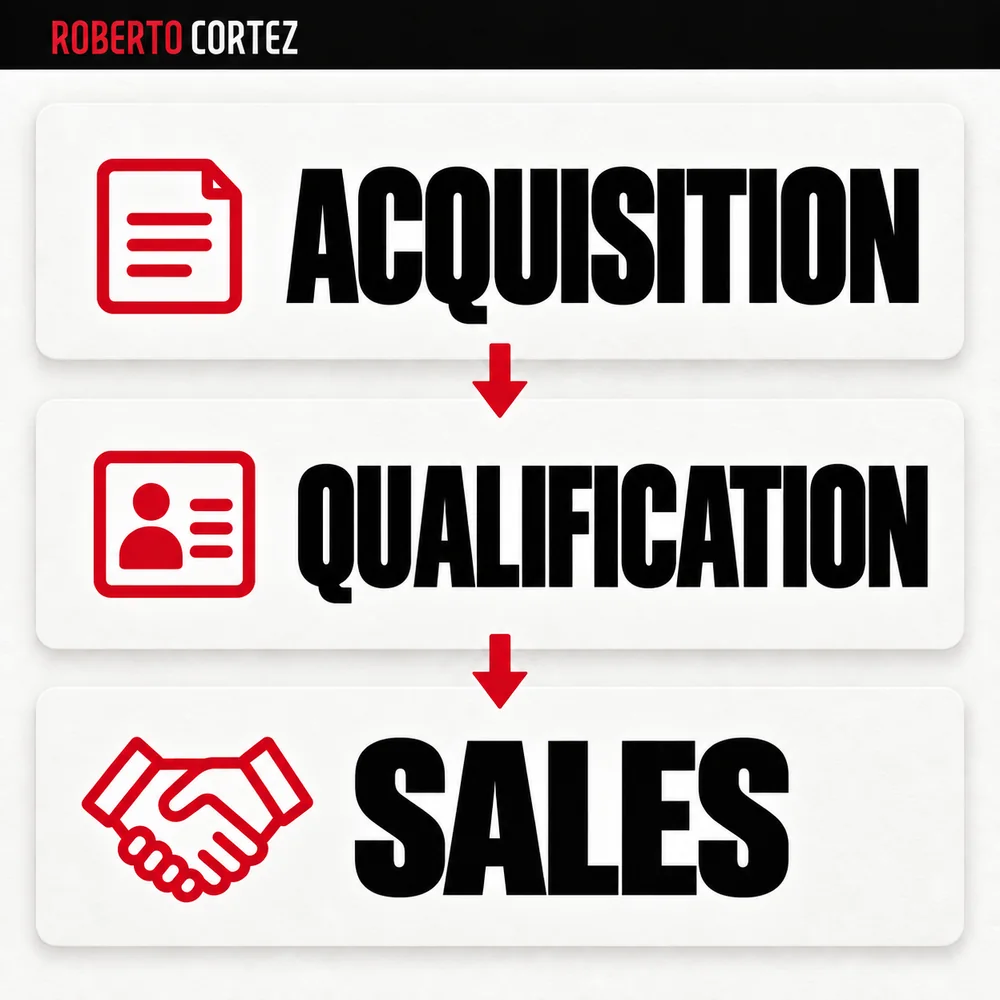
Organize the contact as soon as it enters the system
In the demonstration I did on the show, I showed a flow that connected a WhatsApp conversation to a Google Sheets spreadsheet through n8n, with AI helping to collect and organize the exchanged information. The interest isn't in having a robot pretend to be human, but in keeping context accessible for whoever continues the conversation.
Define where you store each request, who is responsible for it, and what statuses let you track its progress. A simple organization already helps distinguish new contacts, ongoing conversations, and opportunities that already had a decision made, even without elaborate systems behind it.
If you use AI to interpret responses and automatically fill in fields, always confirm that the information was collected correctly. A missing piece of data should still be flagged as missing; an automatic classification shouldn't create a certainty that the conversation doesn't yet support. If you want to explore this kind of flow applied to prospecting, it's worth reading about AI in B2B prospecting to qualify opportunities before reaching out.
Test the message and creatives with a clear criterion
No ad structure holds up for long with just two or three static creatives, because audience fatigue happens quickly on social media. Testing variations helps you understand which arguments spark interest and which have already lost effectiveness, but only if you know exactly what you're changing each time.
If you change the image, the text, and the format all at once, it becomes hard to know what caused the change in results. A more organized approach is to isolate one variable per test: hypothetically, comparing only two different video openings with the rest of the ad kept identical, so you can attribute the result to that specific choice.
AI can help prepare variations of images, text, or small animations from static photographs, which makes the testing process faster than producing everything manually. Even so, the team still has to review the content, confirm what's being promised, and connect the results to the business, not just to click metrics.
Build a sales follow-up that doesn't give up at the first silence
Much of the return on a capture investment doesn't come from the first call, but from organized persistence over the following weeks. Abandoning a contact just because they didn't answer the first phone call wastes everything already spent on ads to bring them there in the first place.
With cost per lead rising structurally in digital auctions, the margin for error shrinks. The practical rule is to keep the contact active until there's an explicit "no" or a purchase decision made, rather than leaving the request forgotten after one unanswered attempt. To dig deeper into closing these conversations, it's worth reading how to turn more leads into clients in a service business.
Email sequences and direct messages help maintain presence without requiring someone to write everything manually every day, but the content still has to be reviewed by a person. It's also worth keeping a reactivation routine for opportunities that have gone cold over the past few months; often the need is still there, but the right moment for the client only arrives later.
Measure what happens after the lead, not just the cost of generating it
A cheap contact might require a lot of work before turning into a sale, while a more expensive contact might be better framed and close more easily. That's why it's worth tracking how many requests advance to conversation, proposal, and client, not just how much each lead cost.
On the show, I emphasized the importance of looking at retention and customer value over the course of the relationship. Putting all the pressure on the number of new contacts leaves out an important part of the business: if retention is weak, the inevitable rise in traffic costs ends up squeezing margins.
Tracking each stage of the sales process helps you understand where the problem lies: incoming lead, contact established, diagnosis done, proposal presented, deal closed. If you notice that most opportunities stall between the proposal and the signature, the problem is rarely in the ad traffic; it's more likely in the diagnosis, the proposal, or the sales team's follow-up cadence.
If you need help reviewing this entire journey, from the ad to the close, check out our growth services for online businesses.