

A team can have people available one morning and still be unable to advance the project assigned to that time. An approval, some copy or a decision that the provider cannot make is missing. Meanwhile, other work needs attention, and the schedule starts depending on a response whose arrival nobody can confirm.
I have argued for making responsibilities and expectations clear before and during a project. It is also important not to establish a pace of attention the business cannot sustain. When a wait arises, those principles help clarify what is genuinely blocked and how to continue without surprising the client or disrupting the team.
I will use a fictional example: a page has a planned implementation window, but the client has not supplied approved copy. Some preparation can move forward, while other decisions depend on the final content. The aim is to manage that situation explicitly, respecting what was agreed and without inventing penalties or immediate availability.
Confirm what is missing before classifying the project as blocked
Identify the missing information or decision and confirm that the request was sufficiently clear. Check who should provide it, in what format and for which stage. A project marked “waiting for client” may conceal a real dependency, but also an ambiguous request, an unanswered question or work your own team still needs to complete before progress is possible.
In the example, “send the content” is too broad to explain the blockage. The client may believe they complied by sharing notes, while the team expects an approved version of the copy. Before discussing delay, clarify the distinction between working material, complete content and a final decision about what will be implemented.
Find the last request sent and check what was agreed. Did the right person receive it? Could they understand the action required? Was there a response date recognised by both parties, or only an internal team expectation? These questions help identify the next step without immediately assigning the entire wait to the client.
The response may also already exist elsewhere in the project. Approval in one conversation might not have reached the implementer, or a file may have been placed in a folder without notice. Gather the context before asking for the same material again, because internal disorganisation can prolong the wait and strain the relationship.
Write the blockage as an operational sentence: “Implementing the content depends on this person confirming this version of the copy.” Another team member should be able to understand what prevents progress. Avoid vague statuses displaying only the client's name without identifying the specific action that remains to be taken.
If the original request was unclear, correct it and explain what you need now. Do not turn an incomplete instruction into a failure the client was expected to anticipate. The conversation becomes more productive when it begins with a verifiable condition and an action the person can perform, rather than a general accusation of poor collaboration.
This preparation begins with organising the first month of a project. Defining stages and responsibilities does not eliminate every wait, but it provides common ground for understanding what happened and deciding what needs clarification when the plan no longer advances as expected. That shared understanding makes subsequent scheduling decisions easier to explain.
Identify the capacity that is actually reserved
Translate the reservation into specific work, skills and time windows, distinguishing available time from the attention needed to resume. A wait may affect only part of the team or block an entire sequence. This view allows precise assessment of options without assuming the whole project has stopped or that all released time can be filled with new commitments.
In the example, implementing the copy may depend on one person while final review needs another. If the first window is lost, the effect may reach the review planned afterwards. Follow that sequence, because moving a stage without examining those that follow can simply transfer the conflict to another person's schedule.
Distinguish a firm reservation from a forecast still subject to conditions. The team may internally have assumed a date that depended on receiving material by a particular point. The client may have understood that same date as a fixed commitment. Before reusing the capacity, identify the difference and clarify it with whoever owns planning and the relationship.
Look at the work that continues during the wait. Answering questions, checking versions and monitoring the dependency consume attention even when production stops. Someone keeping several projects on hold may look available on a calendar while still facing interruptions and decisions that require context to resolve properly.
Also identify the effort of recovering context, without assigning it an invented value. A short task may require rereading decisions and checking changes before starting. Include that preparation in the actual plan instead of assuming a received response allows work to restart at precisely the point where it stopped, with no additional effort.
If the reservation involves a scarce skill, assess who else depends on it. One person's availability may not be replaceable by another's, even when both have free hours. Managing the wait should recognise the capacity needed to complete delivery rather than merely search for an empty block in the overall calendar.
This analysis makes the conversation more concrete. Instead of claiming that “the delay affects everything”, explain that an implementation stage and a review depend on the missing information. Precision supports alternatives proportionate to the impact and avoids presenting a larger change as inevitable when the blockage actually requires a narrower adjustment.
Separate independent work from work that depends on the response
Review the tasks and identify which can advance without assuming information that remains unconfirmed. Keep useful preparation distinct from execution that may need to be redone. Working during the wait makes sense when it produces a usable deliverable, respects the agreed scope and avoids creating an appearance of progress through decisions that still belong to someone else.
For the fictional page, it may be possible to check already approved assets, prepare the technical structure or collect questions for review. That depends on the agreement and what is genuinely available. The team should not fill time by inventing content or making the client's business decisions merely to show activity on the project.
Some tasks are only apparently independent. A layout choice may depend on the final copy's length and structure. If you proceed with provisional content, make the assumption explicit and assess whether the work remains useful if it changes; do not present that production as unconditionally complete while the dependency remains unresolved.
Partial preparation should have a concrete purpose. It may reduce the work needed after the response or clarify something blocking the client. If the only reason is keeping the team occupied, consider whether useful work elsewhere can be performed without creating a new commitment incompatible with the expected restart of this project.
You can also help the client provide what is missing within the actual scope of collaboration. A more precise question or format example may unlock the response. That differs from silently accepting a new deliverable; if the need has become producing material the client was meant to provide, discuss and agree on that change.
Record what advanced and what remains dependent. An update such as “technical preparation complete; content and final review await approval” makes the project's state understandable. Saying only that progress occurred can hide the condition still preventing completion and lead the client to believe delivery is closer than it actually is.
Review the decision about independent work if the wait lengthens or changes appear. Preparation that was useful initially may stop being useful when the project's direction changes. Keeping assumptions clear helps prevent the team continuing to invest in a solution that still lacks the conditions required for confirmation and that may no longer match the intended delivery.
Explain the impact and options before changing expectations
Communicate the blockage, the affected stage and the options you can discuss with the client. Separate confirmed facts from forecasts and indicate what still needs a decision. The message should support a next step, avoiding both a promise to recover all lost time and a calendar change presented as settled before the necessary alignment has taken place.
Useful communication begins with what is missing and what its absence prevents. In the example, explain that content implementation depends on the approved version and that the planned window needs review if that condition is unmet. The wording should match the existing agreement without adding consequences that were never discussed with the client.
Present options the operation can genuinely fulfil. It may be possible to receive a complete portion and advance an independent stage, clarify a question preventing approval or agree on a new sequence. Do not offer alternatives merely to sound flexible when you know the team lacks the capacity to carry them out.
Distinguish the date by which you need a response from the date when you can deliver. Material arriving may allow a plan to be confirmed, but it does not automatically resolve the availability of the people involved next. Explain that relationship so the client understands what their response unlocks and what still requires internal coordination.
Keep the tone direct without turning project management into an argument about blame. There may be legitimate reasons for the delay and clarification work your team needs to perform. The conversation should reach a usable decision while preserving enough history to understand how the plan changed and why each adjustment was necessary.
If one person coordinates the project and another approves it, confirm how the decision reaches both. A message sent to someone unable to resolve the blockage can increase communication without improving the situation. The next step must reach someone with the context and ability to act on the dependency you identified.
Transparency also means acknowledging your own availability limits. Growing a business with margin and team capacity requires distributing attention across commitments. Explaining that reality in advance is more useful than accepting an impossible urgent request and later trying to compensate through pressure on the team or through promises that the operation cannot support.
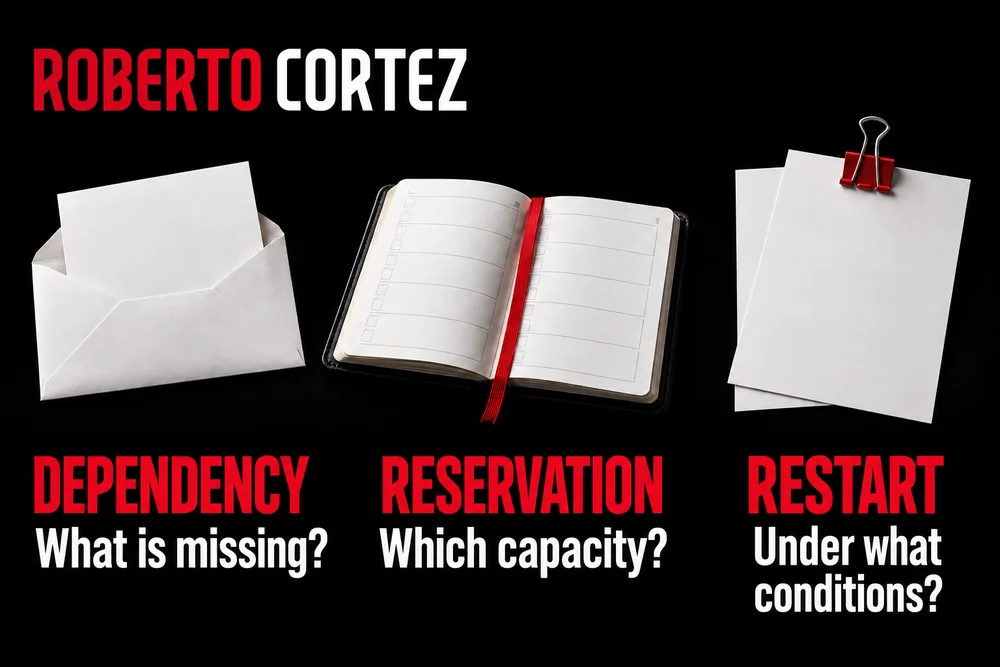
Decide how to use the window based on what was agreed
Before moving work or taking on new commitments, confirm the reservation's conditions and who can decide to change it. Assess alternatives that respect the agreement and communicate their effect on the plan. Waiting may justify reviewing capacity use, but it does not automatically create a priority rule, an additional charge or future availability that was never agreed.
In the example, the team may have agreed on a window conditional on receiving approved copy. If that condition is not met, the next step is to apply or clarify the planned rescheduling process. When the agreement is insufficiently clear, the solution needs discussion instead of being invented afterwards as though it had been accepted from the start.
Within the operation, distinguish work that can occupy part of the window from work that creates a longer obligation. A bounded, independent task may fit the expected restart. A new project with an accepted deadline may consume the same skill for longer and make the previous commitment impossible under the conditions the client still expects.
The decision should consider every affected project. Do not resolve an external wait by silently delaying another client. The team coordinator needs to see the impact on delivery, reviews and preparation to decide from a perspective broader than the empty calendar block that appeared at that particular moment.
Keep the waiting project visible even when active production moves elsewhere. The commitment does not disappear because it no longer occupies this week's schedule. Record who monitors the dependency and when it will be reviewed, so using the capacity does not turn into forgetting the original project and its remaining responsibilities.
Also avoid promising an indefinite reservation without understanding how it will be sustained. If the process requires a decision about continuation, bring it to the client with sufficient information. Clarity about what remains reserved and what needs fresh confirmation protects the relationship from differing interpretations of the same pause.
If commercial consequences need discussion, treat them as a specific decision grounded in what was actually agreed. Do not use the situation to improvise penalties or new conditions. Operational work means explaining dependencies, options and capacity; any change to the commitment needs to be recognised by the parties involved before it is treated as the new basis for planning.
Verify readiness before confirming the restart
When the response arrives, confirm that it resolves the dependency and that the material is complete for the next stage. Then check the necessary capacity and agree on resumption with a clear date or condition. Receipt, validation and restart are separate moments; combining them into an immediate reaction can return the project to execution while its original missing conditions remain.
In the example, the client may send copy that still awaits internal approval. The file arrived, but the decisive dependency remains open. The team should acknowledge receipt, identify the material's status and explain what still needs confirmation before treating the content as a final basis for implementation.
Also establish whether anything changed during the wait. The offer, message or a structural decision may have shifted. Those differences need to be understood before the earlier work resumes, avoiding continued implementation of something that no longer matches what the client intends to approve or use.
Review the people needed throughout the sequence. An implementation window is insufficient if review and delivery cannot follow. The restart date should reflect that path and existing commitments rather than assume every stage automatically returns to the configuration it had before the pause began.
If preparation exists, check what remains usable. Some assets may still be correct; others may need updates because of changes confirmed in the meantime. That review distinguishes restart effort from new work and helps explain what the team must do to recover the context accurately before execution continues.
Confirmation should make the next milestone and each party's responsibility clear. Avoid vague messages such as “we will pick this up” when the person needs to know what happens next. Concrete information about preparation, execution and validation supports continuity without turning every day into another negotiation about the project's priority.
If the same project repeatedly alternates between execution and waiting, investigate the cause before treating every return as an isolated case. An available approver, a definition of complete content or a postponed decision may be missing. The solution may require reviewing the work sequence instead of merely finding another slot in the team's schedule each time.
Apply the learning to future projects
Review what made the wait difficult and turn that learning into clearer preparation for future work. Define dependencies, contacts and readiness conditions based on what the operation can fulfil. The aim is to reduce ambiguity and improve coordination without turning one episode into a rigid rule that ignores differences between clients, deliverables and ways of working together.
If the blockage began with an unclear request for materials, improve that request's format. State what is needed, who approves it and which stage will use it. An example can help, provided it does not suggest that every project requires exactly the same content or sequence regardless of its actual purpose.
If the difficulty was deciding who could release or alter a reservation, clarify that responsibility internally. The team should not depend on individual interpretations whenever a client takes time to respond. Nor does every small decision need to reach the founder when sufficient criteria allow a responsible person to manage the case.
That organisation relates to removing repeated decisions from the business owner's agenda. Define what the team can decide, which information it should collect and when escalation is needed. The criteria should help fulfil commitments without turning autonomy into permission to change conditions on an individual's initiative.
Observe whether waits cluster around one stage or material type. That may reveal a need for earlier preparation or different client participation. Do not assume every delay has the same cause; compare situations with context to choose an improvement that addresses the problem appearing consistently across the cases you have actually reviewed.
To integrate these decisions into operations, read the guide to delegation and processes for small teams. A well-managed wait keeps the dependency, capacity and next step visible. The team can then explain what is stopped, what can advance and the conditions for returning to work responsibly, using a plan both sides can understand and follow.