
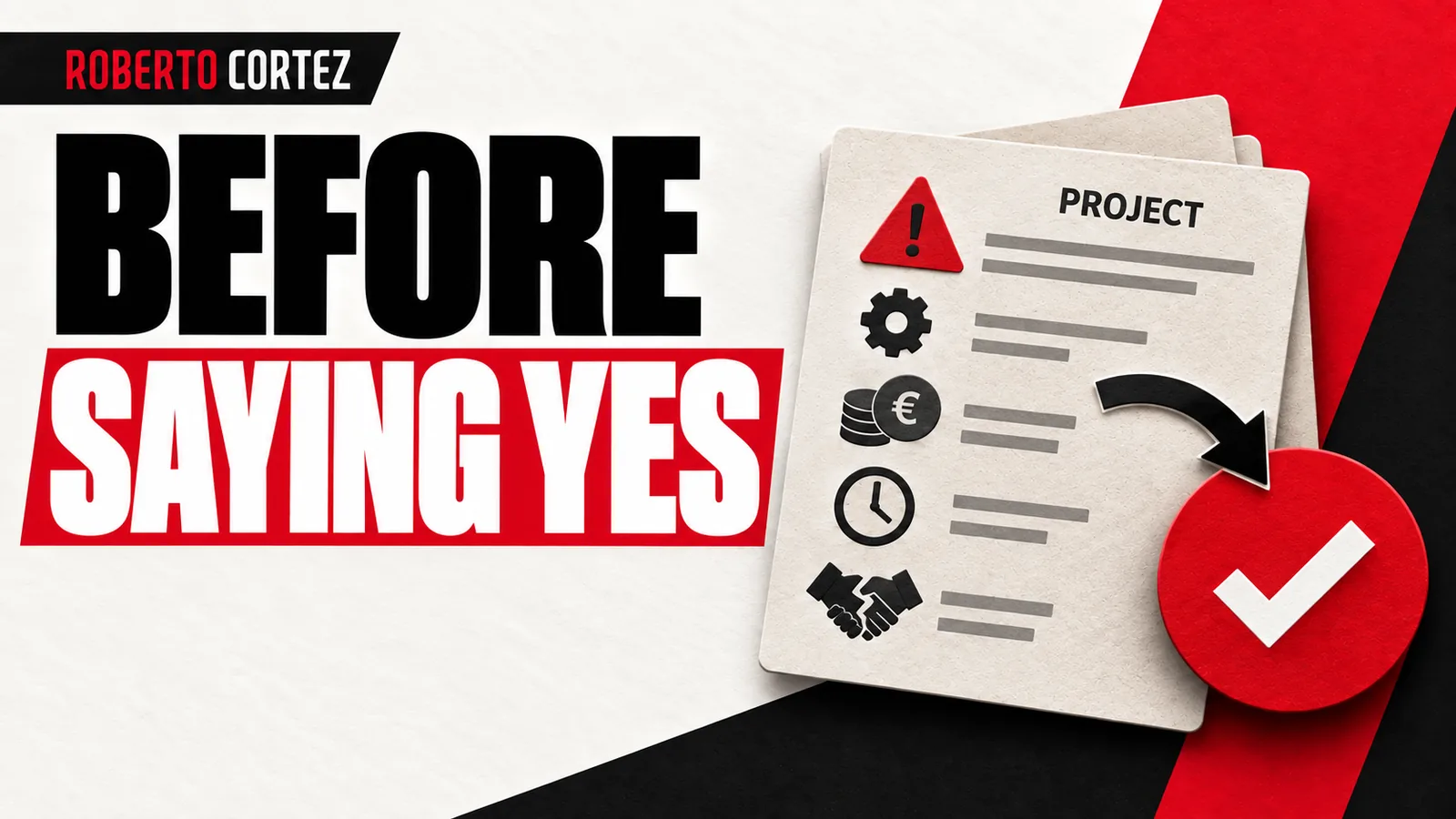
Why risk belongs in the price before I accept
When a client's business is immature, the risk of things going wrong is higher, and that has to show up in the price, not in a discount. When I work with a much more early-stage project, I charge more, precisely because the risk of that business is higher, not lower.
The opposite logic, lowering the price because the client is just starting out, creates an endless loop: you underprice hoping the business succeeds and then charge properly, but that rarely happens consistently. If my calendar is full of fragile clients, my revenue will always be unstable, up one month, down the next, because the whole base is uncertain.
The criterion is not about liking the client or wanting to help someone who is just starting. It is simple: if the risk is higher, the price has to compensate for that risk, or it is not worth taking the project.
Upfront work and the assets that stay with the client
A project with nothing built forces me to construct landing pages, set up pixels, review conversions and configure tag managers before I can even start managing campaigns, and that has to be charged separately. It is not routine maintenance, it is asset production that stays permanently with the company.
A direct example: some campaigns I built years ago still generate revenue for companies I no longer work with. That is value I created that keeps existing after I leave. If the company has nothing set up, I have to build everything from scratch, and that has to be paid for.
When the company already has a consolidated base, the initial effort drops and there is more room to negotiate price. That difference, between building from zero and simply managing what already exists, should weigh heavily in the proposal.
Who approves what when onboarding a marketing client?
How to Test an Automation Before Handing It to Your Team
Growing an online business: what I learned about margin, team, and AI
To design execution and handle exceptions, explore the business process automation guide.
Expected recurrence: clients for years, not months
The goal is to close clients for years, not for two or three months, because those long-term clients are what sustains a stable team. I am direct about this: I do not want clients for two or three months, because those are exactly the ones that make revenue unstable, rising and falling without predictability.
When there is a consolidated history, a validated product and a signed contract for six or twelve months, there is real expected recurrence. In those cases there is more room to be flexible on price, because the return comes over time, not all at once. It is the client's lifetime value that justifies a more adjusted initial price.
If, on the other hand, there is a high risk of the client leaving right after all the setup work is done, that should raise the proposed price. This is not pessimism, it is recognizing that heavy upfront work only makes sense if there is some security it will keep paying off.

Founder maturity and the cost of teaching the basics
How founders or partners communicate and handle digital tools determines how much extra work I will have just to move things forward. I have found myself in front of someone who did not know how to log into Gmail, and in those cases someone has to pay that digitalization bill, that education bill.
When I feel I speak the same language as the business owner, that there is an exchange of knowledge and that I will grow with that project, it becomes natural to want to work with them. When it is the opposite, when I need calls just to explain the basics, that consumes time that should go into technical execution, and that time has a cost.
This is not about judging someone who is starting out. It is about recognizing that teaching the basics is work, and that work cannot be hidden inside a normal flat retainer.
The weight of portfolio in the decision
Some projects matter less for immediate money and more for the brand name they add to my portfolio. There are businesses I want to work with, even without the fairest price in the world, because they are large companies that later carry weight when I negotiate with others.
Other projects exist purely for the money, and in that case the money has to be genuinely worth it, because there is nothing else to gain from them. Before deciding on a price, it is worth asking what role this project plays: is it for my résumé, for my cash flow, or for both.
That distinction stops me from applying the same criteria to everything and helps justify, to myself, why sometimes it is worth lowering the price and other times it is not.
Warning signs that lead to a decline or a higher price
Certain behaviors during the first conversation say more about the project than any business presentation. One of them is a client placing too much expectation on marketing or ad work to save the business. If the client has their back against the wall and is putting everything into this strategy to save the company, that is not my problem.
Another sign is toxicity in communication, an authority-driven posture where the client assumes they command and I just execute. I am clear about this: no client's money justifies anxiety inside the team. When these signs appear, the proposed price goes up, and often that higher proposal creates more friction and simply is not accepted, which is fine.
This is not about refusing out of stubbornness. It is about recognizing that some behavioral risks cost more than any retainer can compensate for.
Accept, adjust, or decline: how I decide
After looking at the business risk, the required upfront work, founder maturity, portfolio value and warning signs, there are three possible paths. I accept when the project already has history, a validated product and partners I speak the same language with; in those cases there is room to be more flexible on price because recurrence is more likely.
I raise the price when the business is immature, requires heavy initial setup work, or the partners need constant support with the basics; here the price has to cover that risk and that extra effort, not hide it.
I decline, or let the price rise to a point where the proposal will likely not be accepted, when I find clear signs of toxicity or the expectation that my work alone will rescue a struggling business. Working for a minority does not mean accepting any client that shows up, it means choosing the right clients for the time and energy I have available, something that also applies to anyone building a business in this online business and sales space.
Source note
This reflection comes from the class I gave on Sextas Ímpares #92, on how to price freelance work without undervaluing it. You can watch the full class here: https://www.youtube.com/watch?v=op8b_Q-8P_g.