

A backlog alone does not tell you how to resolve it. You might have a one-off implementation blocked by missing knowledge, a daily operation whose volume exceeds available capacity, or delayed decisions that prevent anyone from moving forward. The same feeling of overload can come from very different situations within a business.
I will use a fictional example: a service company wants to organise its contacts in a CRM and improve how it follows up commercial enquiries. Data is scattered, information is duplicated and each person records statuses differently. Meanwhile, new enquiries keep arriving and need a response from someone in the business.
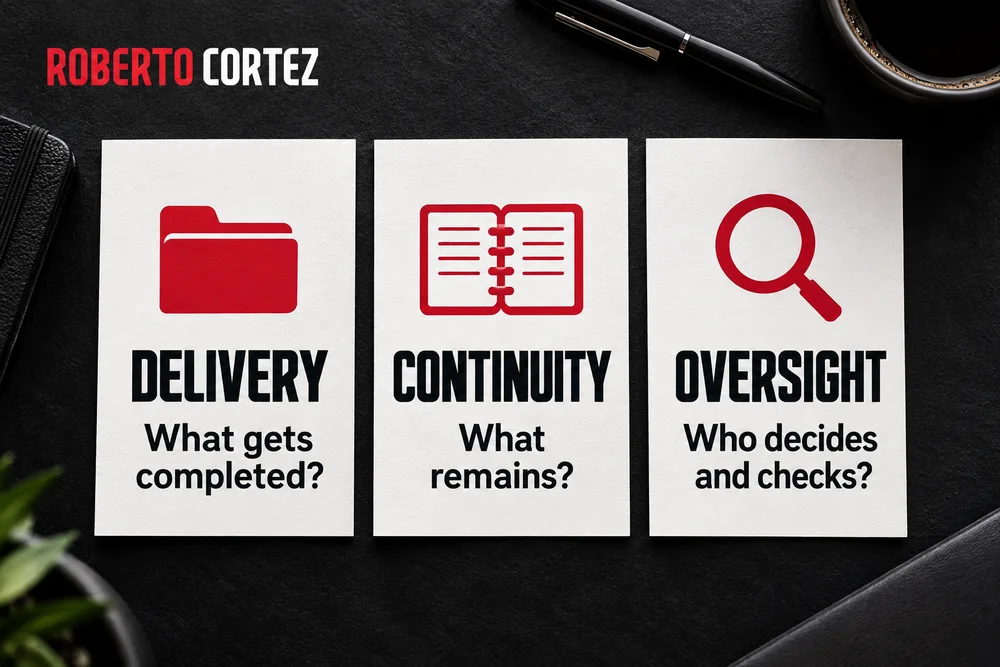
Configuring the tool, preparing the data and checking the import could form a specialist project. Following up enquiries every day and deciding the next step for each opportunity is a responsibility that remains. Combining everything into one vague description makes it harder to identify the support you need to hire and what will still remain unresolved.
Separate work that ends from responsibility that continues
Describe what will be complete at the end of the project and what will keep happening afterwards. An implementation can finish while the operation using its result continues. This distinction lets you seek specialist expertise for a defined delivery and assess separately who will handle the routine work your business needs to maintain over time.
In the CRM example, the project's completion might include an approved structure, imported data and completed checks. From that point onwards, someone still records contacts, updates statuses and follows up responses. Having a configured tool does not demonstrate that there is capacity to perform this work every day within the team.
Write two descriptions before comparing alternatives. The first explains the change you want to achieve: your starting situation and what should exist at the end. The second describes how things will operate afterwards, including frequency, approximate volume and the decisions needed to keep the result useful for the business.
Avoid defining completion solely through an activity performed by the provider. “Install the CRM” could be technically complete while the team still fails to understand the statuses or find an enquiry. A delivery needs to match what was agreed and be verifiable by the people who receive it and will use it.
The reverse can also happen: a need looks temporary because nobody has organised it as a responsibility. If someone must correct data, produce new integrations and resolve process failures every month, there may be recurring work that needs an ongoing solution. That should appear in the assessment even if you begin with a limited intervention.
This distinction does not force you to choose one solution for everything. You can bring in a specialist to prepare the change and assign the operation to a team member who has the conditions to take it on. The important point is to check that person's existing workload before treating their availability as guaranteed.
Also ask what will stop being necessary once the delivery is complete. If the answer is “nothing, we will need exactly the same support”, revisit how you defined the project. External support may still make sense, but the need should be described as ongoing, with expectations that match that continuity of work.
Establish whether you lack expertise or available capacity
Missing expertise and a team without time require different assessments, even when both delay work. Identify what nobody knows how to do and what people can do but cannot fit into their schedules. Then establish whether the specialist need is occasional or will become a regular part of the activity you intend to develop.
Importing data between systems may require knowledge the team does not yet have. Responding to commercial enquiries may primarily require capacity, information and clear responsibility. Hiring someone with extensive integration experience does not automatically create availability to follow up every sales conversation that enters the business throughout the working day.
Look for concrete examples of blocked work. If the responsible person can explain the steps and criteria but has other tasks incompatible with the incoming volume, capacity is an issue. If nobody can assess the options or recognise good execution, you also need expertise to prepare the work and verify the delivery.
Some knowledge is worth developing internally because it will be used repeatedly and influences the business's main activity. Some specialist skills are needed for a particular change without, by themselves, justifying an ongoing role. The choice depends on expected use and real learning conditions, rather than simply on how interesting the tool seems.
In the fictional project, you might want the team to learn how to manage fields and retrieve information without expecting it to master every technical detail of an import. Define the level of independence needed after delivery. This guides what you should request from the specialist and what the team needs to learn during the work.
Before concluding that you have spare capacity, check how apparently available hours are being used. Thinking through what to do with the time AI has freed up in the team helps distinguish an observed reduction in effort from an expectation that has yet to be demonstrated. Apply the same care when counting on a new tool to compensate for additional work.
The outcome should be an understandable need: we require this expertise to complete this change, or we need ongoing capacity to fulfil this responsibility. Both can exist together. Separating them lets you assess external support and the internal team without requiring one person to solve problems that have different causes and requirements.
Define a delivery the team can accept
A specialist project needs a verifiable delivery, the conditions to produce it and someone able to confirm that it matches the request. Define scope, acceptance criteria and exclusions before comparing proposals. If you cannot yet describe the result, you may need an initial diagnostic stage with its own boundaries agreed before the main work begins.
For the CRM, “have everything organised” permits very different interpretations. It is more useful to identify what information goes in, how it will be treated, which records require confirmation and what will be available to consult. Criteria should describe the expected result without requiring the owner to pretend to have technical knowledge they do not possess.
The specialist can help translate the need into options and criteria. That does not remove the company's responsibility to explain its sales process and decide what each status means. The implementer can propose a structure, but should not have to guess which conditions move an enquiry from one stage to another within that process.
If the data has not yet been examined, make that uncertainty explicit. An initial assessment may reveal problems that change the work required. In that case, first define the diagnostic stage and the point when the next decision will be made, instead of presenting an early estimate as though the scope were already fully understood.
Also record exclusions relevant to subsequent use. Preparing the structure and importing information, for example, does not mean taking over sales follow-up, writing every message or correcting any data created in the future. Exclusions help prevent expectations that would otherwise only emerge when the team asks the specialist for additional support after delivery.
Acceptance criteria need an owner and a method of verification. It may be necessary to compare records, test a representative path and confirm that the team can locate the information it needs. You do not have to follow every execution detail to know what you will inspect before accepting the completed work.
Finally, agree how discoveries that change the request will be handled. A connection that does not actually exist, or a dataset with significant problems, may require a different decision. Defining that decision point lets you assess a change before accumulating work that nobody has clearly agreed to take on as part of the project.
Compare the full effort required by each alternative
Compare alternatives through the work they need to provide, including preparation, execution, oversight and subsequent use. A quoted fee and the cost of an internal person do not necessarily represent the same scope. Make those differences visible before deciding, particularly when one option relies on additional work that the team will still have to perform.
A specialist proposal may include implementation while leaving data preparation to the company. Another might include support with that preparation but provide less follow-up after delivery. Without identifying these differences, you could choose the lower price and later discover that the team lacked capacity for the part it was expected to provide.
For the internal alternative, consider who will learn to do the work, who will support that learning and which tasks must be removed or postponed. Expertise does not appear simply because a role has been given a new name. The time needed to execute the work well is part of the operational decision.
If you are considering expanding the team, examine the work that will exist after implementation. A temporary need can justify specialist support without providing suitable ongoing work for a permanent role. Conversely, a daily responsibility with sustained volume can continue to require capacity even after every system has been set up and is ready for use.
Connect this assessment with margin, team capacity and business growth. Expanding the organisation or buying more support does not, by itself, demonstrate an improvement in the business. You need to understand the contribution you want and the conditions that make the work sustainable, using real information from your own operation.
Do not turn sales forecasts into a guaranteed ability to pay. If the decision depends on work that has not yet been confirmed, identify that dependency and examine what happens if it takes longer to arrive. The comparison becomes more useful when it shows assumptions that could change the choice rather than hiding uncertainty inside a single figure.
Include the cost of continuing to wait, described through observable consequences. There may be manual tasks, delays or an opportunity you cannot execute. Avoid assigning hypothetical revenue to these problems as though it were a demonstrated loss; use the information you have to understand the priority and the conditions needed before moving forward.
Reserve internal time for decisions and oversight
Bringing in a specialist does not remove the need for context, decisions and verification inside the company. Identify who will answer questions, provide information and accept the delivery, reserving time for those responsibilities. Execution can be external while the project still depends on internal choices that must happen for the work to progress well.
In the CRM example, someone has to explain how enquiries arrive, which information is essential and who decides on a process change. If those answers are spread across several people without coordination, the specialist may receive contradictory instructions. Execution then waits for a decision the company has not yet prepared to make.
Choose someone who can follow the work or bring together the necessary decision makers. That does not mean concentrating every approval in their hands. It means making clear where a question goes, who has authority over each choice and how an answer is recorded so it is not debated again the following week.
Defining who approves what in an automation project with an external team helps organise these boundaries. Details depend on the project, but the question remains: which decisions can be made during execution and which require company confirmation? Both parties need to understand that answer before relying on it to move the work forward.
Reserve review points connected to actual progress. It makes sense to confirm a structure before importing all the data and observe a representative path before considering it complete. These checks let you correct assumptions while the change remains manageable, without turning oversight into a permanent requirement to approve every small step of execution.
If the founder is the only person who can answer and is already unavailable, that condition needs to enter the plan. Hiring execution support does not create time in the decision maker's schedule. You can prepare decisions before starting, assign some to another person or adjust the sequence to avoid accumulating blocked work that cannot advance.
Include this internal involvement when discussing proposals. A provider who needs weekly information and one who needs daily decisions place different demands on the team. Your choice should match the oversight you can actually provide, as well as the technical expertise you want to obtain for the project you have defined.
Prepare the handover before the specialist leaves
Delivery should leave the company able to use the result within the agreed level of independence, with accessible information and a way to request help when needed. Define the handover during the project, including documentation, demonstration and subsequent responsibilities. Waiting until the end increases the chance of receiving completed work that nobody knows how to keep operating.
In the fictional CRM, the team needs to understand how to record an enquiry, correct information and interpret statuses. It also needs to know which changes it can make and which require specialist expertise. A provider demonstrating the system does not prove that the person who will use it can perform the workflow without help.
Prepare an observed execution using a representative case and data suitable for the exercise. Ask the responsible person to explain what they are doing, locate the information and identify a situation that would make them stop. Questions that emerge help improve the handover before the planned period of support comes to an end.
Documentation should reflect the delivered configuration and live in a location the company knows. Include relevant decisions, required materials and the authorised way to obtain access. A collection of notes scattered across messages can make continuity difficult even when all the technical work has been completed in line with the agreed requirements.
Confirm who will keep instructions current when the process changes. If the team changes fields or statuses, the initial document may cease to match the system. Responsibility for continuity needs to exist, even if future specialist interventions will again be commissioned separately when the business needs knowledge it does not maintain internally.
Also clarify the difference between correcting a delivery that fails to meet the agreement and requesting a new improvement. Both may require contact with the specialist, but they should not be combined into a vague expectation of permanent availability. What was agreed about subsequent support should be understood before the team becomes dependent on it.
The final test is concrete: can the company perform the usual work, recognise an exception and know whom to ask for help? If it can only repeat a demonstration without understanding the limits, the handover still needs attention. That observation is more useful than accepting a documentation folder based on the number of files it contains.
Revisit the choice when the need becomes recurring
Revisit the initial choice when the frequency, volume or importance of the work changes. Observe whether there are still discrete deliveries or whether the company now depends regularly on the same expertise. That evolution may justify a different support arrangement, internal learning or additional capacity, without making the earlier decision wrong for its original circumstances.
After implementation, follow the types of requests that return to the specialist. Some questions may arise from an incomplete handover. Others may represent legitimate new needs because the business is using the system in more demanding ways. Identifying the cause prevents a premature conclusion that you need to hire or that the project was poorly executed.
If the work repeats, organise examples and observe how much it depends on company-specific context. A frequent need linked to daily decisions and learning accumulated in operations may benefit from internal capacity. Even so, that conclusion requires checking the volume, skills and conditions needed to integrate the responsibility into the team successfully.
Ongoing specialist support with defined scope and availability may also make sense. The alternatives are not limited to an isolated project or immediately expanding the permanent team. The criterion is whether you can provide the necessary work with continuity, quality and responsibilities understood by everyone involved in delivering and using the result.
To structure that transfer, use the guide to delegation and processes for small teams. Starting with the result that must continue to be provided, you can define information, independence and oversight. If you need to work through this decision with me, the guide leads to the internal individual mentoring form, with room to explain your business situation.
I would begin by writing a provisional decision, its reason and the condition for reviewing it: we are seeking this expertise to complete this delivery, retaining this responsibility within the team and reassessing if this type of work becomes recurring. The sentence forces you to connect the chosen support with a concrete need. It also lets you change the decision when new information appears, without turning the first choice into a commitment that no longer serves the operation.