
Some proposals seem to make sense from the first conversation. The partner reaches relevant customers, the offer fits what the company knows how to do, and there is enthusiasm to proceed. That enthusiasm starts taking up space before anyone asks who will prepare, deliver and support the work the opportunity requires from the business.
I try to connect the time and energy I devote to an opportunity with my objectives. That includes what I stop doing with my team and on my own projects. A proposal's appeal needs to justify that shift, including when the expected value may emerge later and still depends on conditions that have yet to be confirmed.
Imagine a fictional services company invited by a partner to offer a new form of ongoing support. The company is finishing a change to its delivery process, and the same people would be needed on both fronts. The opportunity may be attractive; the decision is to understand under which conditions it can enter without compromising work already underway.

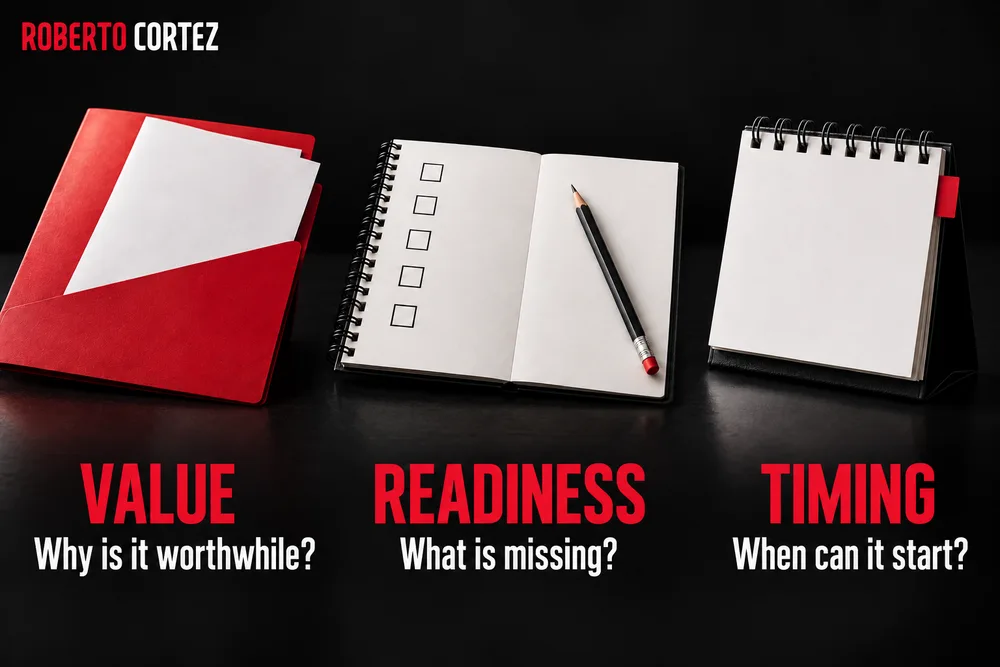
Separate the opportunity's value from the conditions for starting
Describe why the opportunity is attractive and, separately, what the company needs to prepare before proceeding. Suitability for the business does not demonstrate immediate availability. This distinction lets you recognise a useful proposal while assessing its timing, avoiding an enthusiastic acceptance or permanently rejecting something that could work once a specific condition for execution has been resolved.
In the fictional company, the partner may reach buyers looking for exactly that kind of support. This gives the business a reason to study the proposal, but does not confirm that the format is ready. It needs to understand what will be sold, how information about each customer will arrive, and who can deliver the experience both parties intend to present.
Explain the expected value concretely enough to assess it. Access to a recognised need, learning about a segment and contributing to an existing offer are different hypotheses. An expression such as “it could open many doors” does not yet let you compare the required work with what the company intends to achieve by accepting the opportunity at that moment.
Distinguish what you already know from what you expect to discover. A partner may express interest without confirmed demand among end customers. That does not prevent exploration, but changes the size of commitment that makes sense. A commercial expectation should remain identified as an expectation until there is enough evidence to describe it in a different way.
Starting also has its own requirements: a defined offer, available people, information, preparation and coordination. Some can be resolved quickly; others depend on work that has not begun. Placing these conditions alongside the expected value helps you discuss timing without devaluing the proposal or pretending that its quality automatically resolves a lack of capacity to carry it out.
Strategic planning for a small business should help with this conversation. The question is which objective justifies making room for the opportunity and which route enables its execution. If the answer describes only potential, the part that turns interest into a decision the team can fulfil is still missing from the discussion.
Confirm where the response deadline comes from
Ask what event makes a response necessary now and what changes if work starts later. Distinguish a genuine external window from a preference or a date that remains negotiable. Knowing the difference helps assess the cost of waiting and explore alternatives, without treating every expression of pressure in a conversation as an unavoidable condition imposed on the business.
The fictional company's partner may be preparing communication for a fixed date. In that case, establish whether it needs a commercial decision, materials or the service to be available already. These are different requirements, with different preparation consequences; assuming that all must happen simultaneously may make the opportunity harder to accommodate than it actually needs to be.
Ask for enough context to understand the restriction. There may be an event, a catalogue change or a commitment to another party. The explanation does not oblige the company to accept, but enables comparison using concrete information. “It has to happen now” leaves too many questions unanswered to support a decision that displaces work for several people.
Check what happens without a positive response too. Does the opportunity disappear, move to another company or potentially return on another occasion? Avoid assuming there will always be an identical opportunity, but also avoid treating the first date mentioned as the end of every possibility. Confirm what can be confirmed and record what remains uncertain in the conversation.
A response date does not have to mean a start date. It may be possible to communicate conditional interest, propose another schedule or explain that the company can only assess the proposal after receiving missing information. That response needs real substance, without giving the partner the impression that a commitment exists while you are still studying the conditions.
When the window is genuinely incompatible with the necessary preparation, recognise the limitation. Accepting an impossible deadline does not make the company more available. The decision may be to decline that configuration, retaining a clear explanation of what was missing and avoiding promises that the same agreement will remain available when the calendar permits another conversation.
Identify the work that would be displaced
Assess the opportunity with the people who would execute it and identify which work would lose time, attention or priority. Include preparation, coordination and follow-up alongside visible delivery. The required capacity needs a concrete source, so acceptance does not depend solely on expecting the team to absorb another commitment without making any changes to its existing workload.
In the fictional company, the person able to prepare the new support format is also completing the current process change. The analysis should show what would stop happening if that person began working with the partner. An alternative sequence may exist, but needs designing before announcing the new initiative as though it would have no consequences for existing work.
Look at existing commitments through what they demand, as well as the number of tasks. A brief review may require concentration and knowledge that few people possess. A larger delivery may be organised within a predictable routine. The apparent size of the work does not explain, on its own, how much room exists to add another responsibility for the same person.
Include the opportunity's less visible work. Preparing information handovers, answering the partner's questions, reviewing materials and following the first cases may require more attention than the initial presentation suggests. You do not need to know everything precisely, but should prevent the plan from counting only the part that is easy to describe in a commercial conversation.
Considering growth, margins and team capacity helps connect volume with delivery conditions. An additional request can contribute to the business while competing for resources needed elsewhere. The decision should acknowledge that competition, showing what changes and who remains responsible for maintaining the commitments that the company has already made to its existing customers.
Ask the team where uncertainty remains, instead of requesting only confirmation that it can deliver. An affirmative response can conceal assumptions about other people's availability or materials still to arrive. Making those assumptions visible lets you revise the proposal before the commitment begins to depend on effort that nobody ever properly discussed or agreed to provide.
Make the readiness condition observable
Define what must be resolved before the opportunity can begin and how you will recognise that condition. Avoid using “when there is more time” as the sole postponement criterion. An observable condition lets you prepare the start, revisit the decision with new information and explain to the partner the difference between real interest and a promise without an executable path.
In the fictional company, the condition might be having the current process usable by the team and the new support format described with clear limits. That is more concrete than waiting for operations to become quiet. The business can then check whether the necessary work is complete and which dependencies still prevent it from taking on the new delivery.
Choose conditions connected to execution without demanding perfection everywhere. It may be unnecessary to rewrite all internal documentation before trying a small format. What matters is identifying the minimum needed to fulfil what will be promised, including decisions that cannot remain unresolved after the customer has accepted the offer and begun expecting the agreed work to happen.
Assign responsibility for resolving each relevant condition. If the commercial format needs defining, identify who must decide and what information they should receive. If capacity is missing, clarify where it could come from and what needs to change to make it available. Postponement becomes useful when there is a link between what is missing and work that can resolve that gap.
Distinguish a condition controlled by the company from one dependent on the partner. Internal preparation may proceed while external confirmation is pending, but this does not require unlimited investment. Define how far preparation makes sense and what should stop if necessary information or commitment does not arrive under the conditions discussed between the parties involved.
Record a review point connected to actual work. The review might happen when a proposed format exists, when the team finishes the relevant preparation or on a date that allows the next step to be decided. The purpose is to return to the opportunity with different information, rather than repeat the conversation and postpone again because nothing has changed.
Negotiate how to begin before making the full commitment
Find out whether the opportunity allows a different scope, sequence or starting point while preserving usefulness for both parties. A limited start can reduce uncertainty when it enables relevant learning with controlled capacity. It makes sense only if the format remains viable and everyone understands what was accepted, what is excluded and what requires a new decision.
In the fictional company, it may be possible to prepare a restricted format before offering the full support originally envisaged. That option should address a concrete need for the partner and buyers. Reducing the scope solely to fit the schedule, while removing what made the offer useful, would produce a smaller commitment that remained just as difficult to justify.
Another possibility is to separate preparation from the start of delivery. The company could participate in a definition conversation now and propose a later delivery date. Clarify what work that initial stage includes, because an exploratory meeting can begin generating materials, requests and expectations that turn exploration into an informal project without anyone making an explicit decision to proceed.
If you propose a test, define the question it should answer. You may need to understand the handover between partner and team or check whether the format suits the stated need. The test needs work limits and a review, without being presented as a guarantee of continuation or advance proof of commercial results that remain unknown to the business.
Also check the preparation required for the reduced format. Some deliveries involve initial work that changes little when the number of cases falls. A small test may therefore still occupy the person whose availability created the initial concern; the assessment should recognise that cost instead of automatically treating “pilot” as another way of saying “little effort”.
Negotiation does not guarantee an acceptable configuration exists. The partner may need something the company cannot provide during that period. In that situation, the useful conclusion may be to decline, keeping the reasons clear and avoiding a version that neither party considers suitable merely to preserve the feeling that the opportunity has somehow been taken.
Compare what you know with what you are still assuming
Before deciding, separate observed demand, confirmed conditions and expected results. Consider the resources needed before benefits appear and the effect of a slower market response. Assess the opportunity with uncertainty visible, so a favourable forecast does not replace the preparation the company needs to complete before it can responsibly fulfil the commitment it is considering taking on.
In the fictional company, the partner may present interested customers without being able to confirm how many will buy. That information has value, but does not equal realised revenue. The decision should consider preparation required even if demand takes time to materialise, without converting an expectation into certainty to justify an immediate start on the work.
Use a consistent comparison between alternatives. Accepting now, preparing for later and declining have different consequences for operations and the partner relationship. Describe those consequences with the same level of scrutiny, avoiding assigning all the benefits to your preferred option while concentrating only on the problems associated with the other choices available to the company.
The risk involved in accepting a services project also includes understanding the initial work and the relationship's conditions. Add the timing of those resource requirements to this assessment. A proposal can offer attractive commercial terms and still arrive when the company cannot complete the preparation without compromising something it has already committed to delivering elsewhere.
Identify the uncertainty that most changes the choice. It might involve a person's availability, the definition of the offer or the possibility of moving the start date. Seeking an answer to that question is usually more useful than gathering broad information that makes a document longer without changing the decision that you actually need to make.
Accept that some uncertainty may remain. The purpose is to choose using clear criteria and conditions proportionate to what you know, rather than predict every event. If missing information is essential to taking responsibility, make the decision conditional or decline; if limited preparation can resolve it, define that step and the boundary beyond which it should not continue.
Respond consistently with the decision you made
Communicate whether the company accepts, proposes a different configuration, requires a prior condition or declines the opportunity. Explain the next step and who is responsible, without confusing interest with commitment. A clear response lets the partner organise its work and prevents the team from beginning to execute a proposal that has not actually been agreed between the parties.
If you accept, confirm the scope and conditions supporting the decision. The team needs the same information communicated to the partner, including limits and dependencies. If the commercial conversation promises a broader start than operations assessed, the decision no longer corresponds to the scenario that justified taking on the commitment in the first place.
If you propose a different start, present the difference concretely. It might mean a later beginning or a limited format reviewed before continuation. Avoid a vague response that leads the partner to reserve capacity without knowing what is confirmed, because that transfers uncertainty within your company into another person's planning without giving them a clear basis for their decisions.
If a prior condition is needed, identify it and explain how it will be monitored. Conditional interest should not appear in internal documents as work already sold or delivery already agreed. Whoever manages the relationship needs to distinguish an opportunity under evaluation from an accepted decision, so an overly optimistic interpretation does not create unnecessary operational pressure.
If you decline, you do not need to invent a flaw in the opportunity to justify the choice. You can recognise its suitability and explain that the conditions for execution do not exist at that moment. Keep the response proportionate, avoiding promises of future availability you cannot confirm and leaving no preparation requests open after deciding not to proceed.
Revisit the opportunity when something relevant changes
If the opportunity was postponed, review it when the condition supporting that decision changes or new information alters the comparison. Confirm both parties' interest and the execution context again. Internal readiness does not guarantee the proposal remains available or equally valuable, so returning to it requires a current assessment and a renewed understanding between everyone involved in the work.
In the fictional company, completing the process change may release capacity, but the partner may meanwhile have selected another solution. That possibility is part of postponing. The review should recognise what happened, instead of treating preparation work as an entitlement to an opportunity that the parties never actually agreed they would carry out together.
If interest remains, confirm scope, availability and starting conditions. Do not automatically reuse assumptions from the previous conversation, especially when the offer or team has changed. Older information helps recall the reasoning, but the decision needs to match the context in which delivery will actually happen and the people who will be responsible for executing it.
Keep the decision's reason and what you learned. The cost of repeating the same decisions also appears when every invitation reopens a discussion without memory. A brief record helps recognise useful patterns, such as recurring readiness conditions or commitments that should be clarified earlier when discussing future opportunities with potential partners.
I want to recognise an attractive opportunity without feeling obliged to accept it immediately. The proposal's value, the company's timing and the conditions for execution need to fit within the same decision. Accepting, negotiating or declining becomes clearer when I can explain what will happen to existing work and why that particular start makes sense now.