

Why automation follows rules, not AI opinion
In a recent class, I explained that the tool I use to optimize Ad Summit campaigns has "no brain behind it deciding." It's an automation: if return sits within certain parameters, it raises or lowers the budget; if not, it does nothing. There's no call to a language model on every run.
It doesn't matter here whether artificial intelligence thinks a campaign is doing well or badly. That call belongs to whoever sets the strategy, deciding what counts as inside or outside the objective. The automation only applies that decision, hour by hour, without interpreting anything.
This connects to a broader view of the media buyer's role that I discussed in the same class: less operational over time, more responsible for defining business economics, the campaign objective, and the limits within which the machine may act. The tool speeds up reading the data. The judgment about what's acceptable stays on the human side.
The minimum spend before any cut
A common mistake is letting a system pause an ad set after only a few euros spent, when the result isn't reliable enough yet. In the matrix I built for Ad Summit, I set that no ad set could be paused for ROI below 0.8 without first having spent more than 60 €.
Until that spend is reached, the cutoff rule simply doesn't apply. And until cumulative spend hits 50 €, there's still a floor: the daily budget for any ad set cannot drop below 5 €, even if the matrix points to a lower value. Those specific figures served that particular campaign; the underlying logic is that you need a minimum sample before drawing conclusions, and a higher spend threshold doesn't prove anything by itself, it just makes the reading less fragile.
Without that floor, you risk killing creatives that just needed more impressions to start converting. Human judgment sets the acceptable cost of testing; the rule ensures that test runs to completion without premature interference.
What I expect from a media buyer in the AI era
How to plan an app with Claude Code before you start coding
To design execution and handle exceptions, explore the business process automation guide.
How much the budget can move in a day
An automation with no cap on variation can shift a daily budget drastically overnight just because it caught one isolated sale, and that usually destabilizes delivery on the ad platforms themselves. In the example shown in class, ad set number 65 went from 25 € to 15 € per day, a moderate decrease within the rule, not an abrupt cut to zero.
Give me the data, explain the rule, and show me where it failed: that's the kind of reasoning behind every adjustment. The matrix runs on a fixed schedule, hour by hour, and every change gets logged with the reason behind it. There's no free jump, no improvised decision made by the tool.
If you want to apply this logic to your own business, it's worth staggering increases in steps, rather than letting the automation raise everything at once. I would also start by setting an absolute daily cap for the whole account, so a data-reading glitch overnight doesn't multiply spend unchecked.
Alerts on every change, not silence
In the live demonstration, the system sends a periodic report straight to WhatsApp, showing account status and any changes made. At one checkpoint around 4pm, the alert showed the day's ROI at 0.56 and that spend up to that point had moved from 578 € to 583 €.
This kind of alert doesn't replace strategic judgment, but it avoids spending the whole day manually refreshing dashboards. I want to understand what changed and what I need to decide, not guess whether something went wrong because I hadn't looked at the dashboard in six hours.
If you're going to build something similar, a reasonable path is to keep a simple log of every automated change, with the time, the old value, the new value, and the metric that triggered it. That saves arguments later, with yourself or with a client, about why a budget moved.
The emergency switch
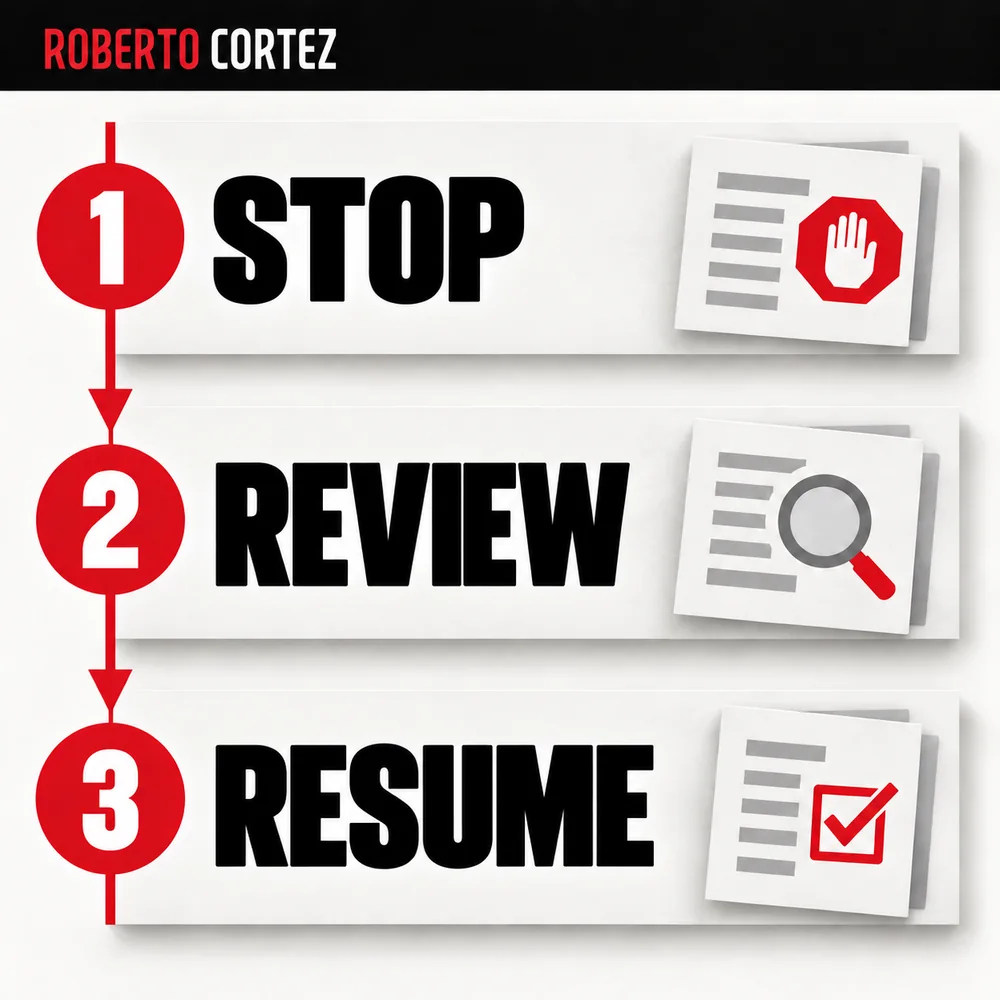
In the same class, while showing the live panel, I tried to turn off the automation via a visible switch and the system errored out because of a lost internet connection at that exact moment. The episode, accidental as it was, illustrates the point: you need to stop everything with one click, without erasing the rules already configured.
If the connection drops, if conversion data looks odd, or if you simply want to pause and reassess, the switch has to be reachable at all times. Campaigns keep running on their existing parameters; only new automated changes get suspended until you decide to resume.
I would start by testing that switch before trusting it in production, precisely so you don't discover it fails exactly when you need it.
What the matrix never decides for you
The automation can tell you whether a number sits inside or outside the expected range. It can't tell you whether the offer is misaligned with the ideal customer, whether a lead went cold for lack of a follow-up email, or whether the bottleneck sits in the offer itself rather than the ad.
That broader reading of the funnel still requires someone who knows the business from the inside.
In class, I also brought up the example of a 7 € course whose campaign cost around 22 to 23 thousand euros in ads and produced 50 thousand euros in course sales, a difference between revenue and ad spend, before other costs, of roughly 30 thousand euros over two or three years. On its own that doesn't look extraordinary. But those same customers, over time, generated more than half a million euros in further purchases. It illustrates how a cutoff rule based only on short-term return can eliminate campaigns that, viewed over time, are worth keeping. Choosing the right time horizon for analysis is another decision that always stays on the human side, never the automation's.
Source note
This article draws on the public class Sextas Ímpares #151, "O papel do gestor de tráfego na era da IA," available at https://www.youtube.com/watch?v=SYe0ebyVZ5c. A few useful points to see the matrix in action: around 35:40 I explain the ROI criterion and the 60 € minimum spend; around 39:00 I show the 5 €/day floor until 50 € is spent; around 41:00 the automated WhatsApp alert appears with the 4pm checkpoint. The specific figures belong to that campaign and that moment; the logic of setting limits before automating is what stays.