

In Live 151 of Sextas Ímpares, I showed the dashboard I use to manage Ad Summit campaigns. While recording, one of my ad sets, number 65, dropped from €25 to €15 per day. I explained why right there: I had built a rule matrix that runs hourly, without calling any language model at execution time. There's no LLM behind it, no brain built behind it deciding in that moment. It is plain automation, with fixed rules I defined myself, based on accumulated business experience.
The rule that decides cannot be a black box
An automation is only auditable if the rule governing it is explicit and known before it runs. My rule is simple: ROI under 0.8 only pauses after spending more than €60, and until €50 the minimum daily budget is €5 per ad set.
I wrote this matrix based on my business experience, on what I am willing to pay per acquired customer, and on the goals set for the event, 2,500 sales was the Ad Summit target, with a daily pace calculated from it. The machine applies the rule, I wrote it before letting it run on its own.
If you cannot explain the rule making decisions in your accounts, start by writing it in plain language before coding it. "If ROI drops below X after spending Y, lower the budget to Z" is a sentence anyone on your team should be able to read and understand without opening any code. If the rule only lives in your head, nobody can audit anything when you need to explain a decision to a client.
Knowing what changed, when, and why
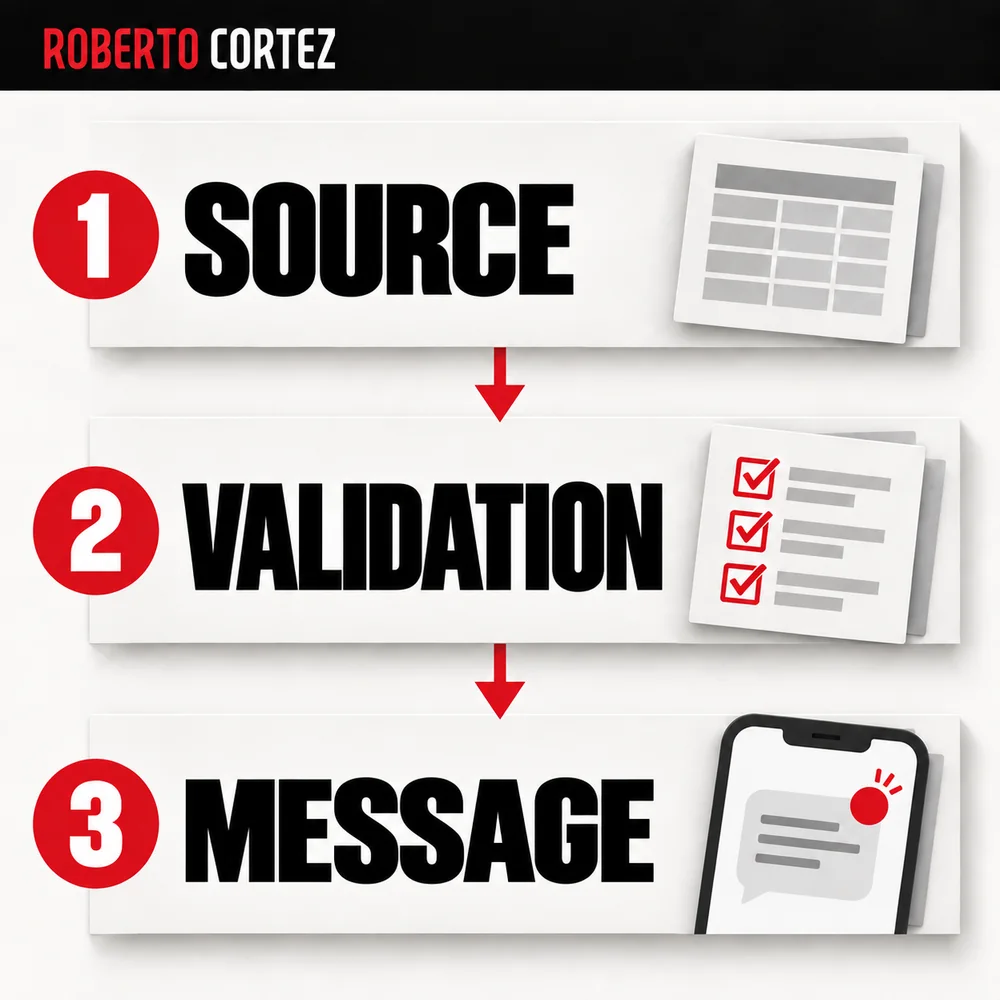
My system sends me an hourly WhatsApp message with what changed and why, combining three elements at once: the previous value, the new value, and the specific cause of the change. That way I follow decisions without opening the dashboard constantly.
In one of these checks, the day's ROI stood at 0.56, spend had moved from €578 to €583, and the automation adjusted the budget as a direct consequence of those two numbers. This kind of alert works because it doesn't force me to open the dashboard to reconstruct the story myself, it already arrives with the three pieces bundled together.
If you are building something similar, it is worth treating these three elements as the bare minimum to keep every time an automation changes something on your behalf. Knowing that a budget changed is not enough, you need to know where it came from and why it changed at that particular moment rather than a different hour. An ad set dropping from €25 to €15 in the afternoon carries a different meaning than the same drop happening in the morning, before enough data exists to trust the decision.
What to Record When a Campaign or Partnership Ends
What I expect from a media buyer in the AI era
How to use AI in business beyond chatbot prompts
What the AI decides and what I decide
I was clear in the class about the division of labor: artificial intelligence helped me build the system, but it does not decide in real time what counts as a good or bad result. I want AI to help me almost like an assistant that detects deviations and alerts me.
Defining success, spending limits, and business goals remains mine to do, decided before any automation runs. This distinction matters for auditability because it simplifies what you need to review when something goes wrong. If the automation is purely mechanical, with fixed rules, your investigation reduces to comparing what the rule said against the data that existed at the exact moment of execution. You do not need to ask why a language model "thought" a certain way, because there is no model thinking at all, only the rule you wrote being applied.
A practical way to think about this
Imagine you manage several campaigns and want to understand, a week later, why a specific ad was paused on a Tuesday afternoon. To reconstruct that decision clearly, you need to answer three concrete questions about what happened at that moment.
If your automation follows the same principle as my example, those three questions are: what was the accumulated spend at that moment, what ROI was measured, and which specific rule, the 0.8 cutoff or the €60 minimum, was triggered to justify the pause.
You can start with something simple, even a spreadsheet or a basic table, that pairs these three variables with each automated change your account goes through. It does not need to be sophisticated from day one, it can grow over time. What matters is that when a client asks why the budget dropped, you have a concrete answer backed by stored data, rather than an explanation invented on the spot to look in control.
Accountability does not disappear with automation
I insisted on this point during the class: even if the machine executes most of the operational work, the person who built and approved that rule remains accountable for results. Accountability never shifts to the machine, it stays with whoever designed the system.
I don't care whether it was a robot that did it or the person who did it, I want to charge for results, and that accountability always falls on whoever designed the system, never on the machine itself. This means auditability is not just about storing data in a log. It also comes with a personal stance: if you build an automation and cannot explain, months later, why it made a specific decision, the problem is yours, because you built it without making sure you still understood what it was doing every hour it ran.
Not everything needs elaborate automation
My example works because Ad Summit already had six previous editions of history, with data on customer value over time. That accumulated history, not the automation itself, makes the rule matrix reliable. Without it, collect data manually first and understand which rules fit before automating anything.
The rule matrix works because it sits on top of years of real sales experience, not because automation has special predictive power. Without that history, start by collecting data manually and figuring out which rules fit your case. Automation comes after, to apply a decision you already understand.
The rule matrix is only reliable because it was built on top of that accumulated business knowledge, the result of years of real sales, not because the automation itself has some special predictive power. If you do not yet have that history, the first step might not be building an elaborate automation, but rather collecting data manually for a while and figuring out which rules make sense for your specific case. Automation comes afterward, to consistently apply a decision you already understand well through direct experience with the business.
Source note
This article draws from Sextas Ímpares #151, "The media buyer's role in the AI era," where I showed live the dashboard I use to manage Ad Summit campaigns and explained the rule matrix that adjusts budgets hourly. You can watch the full class at https://www.youtube.com/watch?v=SYe0ebyVZ5c, with the ad set 65 example around the 35-minute mark, the explanation of the ROI and minimum spend matrix shortly after around minute 36, and the hourly WhatsApp report around minute 41.