
The question often arises when sales has new opportunities and operations already feels pressure. Some people have full schedules, others are waiting for approval, and projects have looked almost finished for too long. Adding up the team's contracted hours does not, on its own, show whether there is capacity to take more work into active execution.
I have argued that a project needs tasks, owners and stages distributed over time. I have also warned against creating an initial level of attention that cannot be maintained later. When several projects share the same team, both concerns need to inform the decision about how many can move forward at the same time.
Imagine a fictional services company working through diagnosis, production, review and delivery. People are available in production, but review depends on someone who also supports existing customers. If everyone starts another project because they can produce, work may accumulate before delivery and the company may still be unable to finish what it has promised.

Define what counts as a project in progress
Establish a clear starting point and a clear finishing point for tracking open work. Distinguish proposals, contracts, preparation and execution using definitions that sales and operations understand in the same way. Counting helps decisions only when it represents comparable commitments and avoids mixing future opportunities with work that already requires the team's attention in its present operating conditions.
In the fictional company, signing a contract does not have to mean starting production immediately. There may be an agreed start date and prerequisites, such as receiving information or confirming scope. Make the distinction explicit for customers and the team, preventing each department from interpreting the same sale as a different stage of the project.
Choose a start that corresponds to the operational commitment you want to control. It could be when a team takes responsibility for a delivery with sufficient conditions to work. If significant preparation happens before that point, track it too; renaming a phase does not remove effort or make someone available when they are already occupied preparing new cases.
The finishing point deserves equal care. Work sent for review may still require corrections, approval or handover to whoever will use it. Define what must be secured before it stops counting as open, without declaring it finished merely because the person who produced it has moved on to another task in their own schedule.
Avoid changing these definitions to improve the dashboard's appearance. If projects disappear from the count when they become difficult, apparent capacity rises while responsibility remains. The record should make unresolved work findable and show who needs to act to move it towards a conclusion recognised by the people involved in providing and receiving the delivery.
A simple agreement about statuses may be enough to begin. What matters is that the team can apply the same rules to actual cases and discuss exceptions. When organising delegation and processes in a small team, a shared language helps distribute responsibility without depending on individual interpretations of what is genuinely underway within the business.
Observe the work's path before counting available places
Map the stages needed to turn an accepted request into a completed delivery and identify who participates in each one. Observe where work waits and which skills several projects share. Admission capacity depends on that path, because availability at one stage does not guarantee the others can accommodate the volume you are about to place into active execution.
In the fictional company, diagnosis, production, review and delivery are useful labels only if they correspond to actual work. An information handover between diagnosis and production might require frequent clarification. If that handover is absent from the map, the team may keep attributing delays to production when the problem lies in the conditions received before work can begin.
Follow a few concrete projects from start to finish. Ask where they waited, who had to intervene again and what information was missing. Observation helps explain the sequence without immediately drawing every detail of the company or turning each exception into a permanent new phase that everyone must then monitor in their daily work.
Distinguish working time from elapsed time. A task may require little direct effort yet remain stalled for days because it depends on someone else. Both matter for capacity, but answer different questions: how much effort is required and how long the commitment remains open, needing attention until it reaches the destination agreed with the customer.
Do not use a whole-team average to conceal a specific skill requirement. Availability among people preparing materials does not automatically substitute for availability among those carrying out the required review. If one person participates in decisions across many projects, that concentration belongs in the assessment, even when spare hours exist elsewhere in roles unable to perform that work.
Observe the final handover too. A team may produce regularly while deliveries accumulate without acceptance or enough information for the customer to use the result. The path is understood only when it includes what the company genuinely needs to secure, rather than ending at the point most convenient for showing tasks as completed internally.
Compare project types before giving them equal weight
Group projects with sufficiently similar demands and identify differences that change effort, dependencies or necessary review. A simple count can guide admission, but loses usefulness if it treats every case as equivalent. The rule should consider the mix of work underway and the capacity of the people required for each type of delivery the business has committed to provide.
In the fictional company, established recurring support does not necessarily demand the same effort as a new start involving diagnosis and preparation. Counting both as one unit may locate commitments but prove insufficient for deciding whether another start fits. Understand which stages they will compete for and when that demand will reach the people responsible for those stages.
You do not need to invent an extensive classification system. Start with differences that change concrete decisions, such as familiar or new work, complete or incomplete preparation, and straightforward or specialist review. If two categories do not lead to a different admission or follow-up decision, they may be adding detail without improving anyone's understanding of capacity.
Look at the current mix as well. Several small projects may reach the same reviewer together and require coordination comparable to a larger delivery. A substantial project may instead have spaced stages with clear conditions. The mix matters because responsibilities converge in the same people's schedules, regardless of the commercial name attached to each service offered by the business.
Organising the first month of a project helps prevent every new start from demanding maximum attention immediately. Clearly distributed stages show when a particular skill will be needed. That sequence should match the delivery agreed with the customer, rather than simply pushing work into the future to make another sale fit on the calendar.
Record exceptions that change a case's profile. A request that initially appeared simple may come to require a specialist decision or information that was not anticipated. That change belongs in capacity reviews, so the limit continues to represent actual work instead of the classification assigned when the team still knew little about the project's requirements.
Choose an initial limit from observed cases
Use recent work to identify which mix of projects the team managed to support and finish with quality. Consider delays, corrections and exceptional effort before turning that history into a reference. The initial limit should be a cautious operational hypothesis with a planned review, rather than a promise of permanent capacity or a maximum-occupancy target imposed on everyone.
Look for periods when operations worked without continually extending working days or postponing essential tasks. Completing many projects may have required exceptional effort that should not be repeated as normal practice. The distinction matters when moving from an observed result to a rule that will guide the company's next commercial decisions about accepting work.
In the fictional company, the team may notice problems when several new starts reach review together. The limit may need to address that concentration instead of reducing every project type equally. Base the choice on what was observed, while keeping it open to correction when other cases challenge the initial explanation of where capacity is being constrained.
Without sufficient history, begin by making work visible and agreeing a cautious provisional rule with the people executing it. Explain that it will be reviewed using the first tracked cases. Missing data does not justify announcing an exact number as fact; it also does not require accepting work without any criteria until a perfect record exists.
Reserve capacity for activities that do not appear as new projects. Customer support, delivery review, maintenance and problem resolution may continue to require the same people. Ignoring these responsibilities means the admission rule starts from availability the company never actually had to devote exclusively to producing new work for the customers it is about to accept.
Growth supported by margins and team capacity requires recognising that use of resources. Having an admission reference does not mean always trying to fill it. The decision should enable the team to finish existing work well and provide necessary support, with room to respond to the actual responsibilities the company has already agreed to fulfil.
Connect admission to conditions in the following stage
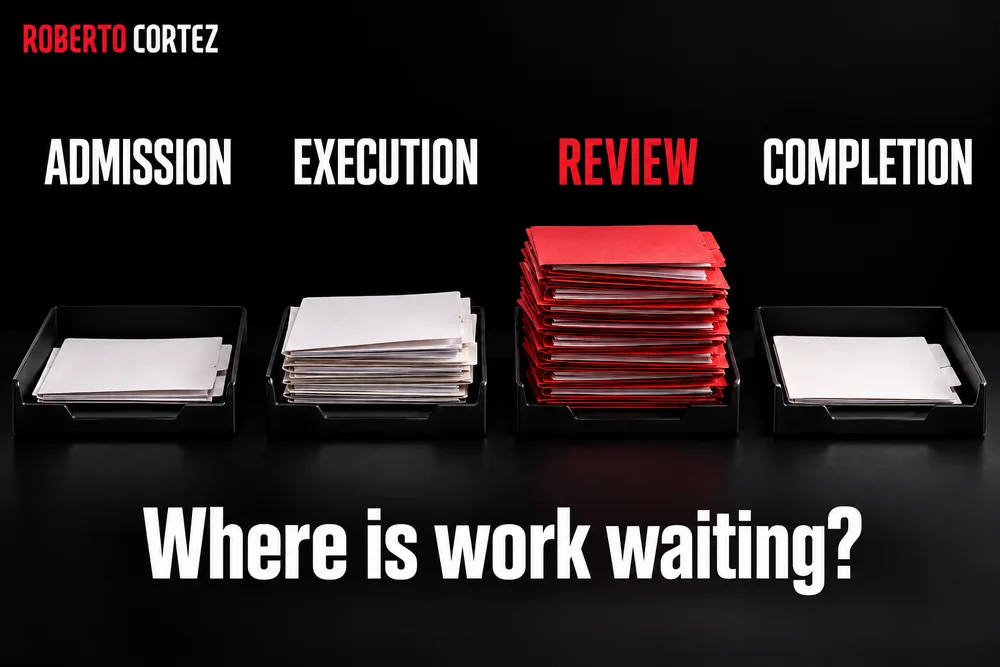
Before starting another project, confirm that conditions exist to move it through the path, including review and delivery. Use the admission rule to decide when work starts and what must wait. The aim is to control open work, preventing one person's temporary availability from creating commitments that then accumulate elsewhere in the team before they can be finished.
In the fictional company, production may have room to start a case while review is already occupied with pending deliveries. The response might be to help finish existing work or prepare a future start without silently turning it into full execution. Make that choice visible so the whole team understands the new request's status and what has been agreed.
A limit by stage can help when work concentrates at a particular point. An overall limit may help track all open commitments. Choose an arrangement that matches the process and is understandable to whoever admits work, without creating decorative numbers that everyone ignores as soon as they receive a request described as urgent by someone else.
Combine the rule with a readiness criterion. A project may fit available capacity yet still lack scope, materials or a defined owner. Starting under those conditions can consume attention through clarification and produce work that later needs revision; availability and preparation therefore need checking together before anyone assumes the start is genuinely possible for the team.
Sales needs to understand the rule's effect on the date it communicates. It may be possible to contract a future delivery without starting immediately, provided this is agreed clearly. Capacity should not be discovered only after the sale, when the team already has to explain to a customer why work did not begin when they expected it to.
Define who can authorise an exception and what information that person needs to see. An exceptional admission should identify its impact on existing work, its reason and a review point. Without that record, exceptions can become the usual way of deciding, and the limit stops representing what the company is genuinely willing to uphold in practice.
Keep waiting work and its return visible
Track blocked projects and those awaiting a response with a reason, an owner for the next step and a condition for resuming. Waiting does not remove the commitment or guarantee that returning work fits automatically. The capacity rule should anticipate how it will require attention again, preventing several delayed responses from creating an overload nobody considered when admitting other work.
In the fictional company, one customer may delay approving materials while another gathers information for diagnosis. The team can move other cases forward, but needs to know what happens when those responses arrive. If every project resumes with immediate priority, waiting work continues to create future demand on the same capacity that is now being used elsewhere.
Distinguish a blockage from missing follow-up. A project may be labelled “waiting for customer” when the request sent was unclear or nobody confirmed what was missing. Recording the next step helps identify actions the company still needs to complete before attributing the whole delay to an external dependency over which it believes it has no control.
Do not remove work from the count simply to open a place. Separating active execution from waiting may help visualisation, but the pending commitment should remain identifiable. The team needs to assess the volume that could return and under which conditions it will do so, without confusing an absence of immediate work with actual project completion.
Agree the return with the customer when the process requires a new date. Explain continuation conditions according to what was genuinely agreed, without inventing rules after waiting has occurred. The aim is understandable planning and ensuring that the response received reaches someone able to decide the next operational step for that particular customer's project.
Observe how long each case remains open and what prevents completion. An old project deserves understanding, rather than an automatic conclusion that it outranks everything else. Information about age and blockage helps choose an appropriate intervention and distinguish justified waiting from work that was forgotten between owners as other requests entered the team's working schedule.
Review the limit through what the team can deliver
Assess the limit through completions, elapsed time, quality, blockages and workload on people. Compare periods and project mixes in context, without attributing every change to the number of active cases. Adjust the rule when evidence indicates different capacity or reveals a dependency that needs addressing before the business can responsibly take more projects into execution at the same time.
Count deliveries actually completed according to the agreed definition. Starting more tasks can create activity without improving the ability to finish projects. If many cases remain open and few reach completion, investigate why before responding solely with another start target or pressure to fill every available hour in each person's schedule with something new.
Track delivery quality and correction work. A completion that repeatedly returns to the team may indicate an incomplete definition of finished or a missing review. Do not assume every instance of rework has the same cause; connect cases to project type and the conditions under which they were prepared and delivered before deciding what needs to change.
Check the effect on people participating in several paths too. The team may show stable results while one person absorbs interruptions and decisions beyond the expected workload. That dependency belongs in the assessment, because an admission rule sustained by invisible effort can appear functional until that person can no longer compensate for missing preparation across the business.
When processes improve or new tools arrive, verify the capacity that has actually become usable. Discussing time freed by AI in the team requires accounting for review and correction. Reducing one task does not automatically demonstrate room for another complete project, particularly if the stage limiting delivery still requires the same intervention from the same people.
Change the limit for an explicit reason and follow what happens afterwards. It may make sense to reduce it temporarily, redistribute a skill or revise the preparation required for admission. The learning is which combination enables better delivery, preserving the distinction between a hypothesis you will test and a capacity observed with sufficient consistency in actual work.
I want the company to explain why it accepts another project into execution at a particular moment. That answer needs to show open work, shared stages and conditions for finishing, alongside apparent availability in the schedule. A useful limit makes the decision clearer and can be revised when operational reality shows that it needs to change.