
It is possible to fill a week with meetings, documents and configuration work and still reach its end without knowing whether the business improved. The work happened and may even have been executed well. What remains unclear is the relationship between what was done and the change that justified spending time on it.
When I organise an action plan, I start with objectives to define tasks, owners and review points. That order requires an explanation of why each action matters. It also allows the plan to change when new information appears, because the team knows what it is trying to achieve beyond completing the list.
I will use a fictional example: a team wastes time looking for the correct version of project information and ends up asking the founder about almost everything. Creating folders, writing an index and presenting the new system are possible tasks. The intended change is being able to find current information to decide the next piece of work without continually depending on one person's memory.
Describe the change you want to observe in the business
Start with a concrete situation you want to change and explain why it deserves attention. Describe who is affected, what happens today and what should happen instead. This lets you discuss the objective before selecting tools or tasks, preventing an available solution from automatically becoming the purpose of the work the team is about to undertake.
In the example, “organising documentation” still leaves much unresolved. It could mean tidying files, removing duplication, clarifying responsibilities or making information accessible for a decision. Each interpretation leads to different work, so it is useful to specify which difficulty is preventing the team from moving forward.
A more useful formulation would enable project owners to find the current information they need to prepare the next delivery. That sentence identifies who should benefit and what the change is for. It still needs verification criteria, but it already allows discussion of whether an index addresses a meaningful part of the difficulty.
It is also important to state what falls outside this objective. The team may need better access to information without reviewing the entire historical archive or replacing every tool. Defining the problem's boundaries protects the ability to observe the intervention's effect, instead of launching a reorganisation so broad that nobody can tell when it is sufficiently resolved.
Ask the people experiencing the difficulty when it occurs. Perhaps the file exists but the approved version is unclear. Perhaps it is easy to find but its contents are outdated. Perhaps the team does not know it has authority to decide even when it has the right information; these are related problems requiring different responses.
I would avoid beginning with an ambitious statement that any company could use. “Becoming more efficient” can provide a general direction, but it does not explain what the team should observe tomorrow. The formulation becomes useful when someone can recognise a case where the situation improved and another where the problem remains.
That relationship between information, autonomy and decisions also appears in removing repeated decisions from the business owner's agenda. The objective should make clear what will no longer depend on the founder and what responsibility becomes defined within the team, without confusing autonomy with an absence of oversight or support.
Distinguish completed work, the deliverable and the intended effect
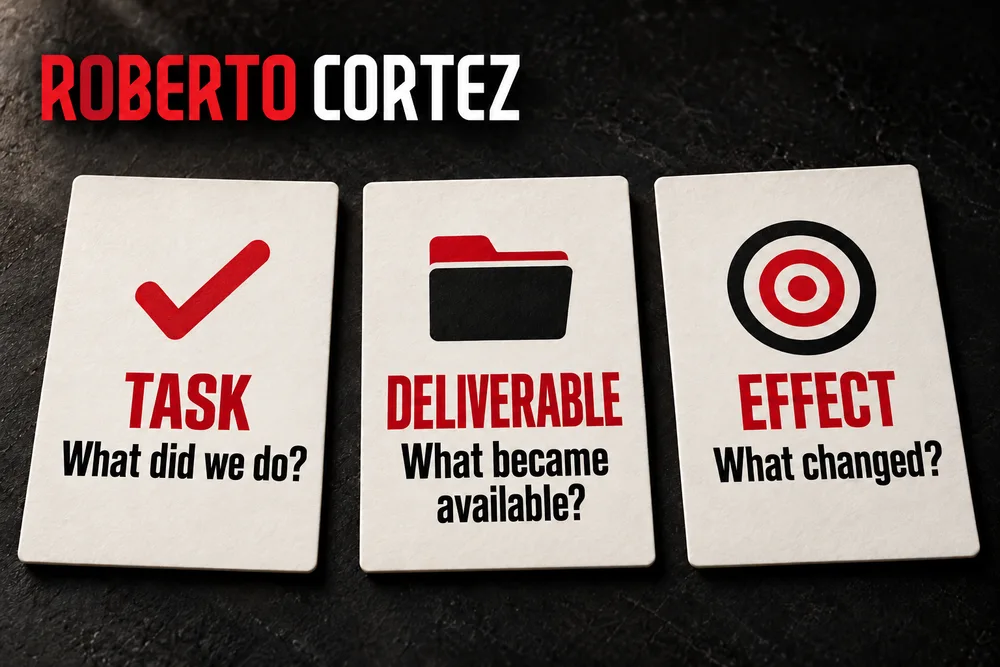
Separate three questions: what the team did, what became available and what changed in use. A task can finish and produce a correct deliverable without the intended effect appearing. Maintaining these distinctions recognises completed work while identifying what still needs to be understood before you can assess whether the business objective has actually been achieved.
Creating a folder structure is work performed. Having an accessible index with working links is a deliverable. The team's ability to locate the current version and prepare a decision is an effect that must be observed in use, rather than inferred merely from the index's existence.
These layers do not compete with one another. The deliverable needs sufficient quality to be usable, and the task needs an owner and a completion condition. The mistake occurs when evidence from one layer is used to declare another complete before it has been verified.
For example, a presentation session can demonstrate that the new process was explained. It does not, by itself, demonstrate that people can apply it in a work situation. To verify that, observe use with a specific question and identify where uncertainty or dependence continues to appear.
Avoid the opposite mistake as well: treating any disappointing result as proof that the team did not work. The task may have been completed while the hypothesis behind it was wrong. Distinguishing execution from effect allows discussion of the decision that guided the work, without reducing the whole analysis to an assessment of individual effort.
In the example, the index may be correct while the difficulty persists because nobody updates the documents. Adding more links does not necessarily address that cause. The team needs to recognise that the deliverable exists, that its use remains limited and that responsibility for updates requires a separate decision.
This separation also improves communication with people overseeing the project. Instead of saying only “it is done”, you can explain that the structure was created, a usage test revealed uncertainty and someone still needs to own a specific piece of information. The status becomes more precise and supports a next step based on what actually happened.
Define the evidence that will let you recognise progress
Choose in advance what you will observe to distinguish improvement from activity. Use evidence connected to the situation you want to change and understand the starting point before setting a target. You may need to combine a measure with case analysis, especially when decision quality matters as much as speed or the quantity of completed work.
In the example, counting folders created does not demonstrate that information became easier to find. You can observe whether someone reaches the current document, identifies the relevant approval and can prepare the next decision. If they need to interrupt the founder, record what information was missing and why the intended route did not provide it.
The starting point helps avoid targets selected simply because they sound demanding. Before promising a time reduction, observe how the search happens and what differs across project types. An occasional difficulty with an old document should not automatically be treated as equivalent to a dependency that interrupts work every day.
When using a measure, define exactly what counts. A “request for help” could involve a legitimate business question, an access failure or a search for a version. Combining everything in one number can make a change look worse because the team started asking more useful questions, even though the original difficulty decreased.
Qualitative evidence helps interpret what the measure leaves out. “I found the file but did not know whether I could use it” points to uncertainty about status or approval. “I know where it is but cannot access it” points to a different condition; the next task should respond to the observed distinction.
You do not need a heavy measurement system to begin. Choose a proportionate way to retain examples and compare operation before and after, preserving relevant context. The aim is to produce enough information for a decision without turning evidence collection into an activity consuming more effort than the improvement being assessed.
This reasoning benefits from a diagnosis before proposing a marketing plan, even when the application is internal. First, understand the situation and what remains unknown. Then choose the intervention and the evidence that will help assess whether it contributed to the intended change, rather than assuming any completed action must have helped.
Connect each task to a hypothesis about improvement
For every proposed task, explain how you expect it to contribute to the objective and what condition needs to hold. Treat that connection as a hypothesis to observe, because performing an action does not guarantee the desired effect. If the relationship is unclear, review the task before assigning it time and responsibility in the team's plan.
An index may help if the difficulty is knowing where information is located. Identifying an approved version may help if the problem is distinguishing current documents from drafts. Assigning an update owner may help when content exists but stops reflecting project decisions; each task responds to a different cause of the problem.
A simple way to test the connection is to complete this sentence: “We will do this so that this person can do that, provided this condition is met.” You do not need to use that wording in public communication. It helps reveal assumptions hidden when a plan contains only action verbs and dates.
In the example, an index may depend on links the team can open and a clear rule for identifying the current version. If those conditions are absent, the task remains incomplete as a hypothesis about improvement, even if the index file looks well presented. The plan should include the decision required to make actual use possible.
There may also be learning tasks whose contribution is reducing uncertainty before investing more work. Observing how the team searches for information may not solve the problem immediately, but it can prevent building a solution for the wrong cause. Explain that purpose so that investigation does not become an indefinite stage with no practical consequence.
After establishing the connections, look for tasks that repeat the same contribution without adding evidence or capability. Two similar presentations may be unnecessary if the difficulty lies in keeping documents current. Removing redundant work requires understanding the tasks' function, rather than simply choosing the quickest or most visible ones.
Moving from execution to business decisions relies on this relationship between action and purpose. The article on connecting operational work to strategic decisions discusses a service delivered to a client. Inside your own business, the question remains useful: what change justifies this task, and how will we know whether it contributed?
Add limits so one measure does not improve at another's expense
Define conditions the improvement must respect alongside the main effect you seek. Speed, autonomy or volume may look better while quality, clarity or workload becomes worse. Limits help assess the change as a whole and recognise a solution that satisfies one narrow measure while creating significant difficulties elsewhere in the operation or for another part of the team.
In the example, fewer questions to the founder seem positive if the team finds correct information and decides with sufficient confidence. They may be negative if people stop asking out of fear and use outdated documents. The same decline in contact can reflect very different realities that an isolated count cannot distinguish.
One useful condition would be keeping clear when a decision requires confirmation. Autonomy in finding information does not mean authority to change client commitments or assume responsibilities outside a defined role. The process should make normal work easier while keeping situations needing oversight visible to the people involved.
Another limit could concern maintenance effort. An index so complex that several people must update it continually may solve retrieval while creating an unsustainable burden. Observe who maintains information, at what points and with which dependencies before considering the improvement stable enough for routine use.
You should also preserve appropriate access to information. Making everything visible to the entire team may seem a quick way to eliminate access questions, but it ignores differences in responsibility and need. The objective is to provide relevant information to those who need it, with the context and permissions appropriate to that work.
Discuss these limits before the team optimises the selected measure. If they appear only at the end, you may discover that the plan encouraged precisely the behaviour you now want to correct. Explaining purpose and conditions together helps people make consistent decisions when they encounter an unanticipated case.
Do not turn limits into an endless list that prevents any experiment. Choose those that could change acceptance of the solution and define how they will be observed. You can then try a bounded improvement, learn from use and decide whether it is worth extending without losing sight of the work and responsibilities it affects.
Review the plan when tasks finish but the change does not appear
When tasks finish without the expected effect, investigate the connection between execution, use and results before adding work. Confirm what was delivered, whether it was used and which assumptions failed. The review should lead to a decision: correct implementation, change the hypothesis, gather missing information or abandon an intervention that no longer serves a useful purpose.
In the example, you might discover that the index was never used because the team kept receiving documents through other routes. The first question then concerns how the real process distributes information. Creating another version of the index may simply duplicate a resource that still has no clear place in everyday work.
The team may also use the index and remain unable to decide. Perhaps documents describe the past without recording the latest decision about delivery. The original hypothesis, “a place to search is missing”, then needs to give way to another: the project's current state needs to be made explicit.
Distinguish insufficient observation from demonstrated absence of improvement. If there have been few relevant usage situations, you may lack evidence to assess the hypothesis. That does not justify declaring success, but it does not force immediate abandonment either; define which observation is missing and when it can be obtained.
Avoid changing the objective's definition merely to make the plan match what was completed. If the desired change was less dependence when searching for information, “we created an index” remains a deliverable, even if it required considerable work. Recognising effort and maintaining the question about effect are compatible.
When changing the hypothesis, record the reason and what you learned. The team needs to understand why an initially important task lost priority or was replaced. That explanation prevents review from looking like arbitrary instability and allows knowledge to be reused when a similar problem arises later.
There are also times when the objective should change because the business context changed. Make that new decision explicit and assess what to do with the work already performed. You do not need to continue an intervention solely to finish the list, but you do need to understand the consequences of stopping it and the dependencies left behind.
Give the objective an owner and a decision point
Define who monitors the intended change and when evidence will be used to decide the next step. That responsibility differs from performing every task in the plan. Oversight should connect work, observations and decisions, keeping the objective present after each person completes their part and updates the status of the tasks assigned to them within the wider project.
The objective owner needs to bring relevant information together and identify dependencies between tasks. One person may organise documents, another define approval status and another observe use. Without someone monitoring the combined effect, every part can be completed while the original difficulty remains unresolved for the team.
Choose a review point consistent with the type of change and the opportunity to observe real use. A habitual meeting may happen before useful information exists or too late to correct an obvious difficulty. Purpose should guide the meeting and the material needed to make it productive for the people involved.
At the review, begin with the intended change and the evidence collected. Then examine the tasks that help explain what was observed. This order prevents the meeting being consumed by an exhaustive walkthrough of the list, leaving no time to decide whether the business is approaching what it wanted to achieve.
Close with a decision and ownership of what comes next. That may mean keeping the plan, correcting a condition, observing an additional case or removing a task that has lost its usefulness. The review should provide direction for the team rather than merely another record that a meeting took place.
To integrate these choices into a broader plan, read the guide to strategic planning for small businesses. A well-formulated objective lets you choose tasks, assess their contribution and change approach with clear reasoning. The list remains necessary, but it now serves a change the team can explain and verify, instead of becoming the only evidence used to judge progress.