
An automation can follow its instructions correctly and still undo another process's work. The problem appears when both have technical permission to write but use incompatible information or criteria. Seeing two executions marked successful does not demonstrate that their combined result makes sense for the team that relies on the record.
Consider a fictional example: a company tracks service requests in a work management tool. The team closes a request after completing it, while a synchronisation still holds an older copy in which that request appears open. If this copy is saved without checking what changed, the request can return to open without a legitimate decision to reopen it.
This is more than executing the same request twice. Two different changes, with distinct origins and intentions, are competing over the same state. The solution needs to clarify the business rule and how the system enforces it when those changes arrive close together in time or use information obtained before another update.
Identify the field and decision involved in the conflict
Start with the value changing and the consequence for the team's work. Identify which automations write it, what information they consult and which events start them. This analysis distinguishes a conflict of meaning, an outdated copy and a repeated execution before you choose how to coordinate the changes arriving at the record from different sources.
In the fictional service request, the conflicting field is status. Closing means that the work has been considered complete according to the company's criteria. The synchronisation may treat that same field as information to copy, without recognising that a later change represents a decision made by the people running the operation.
Follow a specific case through the systems involved and record the observed sequence. Show the previous value, the change made by the team and the update sent by the synchronisation. This path helps establish whether the problem began at the source, in the transmitted content or in how the destination accepted the change.
Include manual changes in the analysis. Someone may have corrected the request directly in the tool while an automation was preparing its update. If the review considers only automated workflows, you could build protection that works between them while still allowing an old copy to overwrite an intervention made by the team.
Also check whether the same field serves two purposes. “Open” might mean work still to be performed for one team and a record still present in a list for another. Synchronising values with the same name does not resolve this difference in meaning; you may need to separate the information before automating its transfer.
The article on avoiding isolated automations across the team helps make these connections visible. Here, the inventory needs to reach the fields being changed and the decisions they represent. Knowing that two integrations exist is insufficient if nobody can explain why both of them write the same status into a shared record.
The outcome of this first analysis should be a description the operation recognises. For example: an update prepared before closure is restoring the previous status. That sentence lets you discuss the behaviour that must be prevented without starting with a tool choice or a generic rule to switch everything off regardless of its purpose.
Define the authorised source for each change
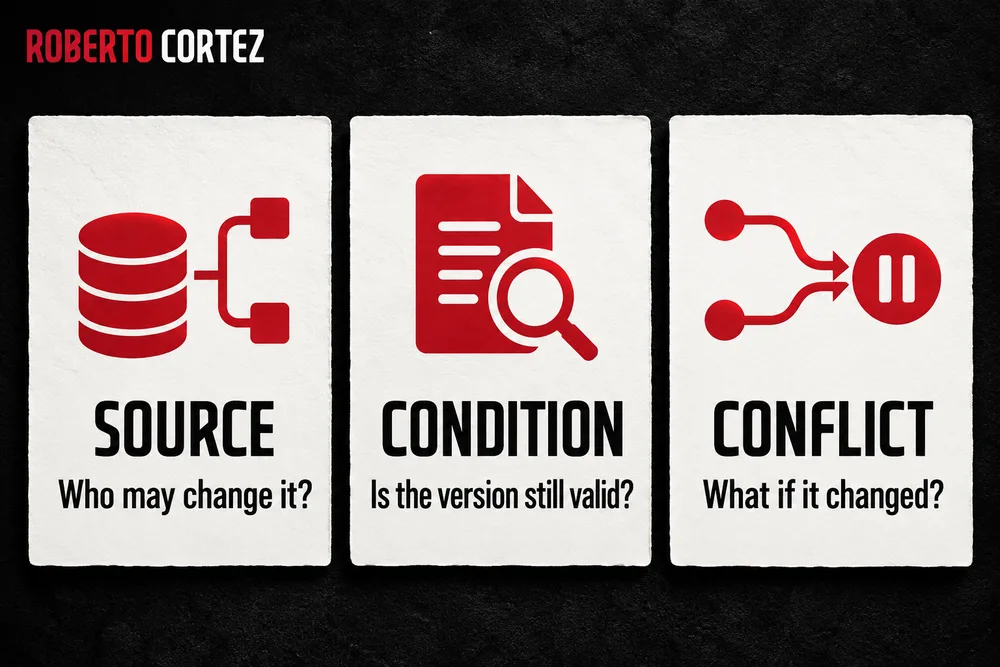
Decide which source may change each piece of information and which conditions justify a status transition. The rule can vary between fields in the same record because contact details, ownership and completion represent different decisions. Make the relationship between systems explicit so a synchronisation does not treat every copy as equally authorised to replace confirmed information.
In the fictional example, the operational tool can be the reference for request status while another system supplies contact information. The contact integration does not need permission to reopen completed work to fulfil its purpose. Separating those responsibilities reduces the scope for an update to interfere with a decision that does not belong to it.
Describe the permitted transitions too. A closed request may legitimately need to be reopened, but that should correspond to a recognised condition, such as an authorised review of the work. Do not turn protection against old copies into a blind rule preventing every future change, even when there is a valid reason to make one.
If two sources may propose the same change, define how the applicable update will be chosen. Arrival order may reflect nothing more than a communication delay. A message received later does not necessarily represent a more recent or more authoritative decision about the work being tracked and the state that should now apply.
Avoid calling a tool the “source of truth” without explaining the scope of that choice. The expression helps only when the team knows for which fields, events and decisions that source is the reference. A system can be correct about contact details and outdated about request completion, both within the same record it transmits.
It is also useful to distinguish proposed information from accepted information. An automation can suggest a classification without immediately replacing the operational status. If the change depends on criteria not yet defined, retaining the proposal for assessment is clearer than allowing two workflows to keep correcting each other without an agreed decision behind their behaviour.
Record the rule alongside the process and confirm that whoever maintains each integration knows it. Otherwise, a local improvement can reintroduce writing to fields that had been reserved for another source. Coordination needs to accompany future changes as well as resolve the particular conflict that prompted the first review of the shared record.
Prevent an old copy from replacing a more recent decision
An update prepared from an old state should be accepted only while it still meets the conditions defined for writing. Ask for effective protection at the destination that detects intervening changes. Reading again and writing in a separate step can still leave a gap in which another change makes that read outdated before the update happens.
In the example, synchronisation read the request before the team closed it. When it attempts to write, it needs to recognise that the basis used to prepare the change no longer matches the current state. The appropriate result may be to reject that update and send the case for reassessment, preserving closure while the intention is clarified.
One possible technical approach associates the change with the version that was read and checks that condition when writing. The comparison and write must be protected by the destination's mechanism. Storing a version number in a field without using it to condition the update merely adds information to the record rather than enforcing the rule.
Some APIs allow conditional requests using a version tag through mechanisms such as If-Match. That capability existing in the protocol does not guarantee your connector uses it or that the destination makes it available. The implementer must confirm the actual support and demonstrate what happens when the condition is no longer true at the destination.
You do not need to choose the technique alone to require the outcome. Ask for two changes to be prepared from the same state and for a demonstration of what happens when one arrives after the other has been accepted. Observe the final value, the rejected update and the information available for resolving the conflict.
A technical condition must also correspond to the business rule. Detecting that the record changed tells you the decision needs reassessment; it does not automatically explain which of the two intentions is correct. If the team wants to reopen a request, the reason and authority for that change still need to be checked.
When the tool cannot apply the necessary protection, that limitation belongs in the implementation decision. You may need to change the route writes follow, reduce the automated scope or reserve certain conflicts for intervention. Do not present an additional read as an equivalent guarantee simply because it is easier to add to the existing workflow.
Coordinate every path that can write to the record
Protection must cover the paths that can actually change the state, including automations, imports and manual interventions. Coordination covering only some entry points leaves others free to contradict the rule. Identify where the write decision is made and confirm that different paths respect the same conditions before producing effects on the record used by the team.
In the fictional case, correcting only the nightly synchronisation may be insufficient. A weekly import may also include request status, or an old routine created by someone else may still run. The review should show active paths and what each may change so that protection does not depend on someone remembering every integration that exists.
One design option is to route changes through a common point that applies the agreed rules. That helps only if the relevant entry points actually use it. An account able to write directly to the destination may continue to bypass that coordination, even without any intention of causing a conflict with the other processes.
Another option may involve organising execution so changes to the same record are handled in a coordinated way. The implementer needs to explain how the record is identified, how an interrupted execution is treated and what happens to changes arriving while another is underway. The name of a technique cannot replace that demonstration of behaviour.
Spacing schedules can reduce frequent collisions, but does not explain what happens when an execution takes longer or someone intervenes outside the usual schedule. The rule must remain understandable in those situations. Otherwise, the company depends on tasks always finishing within the expected duration and on nobody needing to correct a request while they run.
Avoid confusing protection inside one system with a guarantee across every system involved. If an action changes one tool and then another, the team should understand what happens when only the first change completes. Process state must make it possible to locate the difference and decide how to reconcile it without assuming both updates happened.
The aim is to find where the rule can be enforced effectively and make entry points outside it visible. If an exception remains necessary, document how it is authorised and followed. Partial protection can be useful, but the handover must state what it covers and what still needs intervention from someone responsible for the process.
Decide what happens when an update is rejected
An update rejected because of a conflict should return to assessment of the current state and original intention. Do not automatically repeat the same write against a new version just to obtain success. Define when the change is no longer needed, when it can be recalculated and when it requires a human decision, preserving the rejection reason.
For the closed request, reading the record again and insisting on writing “open” can undo exactly the protection you have just created. The new read confirms that the request changed; it does not authorise replacing the team's decision. Synchronisation should check whether there is still a valid reason to change that field or whether it was merely carrying old information.
There are cases where the intention remains valid and the work can be prepared again. A contact update may need to preserve an operational status that changed in the meantime. That decision depends on authorised scope and affected fields, avoiding transmission of a complete record copy when only one part needs updating at the destination.
If the system's response is uncertain, distinguish that situation from a confirmed rejection. Missing confirmation does not demonstrate that the write failed. Before trying another action, seek to verify the result at the destination and retain the connection to the original intention so that recovery does not introduce an unnecessary change to the record.
Create a conflict state the team understands. It should show the affected record, intended change, state found and the person or rule that can resolve the difference. A generic error lost among completed executions can leave work stalled without anyone recognising that a decision remains pending and someone needs to take responsibility for it.
The person responsible for the automation needs to know that recovery path. They do not have to decide every case but should be able to identify who can resolve each type of disagreement. Responsibility for the tool and authority to change a commercial or operational status may belong to different people within the company.
Also establish whether conflicts keep recurring for the same reason. If a routine repeatedly proposes a status it is no longer entitled to set, handling each case manually preserves the problem. Use the records to correct the rule or integration scope rather than making recovery a permanent task from which the process never learns.
Test different orders and interventions by the team
Test changes in different orders, with delays and with a manual intervention between reading and writing. Use controlled examples and write the expected outcome for each case. Verification must observe the final state and pending updates because two executions without errors can produce a combination that contradicts the business rule the company needs to enforce.
In the fictional example, begin by preparing synchronisation with the request open, then close the request before it writes. Define the expected outcome: the old copy must not silently reopen it. Then reverse the order and confirm that the valid closure decision continues to be applied against the appropriate state of the request.
Add a legitimate change to another field. Protection should not force the loss of a contact correction simply because someone updated the status, but the way to preserve both must be designed and verified. This test distinguishes careful coordination from a restriction so broad that it prevents necessary work from being completed by the team.
Also test an authorised reopening. The aim is not to keep a request closed forever but to prevent changes without the required condition. The team should be able to demonstrate the difference between an old copy that is rejected and a new decision that can produce a valid change in the process being managed.
Include delayed messages and an execution resumed after interruption. The record may have changed while the work was paused. Resumption should reassess the applicable conditions instead of assuming that the intention prepared before the interruption remains suitable merely because its turn to execute has arrived and the automation can now continue running again.
The precautions for testing an automation before handing it to the team help organise this verification. In this review, add pairs of changes that can collide and known manual paths. Testing each workflow separately does not show how they behave when they share the same record and affect decisions already made by other participants.
Keep the starting situation, action order and observed result. When a later change affects the integrations, these cases let you verify the rule again. Useful evidence demonstrates preservation of the valid decision and handling of the exception, beyond counting how many tests reached the last step without showing an error in the automation tool.
Hand over an update rule someone can follow
Before putting the process into use, bring together the authorised source for each field, permitted transitions and treatment of outdated versions. Identify who follows conflicts and how the team intervenes without losing history. The handover should explain why a change was accepted, rejected or left pending based on behaviour that was actually verified during the work.
A short process sheet can follow a request and the decisions that change it. It does not need to reproduce the entire technical implementation. It needs to show where to check state, which automations are involved and who can authorise an exception that the usual rule does not resolve for the people operating it.
If there are known limits, make them explicit. An entry point not yet included in the control or a tool lacking a required capability may need temporary manual work. The decision to use the process should consider those limits instead of presenting everything as protected merely because the main case passed the tests that were performed.
The guide to business process automation connects this coordination with the complete workflow. The central issue is maintaining an understandable transition between information, decision and execution. When several automations participate, that transition needs to remain coherent for whoever depends on the recorded state to organise their work and decide what should happen next.
Review the map of writes when a new integration arrives or a responsibility changes. An automation created to add information may start sending more fields after an update. The team approving that change should check whether its new scope remains compatible with the rules of the other processes that rely on the same record.
I would start with the status whose incorrect change most harms the team's work and follow every entry point capable of modifying it. From there, I would define authority, the write condition and the conflict path, with tests showing the outcome. More automations improve operations only when they respect the decisions that other people and systems have already made valid.