

The conversation was pleasant, the person asked questions and nobody raised a difficult objection. Yet when you return to your notes, you discover that you do not know what happens next. Perhaps you promised to send something, perhaps the prospective customer said they would think about it, and the positive impression begins replacing a decision that was never made clear.
I would assess the end of the meeting through the understanding it produced, including your own part of the work. A conversation may end with a well-defined question, a decision to wait or a conclusion that the service is unsuitable. The record should represent that outcome concretely enough to guide the next action taken by the team.
I will use a fictional example: a company seeks help organising how it follows up the enquiries it receives. The provider understands the difficulty and proposes preparing a scope summary; the contact needs to check whether the necessary information is available internally. The possible commitment at that point may be to clarify that condition, without anticipating a purchase that has not yet been decided.
Revisit the decision the meeting was meant to clarify
Before closing, return to the reason for the conversation and ask what has become clear enough to choose the next step. Connect that choice with the stated need and the questions that remain. A meeting becomes useful when its outcome can be explained, even if the conclusion is to gather information or wait.
The objective may have changed during the conversation. Someone arrived asking for a proposal to attract more enquiries, then explained that many current enquiries receive no follow-up. If you continue steering the meeting towards selling acquisition, you may obtain a request for a proposal that no longer matches the problem you have just heard described.
In the fictional example, confirm whether the difficulty concerns incoming enquiries, handover between people or visibility over what happened. Each answer may require different work from the provider. That confirmation makes a useful action easier to choose, because there is no longer a need to prepare a generic document covering every possibility the provider offers.
One way to revisit the decision is to summarise what you understood and invite correction. You could explain that the priority appears to be knowing who follows up each enquiry and ask whether that is the first point worth addressing. The response checks understanding before your interpretation becomes a much more extensive proposal for the customer to evaluate.
The diagnosis before accepting a marketing project helps connect needs, resources and expectations. At the end of the meeting, identify which questions have answers and which still prevent a recommendation. This review can be brief, provided it does not hide the information still needed to decide what would be appropriate.
Also acknowledge when the meeting did not achieve its intended objective. An unknown dependency may have emerged, or someone able to clarify a point may have been absent. Stating that limitation lets you choose how to address the gap, instead of ending with vague agreement that forces both sides to reconstruct the context later.
If the person concluded that another priority matters more, record that choice. A useful conversation can reduce a commercial possibility and avoid unnecessary work for everyone involved. The quality of the outcome depends on understanding the decision, rather than ensuring that every meeting must end with another sales task to complete.
Separate what was said from what you are interpreting
Distinguish the contact's statements, actions they accepted and conclusions that remain your own. A positive reaction may show that the explanation was understood without indicating readiness to proceed. Record the observed behaviour and clarify its meaning when relevant, so that follow-up does not turn friendliness or interest into a decision nobody actually made.
A phrase such as that sounds interesting may express curiosity, initial relevance or simple recognition of a possibility. The context helps interpret it, but does not replace a question when the next step depends on that interpretation. You can ask which part the person wants to evaluate further and what they need to know to do so.
Apply the same care to requests for information. Asking for a presentation does not establish whether someone intends to compare suppliers, explain the idea internally or keep a reference for later. Knowing the intended use allows you to prepare more useful material and understand the commitment that actually exists at that moment in the conversation.
In the example, the contact might say that organising enquiries makes sense and that they will speak with the team. You still need to know what they intend to confirm in that conversation. If they only want to establish where information is stored, record precisely that, without turning the check into internal project approval.
Distinguish your suggestion from an action accepted by the other side as well. Proposing to send a summary and receiving a polite response at the close does not guarantee that the person undertook to review it on a particular date. Confirm the understanding naturally, especially when you are already organising work that depends on a later response.
The notes should preserve this distinction without becoming lengthy. You can separate what was confirmed, what was proposed and what remains unclear. This organisation helps another team member continue the follow-up without guessing how enthusiastic the call felt or which parts of the plan were merely possibilities suggested by you.
Avoid adding intentions the conversation did not reveal. Someone may not want to share every reason behind a decision, and the record should allow for that gap. Working with incomplete information is possible; filling the gaps with a convenient interpretation can lead to unsuitable contacts and proposals in the next stage.
Choose a next step that resolves a concrete question
The next step should help resolve the question preventing evaluation or allow a decision already made to be carried out. Choose the action for its usefulness instead of scheduling another meeting through habit. Explain what the action should clarify and how its outcome will enable a better-informed choice about the work that follows.
In the fictional example, preparing a scope summary can help the customer understand which information needs to be gathered. That summary should describe the intervention under consideration and the dependency still requiring confirmation. Sending a general company presentation would add content but could leave the operational question in exactly the same place as before.
Another possible action is to clarify a technical condition before developing the proposal. Define which information is needed and what it will be used for. Requesting extensive access or documents without explaining the purpose can increase the buyer's effort and create a disproportionate task for the stage the conversation has actually reached.
The work of turning leads into customers in a service business requires continuity between need, proposal and decision. A next step makes sense when it preserves that continuity. The action should advance evaluation of the appropriate service, including discovering that the necessary conditions are not yet in place to proceed with it.
Sometimes a written response is enough. If the question concerns who supplies a particular item, another meeting may consume more time than the decision requires. Choosing the simplest format that can clarify the point keeps follow-up proportionate to the work actually under consideration, instead of adding coordination without improving the evaluation.
You may also conclude that a full proposal would still be premature. If the principal need remains unclear, start by clarifying that information and explain why it changes the scope. The prospective customer should recognise the usefulness of the action rather than receive another task whose connection to the purchase remains unclear to them.
Avoid combining too many steps into a single promise. Gathering information, deciding budget, involving operations and choosing a start date may require different people and moments. Identify the action that can happen now and the later dependencies, so that apparent agreement on everything does not conceal the absence of commitment to any concrete part.
Confirm who owns the action and which conditions it depends on
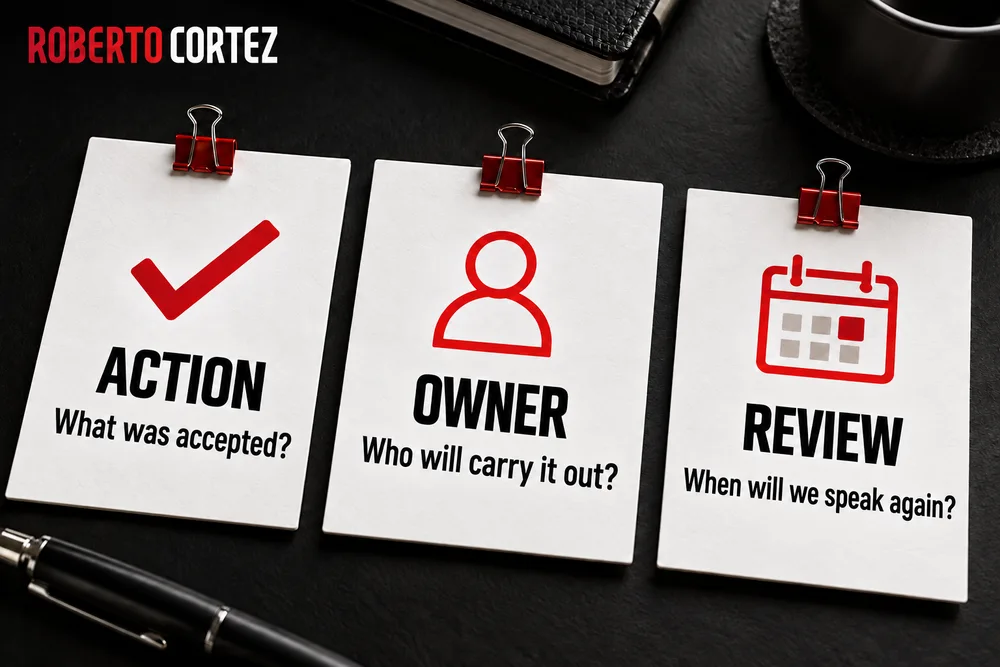
For each chosen action, identify who owns it, what they need to receive and the condition that defines completion. Confirm that the person recognises the commitment and can carry it out. A task assigned during a meeting remains uncertain when it depends on someone absent whose availability or responsibility has not yet been clarified.
Start with your own part. If you promise to send a summary, you need to know who prepares it, what it includes and when it can be ready. A commercial next step loses coherence when the provider demands a quick response without first delivering what it committed to make available to the buyer.
In the example, the contact may undertake to check with the team where the required data is held. That is a commitment to check, rather than a promise that the information exists, is organised or can be supplied. The action description should preserve the distinction so the subsequent response can be assessed accurately.
When someone else needs to participate, ask how they will be involved and what is expected of them. You do not need to turn the discussion into a complete organisational survey. You need to understand whether the contact can pass on the question, prefers another form of contact or cannot yet undertake that step.
Define the expected result in observable language. It might be an answer about information availability, a list of scope questions or a choice between two forms of intervention. Expressions such as follow up or check internally may work informally, but leave too much room for interpretation when they begin directing several people's work.
Dependencies can also be on your side. If the summary requires confirmation from the technical team, first agree how you will obtain it and explain the effect on delivery. Clear responsibilities should serve both sides rather than presenting every part of the opportunity's continuation as an obligation belonging exclusively to the buyer.
A shareable record helps test the understanding. If you cannot write down who does what and what they need before doing it, a question probably still needs clarification. The aim is to reduce the need for later interpretation while keeping the level of detail appropriate to the size of the agreed action.
Agree a review point without inventing a purchase date
Connect the review point with the action and the dependencies identified. There may be an agreed date or a condition that must occur before speaking again. Distinguish that follow-up from the purchasing decision, so that an entry in the calendar is not treated as a confirmed forecast of when the customer will buy.
If the contact knows when they can consult the team, it may make sense to agree contact after that moment. If they cannot yet predict the conversation, record the uncertainty and confirm how they wish to continue. Choosing a date simply because your report needs one does not make the buyer's process more predictable.
The timing should also allow you to fulfil your part. Do not schedule evaluation of a document that still depends on work of unknown duration. Confirm a reasonable delivery estimate and explain how you will communicate any changed condition, preserving the usefulness of the contact you are proposing rather than creating another avoidable rescheduling task.
A review date can serve to check the status of the action even if the final answer is still unavailable. Make that purpose clear when this is the case. Both sides can agree to update the situation without promising that the technical question, priority or investment decision will have been resolved by that day.
Avoid assigning artificial urgency to the buyer. If there is a real condition affecting service availability, explain it precisely and allow the person to consider it. If the deadline is simply your organisational preference, present it that way rather than turning it into a disappearing opportunity designed to force a response from them.
In the fictional example, the review may show that the information is available, requires preparation or lacks the necessary quality. Each answer leads to different work. The calendar entry exists to understand that situation and choose the next step, rather than functioning as an implied commitment to accept a proposal that has not yet been evaluated.
Record where the proposed timing came from. A date suggested by the provider and still awaiting confirmation does not mean the same as a date accepted by both sides. This distinction helps the team organise follow-up clearly, particularly when someone else takes responsibility for the opportunity after the initial meeting has ended.
Write a faithful summary before updating follow-up records
The summary should distinguish the understanding of the need, open questions, accepted actions and matters still awaiting confirmation. Use language the contact recognises and can correct. Then update follow-up with that outcome, avoiding an internal interpretation becoming an apparently accepted commitment simply because it has been entered into the company's system of record.
Start with the conclusion the conversation reached. In the example, it may be clear that the current organisation of enquiries needs to be understood before defining the intervention. That sentence gives context to the following actions and prevents a task list circulating without explaining why it was prepared or what it is meant to clarify.
Include your delivery and the buyer's action with their respective conditions. The provider prepares a summary of the scope under consideration; the contact checks information availability with the team. If the review date has not yet been accepted, preserve that qualification instead of writing it as though it had been agreed during the call.
The summary should be short enough to read and precise enough to be useful. It does not need to reproduce the whole conversation or include data that does not help the decision. Prioritise the points that change the next piece of work and questions whose answers could alter the commercial recommendation being considered.
A confirmation message can help correct a misunderstanding, but a lack of response does not turn its contents into acceptance. If you added a proposal after the meeting, identify it as a proposal. The record should continue showing what was agreed and what depends on subsequent confirmation from the contact before it can be treated that way.
When building a lead funnel the team can work with, preserving context during handovers matters. The meeting summary can serve this purpose when it explains the need, the evaluation status and the next task. A label suggesting an advanced opportunity does not replace that information or establish what the buyer actually agreed to do.
If you use a tool to organise notes, review decisions and assignments before saving the result. More assertive wording may appear better written while changing the meaning of what happened. In particular, confirm who accepted an action, where dates came from and which conditions remain unresolved before relying on the organised summary.
Check the agreed step and accept when there is no commitment yet
After the meeting, follow the action actually agreed and check what happened before choosing another contact. Confirm whether you fulfilled your part and which information arrived from the buyer. When there is no commitment to continue, record that situation and seek clarity, without filling silence with expectations the conversation did not support.
If you promised to send a document and have not done so, start by resolving that delay. The customer's lack of response may reflect waiting for something necessary to evaluate the proposal. Follow-up becomes more accurate when it considers the complete sequence, including tasks your own team has left unfinished before expecting action from someone else.
When the buyer's step did not happen, ask about the concrete point. They may explain that information was inaccessible, another priority emerged or the need ceased to be relevant. Each response helps decide whether to reformulate the action, wait for a condition or end follow-up on that opportunity as it currently stands.
There is no need to create another meeting for every difficulty. A brief confirmation may be enough to correct a dependency or understand that the matter should remain suspended. Continuing should have a recognisable purpose rather than producing sales activity solely to keep the record moving through another administrative step without new information.
Some conversations end with the person unwilling to undertake any step. You can clarify whether information you could supply is missing or whether they prefer not to continue at that moment. Respecting the answer allows a clear close, preserving the distinction between an opportunity still under evaluation and a relationship with no agreed next action.
Use these observations to improve how you close meetings. If tasks repeatedly lack owners or documents are sent without purpose, review the final questions and the way decisions are summarised. Learning should help the team understand conversations better without turning the process into an obligation to obtain a yes in every meeting it conducts.
A B2B sales process becomes more useful when each handover preserves the meaning of the commitment made. A meeting can end with a small, well-defined action that clarifies an important question. Progress lies in knowing what was accepted, fulfilling your part and checking the outcome before assuming anything more about the decision.