

A client can seriously intend to work with you for a long time and still be unable to confirm the next order. They may depend on internal approval, an expansion that is still being considered or the outcome of the first intervention. That intention deserves to be understood without automatically becoming a commercial condition of the current proposal.
The difficulty appears when the discount starts immediately and the return commitment is left for a future conversation. Your team delivers the first piece of work at the reduced price, while repetition still depends on decisions you do not control. If that repetition never happens, the cost of the concession has already fallen on your side.
I would approach the negotiation with two separate questions: what the client can commit to now and what that change allows the operation to do better. More work can bring continuity, but it can also require more coordination, more capacity and more exposure to the same client. The commercial terms should reflect all those consequences.
Clarify what the client means by future volume
Ask the client to explain which work they expect, when they will be able to decide and which part they can confirm now. Distinguish a possibility, an internal forecast and an agreed order. This separation supports terms proportionate to the available information, without treating an expectation as a guarantee or assuming the discount request conceals dishonest intentions.
Consider a fictional example: a studio receives a request to produce a page presenting a service. The client says they may need other pages for new offers and asks for a lower price from the first one. They have not yet defined those offers, the necessary materials or the launch schedule.
At this point, there is an opportunity for continuity, but not enough information to calculate the total work. Future pages may reuse a structure or require different research, copy and approvals. The phrase “we will do lots of them” does not tell you which tasks repeat and which will have to start again.
The conversation should make the forecast more concrete. Ask which initiatives have been approved, who decides on each order and when that decision can happen. You do not need to turn the meeting into an interrogation about the whole business; you need to understand the part being used to justify the requested price.
It also matters whether the person speaking can confirm the volume or can only present your proposal internally. Someone may be convinced they will need several deliveries and still lack the authority to commission them. Addressing that difference prevents both parties from leaving the meeting with incompatible understandings of what has been agreed.
If the client cannot provide that information, record the possibility as a possibility. You can maintain the proposal for the first page and leave a review open once the full set is defined. This preserves room for negotiation without demanding certainty the client does not yet have.
This discipline complements the risks I assess before accepting a service project. Here, the decision is more specific: understanding whether the continuity mentioned in the conversation provides a sufficiently concrete basis for changing the terms of an order that already has work to deliver.
Separate the initial work from the effort that can be repeated
Identify the effort required to begin and check which parts can be reused in subsequent orders. Repetition only reduces costs when there is a concrete operational difference. Research, preparation, coordination and approval may still be necessary, even when the client describes every future delivery using exactly the same name for the service.
In the studio example, the first page may require understanding the offer, organising materials and building a visual structure. Some decisions might serve other pages. Others will need reviewing if the audience, message, contact journey or responsibility for providing content changes between the different deliveries.
It helps to make this distinction before selecting a discount percentage. A reduction chosen only to make the proposal more attractive can consume precisely the value that would pay for initial preparation. Future work that has not been confirmed does not resolve that difference while the team is actually carrying out the preparation.
Record the tasks that happen once and those that happen again for each delivery. Add anything that depends on specific conditions, such as receiving complete materials or being able to approve several pieces in one session. Do not classify a part as reusable if, in practice, it needs approval and adaptation every time.
Some efficiencies also depend on how the client works. An organised set of requests may need less preparation than separate, urgent requests. However, that organisation needs to exist in the accepted plan; it should not be assumed simply because the client mentioned a large volume of future work.
Faster execution does not remove responsibility for delivery. If you produce more quickly, you still need to check whether the work serves the need and fulfils the agreement. Thinking about how to defend your price when execution becomes faster helps separate efficiency from an automatic reduction in the value of the service.
By the end of this analysis, you should be able to explain internally what changes between completing one order and completing a defined set. If the answer remains “there will be more things”, you still need to understand the operational effect. Volume alone does not demonstrate that each delivery has become simpler or less demanding.
Assess the first order without depending on subsequent ones
Calculate the effect of the requested terms on the confirmed order, considering initial work, delivery and the capacity required. Then examine the scenario in which no further purchases arrive. The decision should clarify what you accept in that scenario, rather than depending on future continuity to conceal a concession you cannot yet support on its own.
This does not require every project to generate the same immediate contribution. You can decide to make a concession for a concrete reason that you recognise and can support. The important step is to acknowledge that choice clearly, without presenting it to yourself as future revenue that is already guaranteed.
In the fictional example, the first page requires real work even if the others are never ordered. The team will collect information, prepare the delivery proposal, produce and review the work. If the reduced price leaves that work poorly covered, the studio needs to know it is accepting that consequence.
Consider the costs directly associated with delivery and the capacity occupied by the project. Then check what remains available to cover the business structure and other expenses. Do not call the amount left from a partial calculation profit without considering the other costs of running the business.
The timing of payment also affects your ability to execute. A different payment arrangement can change the need to finance work already completed, but it does not automatically reduce the team's effort. Treat price, payment and delivery as related elements that have different effects on the decision you are making.
Avoid justifying the first concession using an average of orders that do not yet exist. You can construct scenarios to examine the opportunity, provided you keep confirmed information and assumptions clearly visible. If a scenario only works with continuous repetition, that dependency needs to be recognised before acceptance.
You should also consider the alternative use of the same capacity. You do not need to invent a lost sale to give the schedule value, but you should recognise that accepting work limits other choices. An opportunity with possible continuity can be attractive and still require limits on the effort you accept now.
Identify what actually changes in delivery conditions
Look for something in return that makes a verifiable difference to the effort, organisation or exposure involved in the service. Work might be grouped, materials prepared or scope better defined, provided those conditions are useful and feasible. Assess the concrete effect of each change before concluding there is room to reduce the proposed price.
A set of pages defined together may allow research and production to be organised with fewer interruptions. For that to happen, the characteristics of the set need to be sufficiently clear. A list of names for future offers is not equivalent to ready materials or approved content decisions.
The client can also take responsibility for part of the work, such as supplying final copy or gathering internal approvals. That change only helps if they have the capacity to fulfil it. Moving a responsibility to someone without time or preparation can increase the follow-up required and leave the project waiting for responses.
Another consideration is the schedule. Receiving several requests in advance may allow better distribution of work; receiving them all for the same date may require additional capacity. The same volume produces different effects depending on its concentration, the skills required and commitments already present in the team's schedule.
For this reason, do not confuse a purchase commitment with unlimited delivery capacity. Even with a set of orders agreed, you need to check whether you can execute what you are proposing. Negotiation should make relevant dates and dependencies visible instead of leaving an implicit expectation that the discount includes permanent priority.
Some conditions only change how the proposal is presented. Calling the relationship a “partnership” or mentioning growth potential does not reduce the work required. Those expressions may describe a positive intention, but they need concrete decisions alongside them to support a commercial concession based on changed delivery conditions.
A useful check is to explain what the team will do differently if the client accepts the alternative. If you cannot identify a change, the reduction may still be a commercial choice, but it should not be described as a demonstrated operational saving. This distinction improves both the internal decision and the clarity of the conversation.
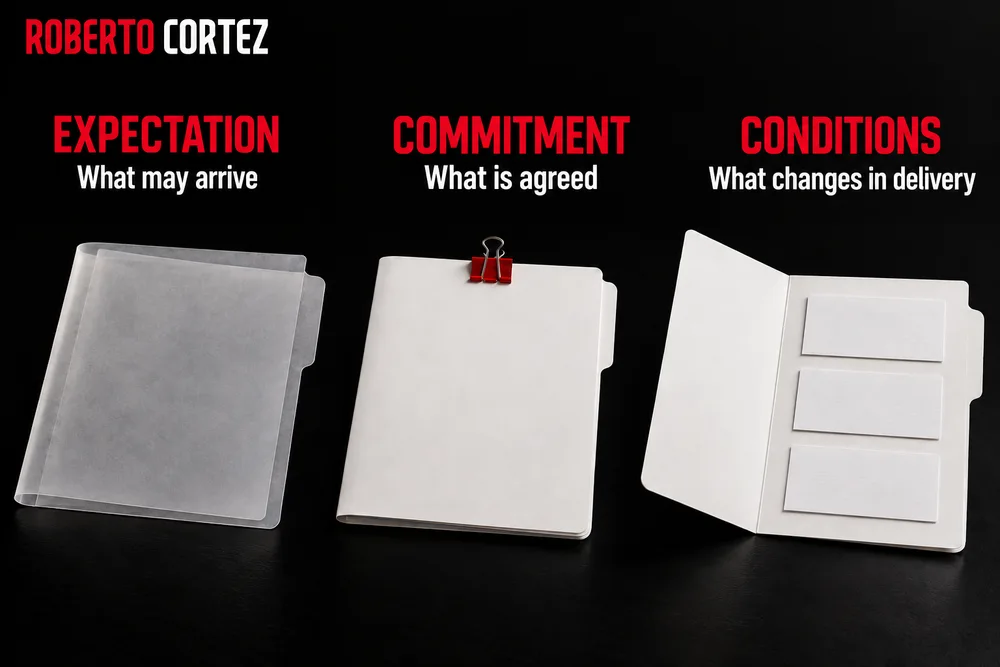
Prepare alternatives proportionate to the existing commitment
Present alternatives the client can assess using the information they have now: begin with the defined order, organise a concrete set or review terms when repetition occurs. Each option should clarify the work included and its dependencies. Avoid promising the same service for less without identifying what has changed in the commercial decision behind the offer.
The first alternative may be to maintain the terms for the initial page. The client addresses the current need and both parties learn about working together. The possibility of further pages remains open, without requiring the first delivery to finance a relationship whose continuity is still waiting for a decision.
Another alternative is to prepare a proposal for a set that has actually been defined. In that case, you need to review scope, sequence, materials and capacity. The outcome may support different terms, but it may also show that concentrating the work requires more coordination than a single order would need.
A third possibility is to arrange a commercial review once repetition has been observed. This allows terms to be discussed using real work and more complete information. The review should not be presented as a guaranteed discount if you still do not know the effort required for the next deliveries or the conditions in which they must happen.
It may also make sense to reduce the initial scope to a useful, smaller intervention. Explain what is no longer included and what the client will have to provide. Do not remove a task essential to fulfilling the promise while maintaining the expectation that the cheaper version delivers exactly the same result.
You can respond simply: “I can assess terms for that set once it is defined. For this first delivery, these are the responsibilities and work included. If we organise the remaining pieces now, I can review the proposal against the total effort and the possible schedule.” This is an example response, not a required condition for every business.
Differentiating services in a competitive market helps explain the work before discussing a reduction. Here, the client needs to understand what they are choosing between the alternatives. A clear response can preserve the opportunity even when you do not accept the discount requested at that moment in the conversation.
Record the agreement and the facts that allow terms to be reviewed
Confirm in writing the scope, price, responsibilities and terms actually agreed for the current order. Record separately the work that remains only anticipated and what needs clarification in a review. The document should allow the decision to be executed without depending on memories of a conversation about future opportunities that are still open.
In the studio example, the team should know whether only the first page or an already defined set has been commissioned. They should be able to identify the materials they will receive, the approvals required and the accepted schedule. If someone needs to ask sales “what did we actually promise?”, the handover from negotiation to execution is incomplete.
The phrase “special terms for future pages” may be too vague. It does not explain which work those terms apply to, what needs to remain the same or when there will be enough information for another proposal. It is better to record the review as a concrete next step without turning a general intention into an expectation of permanent pricing.
The record should also distinguish the proposal made from the terms accepted. A conversation can include several alternatives and end with only one selected. If they are all mixed together in the handover document, the team may execute scope the client did not commission or fail to fulfil a responsibility that was confirmed.
Avoid adding retrospective consequences that were never discussed. If the client does not commission future work, that does not authorise inventing a penalty to compensate for a poorly assessed discount. The current commercial decision should be clear enough not to depend on changing the rules when expectations fail to materialise.
If conditions change during execution, clarify the effect again before committing to another delivery. An additional page with a different audience or incomplete materials may require a different assessment. Recognising that difference does not contradict openness to negotiation; it keeps the negotiation connected to the work that actually exists.
The person managing the relationship should be able to explain the decision as clearly as the person who sold it. This alignment reduces different interpretations between proposal, production and follow-up. Continuity gains a more useful foundation when the team can fulfil the present agreement without depending on informal promises about the next request.
Review the concession when real work arrives
When new orders appear, compare the observed effort with the assumptions used in the negotiation. Check repetition, materials, coordination, capacity and delivery conditions before maintaining or reviewing the next proposal. Actual continuity allows learning, but it does not remove the need to assess whether the way of working still supports what you are offering the client.
In the fictional example, the studio may discover that the initial structure was reused and that the client supplied complete materials. It may also discover that every page requires a fresh discussion of the offer and several approvals. Both situations provide useful information; they should not receive the same interpretation simply because the number of pages has increased.
Examine what happened without changing the criteria to justify the previous decision. If you expected less preparation and that reduction did not appear, record the difference. If a concrete saving emerged, identify it with the same care so it can be considered in a later proposal for further work.
It also matters whether the additional work arrived according to the expected schedule. Concentrated orders may have required changes in the team or delayed other deliveries. A relationship that grows in revenue may still consume more capacity and coordination than you imagined during the first conversation about future volume.
This review should inform future decisions without rewriting commitments already accepted. If you need to change terms for the next order, explain the work and assumptions that have changed. The client should be able to understand the new proposal and decide before proceeding with that delivery under those conditions.
To organise the transition between negotiation, execution and review, consult the guide to the B2B sales process. Commercial terms become more consistent when the information supporting them follows the project. A promise of volume can open a conversation; defined work and delivery conditions provide the basis for an informed decision.