
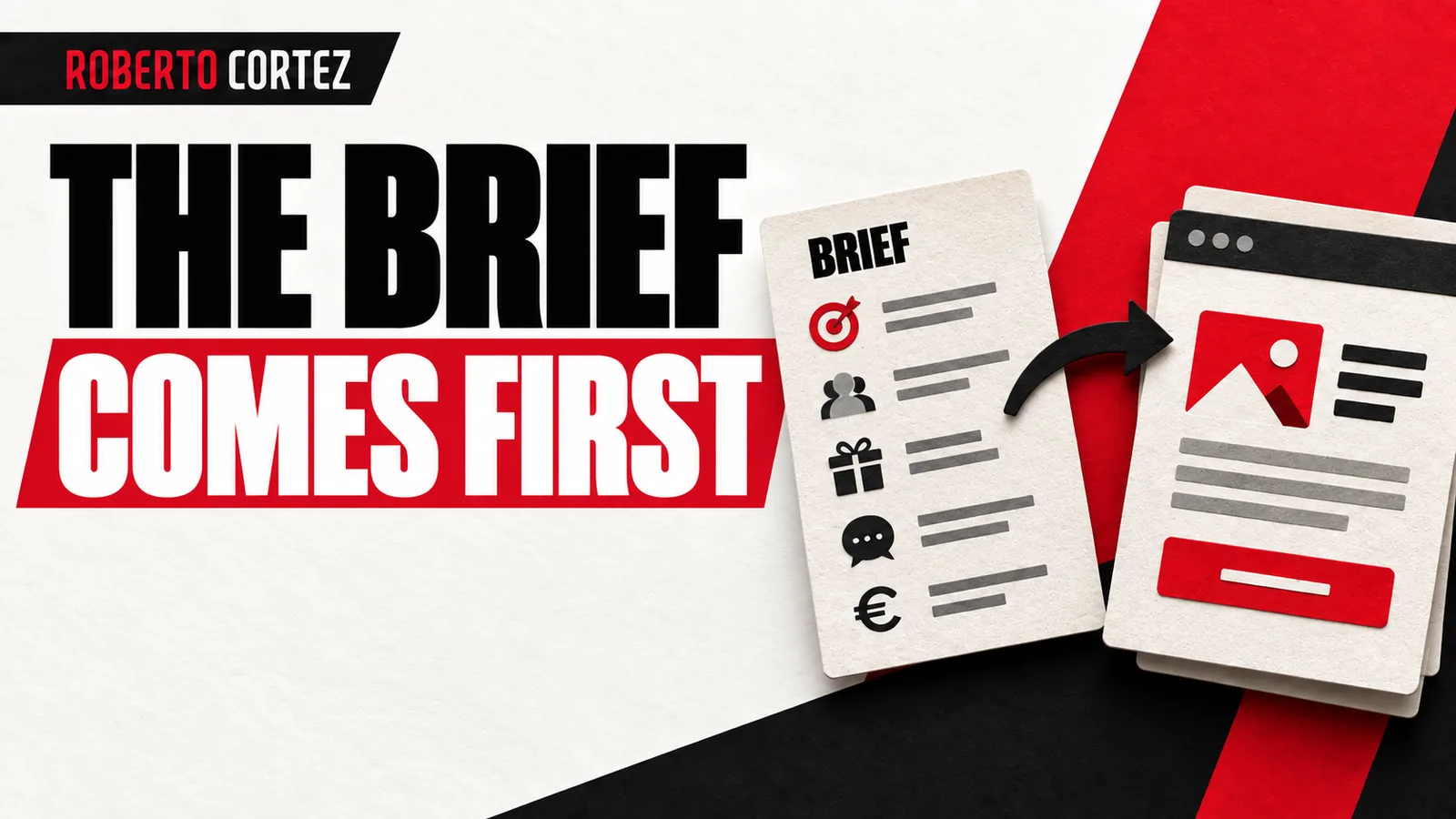
Why asking AI for copy without context produces generic pages
When I ask an AI tool directly to write the page, the answer tends to be a statistical generalization, with no friction at all, nothing that makes the reader feel understood, and no real link to my business. Context is missing, and without context the AI only produces average, generic text, applicable to any business and to none in particular.
In the class Sextas Ímpares #69, around 00:06:52, I'm direct about this: writing copy is not typing something into an AI tool and asking for headlines. Writing persuasive messages requires method and rules, not a vague request. Without that prior intake work, the tool merely sounds confident while ignoring exactly the points where my business has friction.
My job is to think carefully about the real problems of my audience and provide the algorithm with an organized diagnosis. Without this foundation, AI falls back on the obvious: it lists product features and adds empty adjectives, failing to show the reader that I understand their daily routine.
The customer's current state and exact language
A message that works reflects exactly what the buyer feels right now, in the words they themselves use in real conversations. If I try to sound sophisticated, the message loses force. The brief needs to capture the real frustration, unfiltered.
I explain this in the class around 00:19:56: I need to write down and study the potential customer's state of mind before I can speak directly to them. I give the example of freelancers who feel isolated, with no one to validate ideas with or ask for help. When I describe that isolation precisely, the person on the other side feels understood immediately.
In the class I reference extremely simple pop song lyrics, where each element enters gradually so the listener isn't overloaded. The same idea applies to copy: simple sentences, without information overload, work better than elaborate vocabulary.
For the context document, it helps to answer concrete questions: at what point in the day is the customer's frustration highest? What phrases do they say when venting to colleagues? What feeling of isolation or fatigue accompanies their routine? What mistakes do they repeat because they think their case is unique?
How to explain an AI service's benefit without selling a list of tools
How to turn real customer objections into better content
How to build a lead funnel that the sales team can actually work
The desired outcome and the beliefs blocking the decision
Customers don't buy features, they buy the transformation those features bring to their life. And they carry ready-made beliefs about the market that block the decision to buy at all. The brief needs to map both sides: the state of success they want to reach and the mental barrier that needs dismantling first.
I share in the class, around 00:22:58, that I only realized many people saw freelancing as a last resort, for someone who couldn't find work anywhere else, when I heard that from a student during an interview. By identifying that hidden belief, I was able to address it directly in my communication.
If the customer believes they need skills they don't have, that has to be addressed head on in the text. At the same time, I describe the state of success they imagine: more time freedom, being able to choose who they work with, not depending on clients who don't value them. These are examples I use in class to illustrate the point, not a fixed rule for every business.
The proof that lowers perceived risk
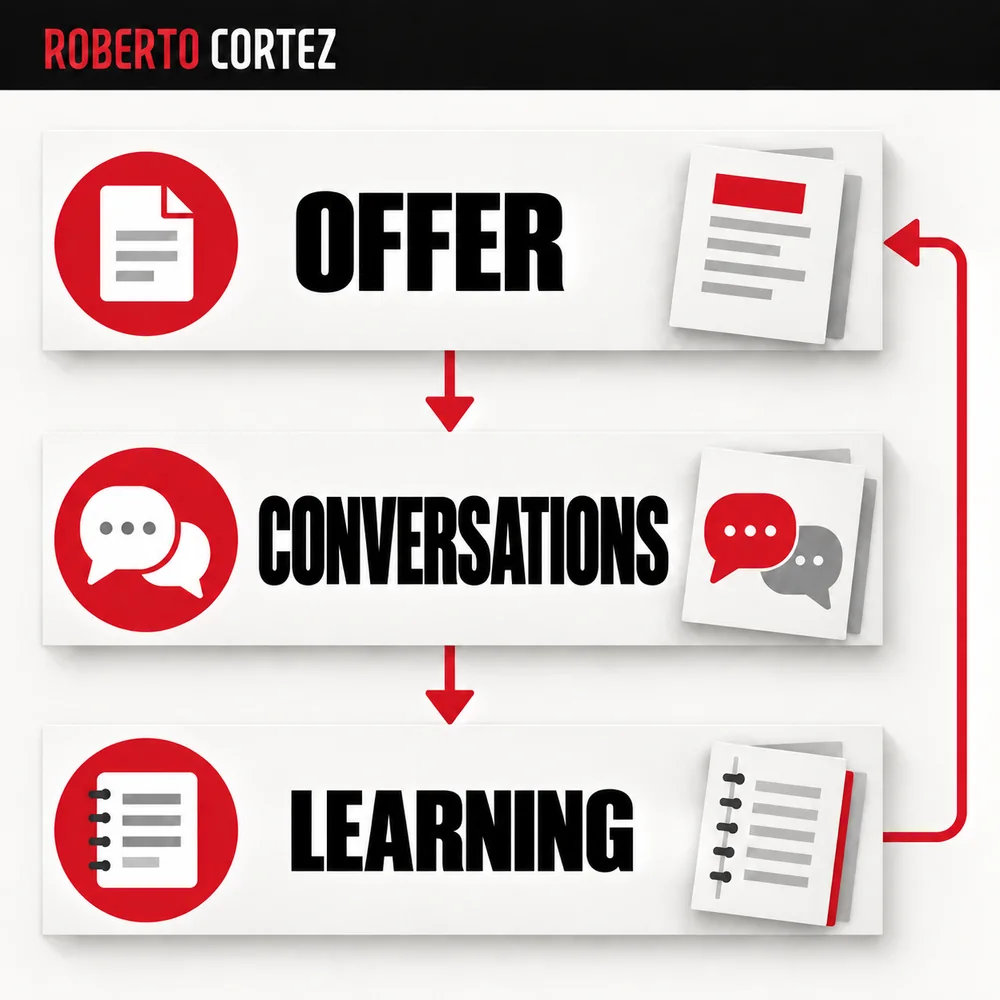
No one moves forward with a purchase if they feel they're taking all the risk while the company keeps all the profit. To make the offer feel natural, I need to show speed, simplicity and low risk, backed by concrete proof, not vague claims.
I sum this up in the class around 00:29:48: the offer becomes hard to refuse when it combines these three conditions, fast, simple and low risk. Without real proof of these three points, AI will invent generic arguments that support nothing at all.
In the brief, it's worth gathering: a verifiable track record of people who went through the process and got results; the practical way I follow up with clients so they aren't left alone; real guarantees, if they exist; and the step-by-step path that replaces improvisation with something already tested. Handing these facts to the tool produces text closer to a serious proposal and further from typical ad exaggeration.
Flag what I don't know yet
A common mistake is pretending I have an answer for everything. When I force AI to invent details about parts of the business I haven't validated yet, the text comes out inconsistent and fragile. A good brief clearly states what remains open, instead of disguising the uncertainty.
I insist in the class, around 00:10:38, that the rule is to think slowly about copy: I write everything quickly in draft form, without fear of early inconsistency, but only decide after reflecting calmly. The same logic applies to admitting doubts: if I don't know whether the customer hesitates more because of delivery time or process complexity, I tell the tool and ask it not to invent an answer for that. On uncertain points, I ask for questions rather than categorical statements.
A hypothetical brief example ready to hand over
To illustrate how this comes together in practice, imagine a hypothetical cash flow service for small service businesses, an invented scenario used only to show the format, not a description of any real business. It simply shows the structure a complete brief should have, before filling it with real data from your own business.
CUSTOMER CONTEXT - Profile: owners of small service businesses with few employees. - Current situation: handle invoicing on weekends, mix personal and business accounts, dread the end of month due to unpredictable cash. - Real language: "I never know how much I can withdraw without choking cash flow." OUTCOME AND BELIEFS - Desired outcome: predictable balance, stable monthly withdrawal. - Belief to dismantle: they think they need a full-time finance director to have order in their accounts. PROOF - Method: a simple cash flow dashboard tracked by a specialist. - Risk reduction: follow-up check-ins in the first weeks. WHAT WE DON'T KNOW (DO NOT INVENT) - We don't know if the client prefers manual data import or direct integration. - Do not assume a fixed price; direct to a diagnostic conversation.This exercise only shows the kind of information worth gathering before writing the prompt, and does not represent a real process at any existing business.
Editing the draft without losing the human tone
After I have the first generated version, the work is cutting generalities and phrases I would never say in a real conversation with the customer about the product. I read it out loud and delete anything that sounds like empty marketing.
I check whether the three pillars remain visible throughout the text: speed, simplicity, low risk. If one disappears in a section, I go back and rewrite just that part. I ask for adjustments to specific sections, not full rewrites, so I keep control over the argument and the tone I want the final reader to feel.
Source note
This article is based on the class Sextas Ímpares #69, "Como Escrever Copy que Converte com Método e Clareza," which I gave on YouTube. You can watch the full class here: https://www.youtube.com/watch?v=4LG6aLFN2wA. The application to AI tools is a current reading I make myself, drawing on the principles I explained in the class about thinking slowly before writing.