

Saying that you are looking for a strategic partner starts a conversation but leaves many questions unanswered. Do you need someone to help you decide, a team to execute a task, or a person who will participate continuously in building the business? Preparation begins by clarifying that intention through the work already in front of you.
I will use a fictional project: a founder understands how small companies struggle to follow up enquiries and has prepared a prototype to organise that work. They can develop the product but are seeking a commercial contribution. They still need to understand whether the gap calls for a business partnership, a limited collaboration or another form of support.
A good presentation does not settle that choice in advance. It provides enough information for the other person to ask questions, recognise limits and explain what they could take on. The conversation is also useful when it reveals incompatibility early, before enthusiasm creates expectations about time, resources or responsibilities that nobody has agreed to assume.
Start with the need that justifies seeking a partner
Explain what the business needs to do and why you consider sharing that responsibility on an ongoing basis important. Describe the gap before assigning a title to the person you seek. A one-off difficulty may call for execution or guidance, while participation in the business requires discussing a broader commitment to its development and decisions.
In the fictional example, “I need someone to sell” is still too broad. It might mean identifying the initial audience, testing the offer, following up opportunities or leading an established commercial activity. These tasks require different contributions and should not be combined into a general expectation that the new person will resolve everything currently missing from the business.
Show where the difficulty appears in the current work. The founder may be able to demonstrate the prototype but not know which companies to approach first or how to establish whether the proposal addresses a sufficiently important need. That description allows a more precise discussion than a vague statement about needing contacts or experience to help move forward.
Explain why you are considering an ongoing relationship. Are there decisions that need to be taken together? Does the desired contribution influence product direction or how operations are organised? If the work is limited and you already know the expected outcome, acknowledge that there may be a more appropriate alternative to seeking a partner in the business.
You do not need to arrive with that analysis finished. You can bring the uncertainty between forms of support itself, provided you do not present something still under consideration as already decided. The conversation becomes more useful when both people know whether they are exploring a possibility or discussing a proposal that the founder has already clearly defined.
Preparation benefits from the same care involved in diagnosing before choosing a marketing plan. First clarify the problem, resources and what is happening. Only then can you assess whether the other person's experience corresponds to the need and where it could be useful within the actual work required to develop the project.
Finish this part with a sentence connecting the need and contribution. In the fictional scenario, for example, the founder wants to discuss who could take responsibility for commercial development while they retain the product and operational understanding. That statement does not confirm a partnership; it makes explicit what needs to be assessed during the conversation about possible participation.
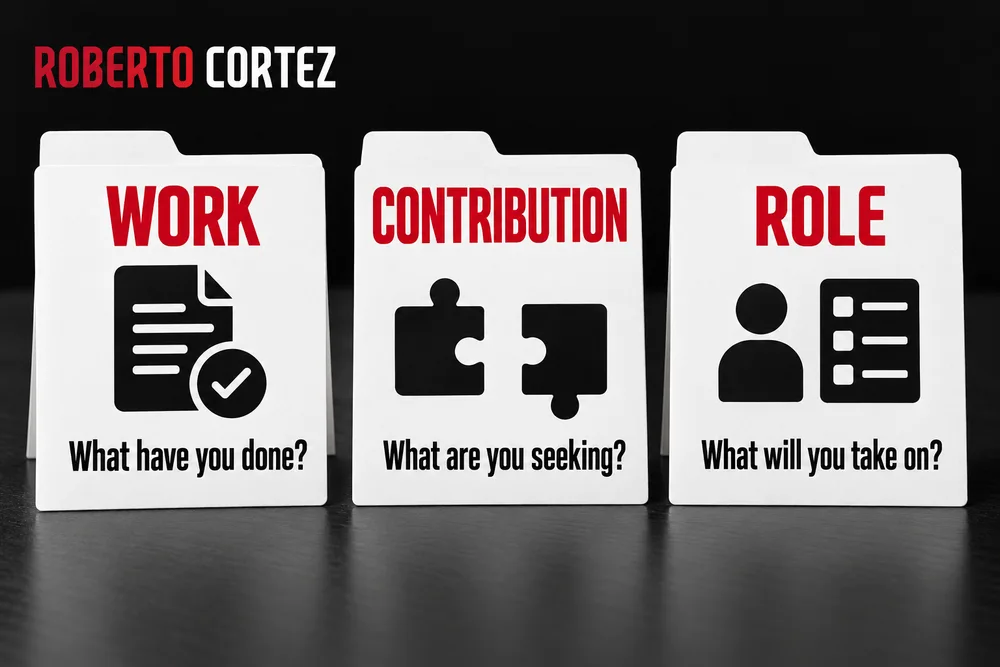
Show completed work and separate evidence from hypotheses
Present what you have built, researched or tried, identifying the outcome and what remains unconfirmed. Distinguish a prototype from a product in use, verbal interest from commitment and estimates from measured information. The other person needs to understand the project's actual stage to assess a contribution, without discovering later that the presentation mixed intention with execution.
In the fictional project, a prototype may show that the founder has thought through the stages of enquiry follow-up. It does not prove that companies use it regularly or would pay under the imagined conditions. Explain what the demonstration allows someone to observe and which questions remain open, preserving its value without assigning results that do not yet exist.
Bring a short record of the checks you have made. It can include the question you were trying to clarify, how you investigated it and the conclusion you could draw. If the information is limited, explain how; an exploratory conversation with an acquaintance does not mean the same thing as continued use of a solution in a real operation.
Also show decisions you changed because of what you learned. If the original design required too much information to get started, explain how you reduced that requirement and what still needs testing. This helps reveal how you work with evidence and corrections, without requiring the first version to have been perfect or every question to have been resolved already.
When starting a business with AI support, distinguishing the production of materials from learning about the market is particularly important. A presentation, plan or demonstrable application can be useful. Being well produced does not by itself confirm the need, suitability of the offer or ability to deliver the service under the proposed conditions for actual customers.
A founder's commitment can be visible in time devoted, research, development or the team involved. Do not reduce it to an amount of money used as a symbol of seriousness. What matters in this conversation is understanding what you have already taken on and how that effort relates to the current stage and the next necessary work.
If you do not yet have customers, state that clearly and show what you know about the problem. Do not invent demand to make the project more presentable or hide its early stage behind growth language. Someone who understands the actual stage can assess whether further discussion makes sense and what they would need to see before making any commitment.
Connect the contribution you seek to concrete responsibilities
Describe the expected contribution through tasks, decisions and work outcomes that someone would need to oversee. Distinguish knowledge, execution and financial resources when they form part of the request. Complementarity becomes something you can discuss when you show how the contribution fits the project, rather than listing desirable qualities unrelated to what needs to happen operationally.
In the example, commercial experience might help select an initial audience, prepare conversations and review how the offer is explained. It could also mean managing an already organised sales activity. The founder should say which need exists now and which may emerge later, so the role does not expand silently while both parties are still discussing possible collaboration.
Identify the decisions you expect to share. Someone may help define the commercial approach without taking over every product priority. Another relationship may require broader involvement in the business's direction. These possibilities need discussion because the same title can conceal very different expectations about authority and everyday involvement in the project and its ongoing decisions.
If you seek a team's execution capacity, explain what work it would perform and what coordination would be required. Do not assume that a relationship with one person provides automatic access to all their businesses' resources. Availability, scope and the form of collaboration need to be assessed by the parties before appearing in the plan as guaranteed resources.
When the request includes financial capital, present its intended purpose and the assumptions behind any estimate you already have. The aim here is to explain what work those resources would enable, not improvise terms or turn the first conversation into a complete financial assessment. Keep visible what depends on further study and discussion before any commitment can be considered.
Connect each contribution to your own preparation. If you request commercial support, what information about the product, audience and operation can you provide? If you seek execution help, which decisions are settled and which require your involvement? The other person needs to understand those dependencies to assess the role realistically instead of guessing what support will be available.
The exercise is complete when you can describe an initial piece of work that would make collaboration observable. It might deepen a commercial hypothesis or clarify a responsibility, without yet executing anything on behalf of a nonexistent partnership. Proposing that step is something to agree, not permission to start using the other person's team, name or contacts.
Explain the role you retain and the limits of your availability
Present the responsibilities you continue to assume, the time you can devote and commitments limiting your participation. Distinguish current availability from future intention. Another person's arrival does not remove the founder's work, and the conversation needs to show how both parties could collaborate without relying on a promise of dedication that has not yet been secured.
In the fictional project, the founder may retain development and process knowledge while continuing another professional activity. That condition changes the possible pace and how decisions are coordinated. Explaining it supports realistic expectations; hiding it until the first delay leaves the other person planning around availability that does not exist under the founder's actual circumstances.
Describe what you can ensure concretely, without turning preparation into an excessively detailed diary. What matters is whether you can participate in necessary decisions, prepare information and follow execution. If availability depends on an unconfirmed change, present that dependency as such and explain what remains possible in the meantime, rather than treating the future situation as already established.
Identify what you do not intend to transfer as well. There may be part of the product you want to keep leading or a customer commitment requiring your presence. The conversation should allow that distribution to be questioned, but must start from an explicit position instead of each person imagining a different division of the necessary work.
When planning an application before building it, technical work needs decisions and context to progress. The same dependency appears in a business collaboration. Bringing in someone with execution capacity does not replace the founder's participation in choices that only they can clarify about the project's intention, scope and priorities, or remove the need to supply that context.
Prepare the reverse question too: what availability could the other person actually offer? Experience and interest do not demonstrate reserved time. Avoid interpreting an attentive conversation as evidence that someone can already assume a regular responsibility, especially before their commitments and possible form of participation have been discussed and connected to the project's needs.
If you discover incompatible availability, record it without disguising it with a vague promise to find time. It may make sense to postpone, narrow an exploratory activity or consider another relationship. Recognising that limit is useful because it protects the project from a plan dependent on work neither party can undertake under the current circumstances.
Prepare questions about vision, criteria and working methods
Bring questions that reveal how the other person interprets the project, chooses priorities and handles disagreement. Seek examples and criteria beyond general agreement with the idea. Alignment on vision and responsibilities needs room for discussion, including expectations that may appear compatible during initial enthusiasm but reveal differences when translated into concrete decisions about the work.
Ask what the person considers most important to clarify before exploring participation further. The answer may reveal concern about demand, delivery capacity or founder availability. Listen to the reasoning and compare it with what you know, without treating a different perspective as a lack of enthusiasm or as a conclusion you must accept without understanding its basis.
In the fictional example, a potential partner might want to speak to companies before adding features. The founder might prefer more product development to demonstrate the idea. This difference allows discussion of learning and prioritisation criteria; the conversation is more useful when it explains what each option aims to confirm and the commitment needed to pursue it.
Bring concrete situations that could create disagreement. How would you choose between responding to a specific request and preserving the product's scope? What information would you want before changing priorities? These questions help reveal working methods without turning the first meeting into an interrogation covering every possible scenario in a relationship that is still only being explored.
Discuss communication and monitoring as well. Understand how people make difficulties visible, request decisions and give feedback when work does not meet expectations. Agreeing that communication will be good is too general a starting point; ask how each person usually organises that part of the work and what conditions they consider necessary for collaboration to function.
Avoid seeking only answers that confirm the choice you already wanted to make. Relevant experience can coexist with a long-term vision incompatible with yours. The conversation should allow recognition of that difference without turning personal affinity into proof that the business relationship will be suitable or capable of resolving the project's challenges under the proposed arrangement.
You do not need to settle every working practice in this first conversation. You need to identify what requires further exploration before any commitment. Record agreement, disagreement and uncertainty without assigning them the same status; an interesting suggestion remains different from a responsibility both parties have accepted discussing in concrete terms as a possible next step.
Bring enough material to discuss without concealing what is missing
Prepare a short project summary and materials that allow relevant statements to be examined, such as a demonstration, process map and learning record. Organise supporting detail for consultation while keeping the conversation focused. The presentation should enable questions and verification, without using document volume or visual polish to make unresolved assumptions appear more certain than they are.
In the fictional scenario, a demonstration may show how an enquiry arrives, who follows it and where a decision arises. Explain which parts work and which are still only a representation. If the prototype uses sample data, identify it; the visitor should not have to guess whether they are observing actual use by a real company.
Select information that changes the assessment of the contribution being sought. A complete history of every idea can make the present stage difficult to understand. A summary of choices, attempts and main questions helps the other person locate the context and request further detail where they consider it relevant to the conversation about possible participation.
Confirm that you can appropriately share the material being presented. Remove personal data, access credentials and third-party information unnecessary for the initial assessment. A demonstration using prepared examples can clarify the process without exposing customer conversations or internal documents from other companies that do not belong within the scope of that particular meeting or discussion.
Include a short list of what you still do not know and why it matters. You may need to confirm who uses the solution, how much delivery work is required or which capability should be developed first. The list need not diminish the project's merit; it shows where discussion can add analysis and which questions still constrain the next step.
Check consistency between the summary and supporting material. If a page says the product is ready but the demonstration shows essential stages still to build, correct that difference before the meeting. Precision about the current stage supports discussion of the real work, avoiding a situation where the other person's first task is reconciling incompatible descriptions of the same project.
Organise the material so you can continue using it after the conversation. Retain the version presented and distinguish later changes, so both parties know which information they were discussing. This helps resume the discussion without treating a new hypothesis as something already explained or accepted during the first contact between the founder and the potential partner.
Finish with a confirmed next step and an accurate record
Close the conversation by distinguishing interest in continuing, requested information and commitments actually made. Record the next step, owner and necessary conditions without interpreting courtesy or silence as acceptance. If there is no basis for proceeding yet, preserve that conclusion clearly; an exploratory conversation can be useful even when it ends without a participation proposal or joint work.
If the other person requests a fuller demonstration, confirm what they want to observe. Preparing that material differs from starting operational collaboration. The founder should know whether the next task clarifies a product question, presents additional evidence or discusses availability, so it answers the question that actually remained open instead of creating another presentation without a clear purpose.
A written summary can help keep interpretations aligned. Distinguish what each party said from your reading of the conversation. If the person showed interest but did not take on a task, record interest rather than a responsibility; that precision avoids building an execution plan around a commitment that was never agreed by the people involved.
Keep the project working with resources that are actually available. Do not announce someone's participation or assign work to their team because you had a good meeting. Use of another person's name, resources and contribution depends on specific authorisation, which does not arise automatically from their willingness to hear the proposal and discuss its possible development.
If the next step requires discussing participation terms, define that phase separately. This initial exercise prepares context and compatibility without selecting percentages, amounts or arrangements for convenience. A decision to explore further should allow the information and appropriate support to be gathered for whatever commitment the parties later consider, rather than treating the first conversation as having settled those matters.
To propose Roberto's participation, consult the guide to a strategic partner for businesses and startups, which directs you to the internal project form. Explain the work already completed and whether you seek knowledge, a team, financial capital or a combination. Contact starts an assessment of the context without confirming participation, availability or funding for the project.
I want a conversation of this kind to clarify the project and the role actually under discussion. Visible work, identified questions and clear responsibilities make complementarity easier to assess rigorously. When the next step reflects what was agreed, the relationship can continue to be explored without asking enthusiasm to replace evidence or either party's own decision.