
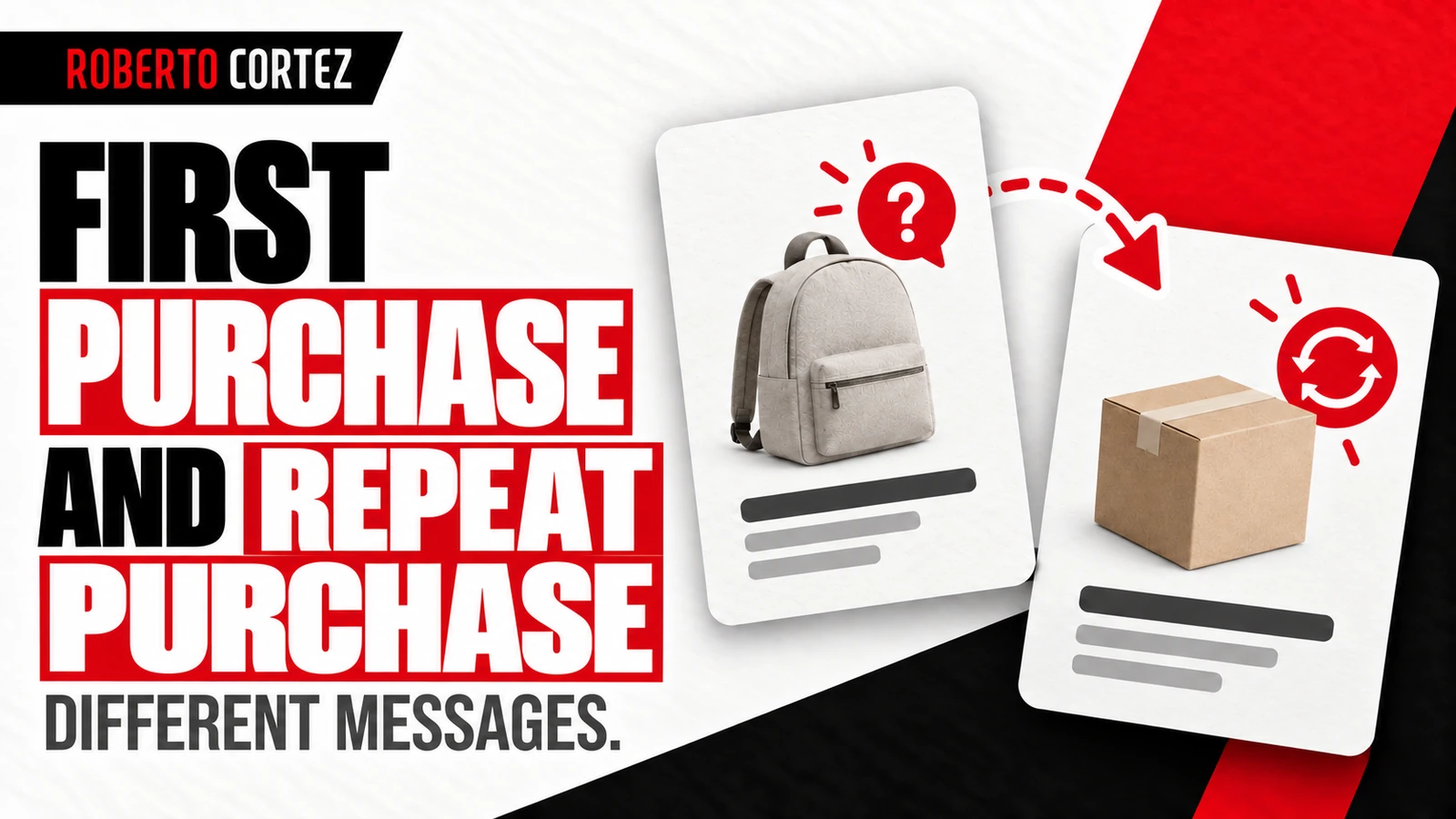
When I look at a store preparing a campaign, I want to know who the offer is intended for. Someone who has never received an order from that business has different questions from someone who already knows the product, delivery times and available support. Putting both in the same group hides that difference.
The same thing happens in reports. An increase in orders can come from more new customers, more active regular buyers or a combination of the two. Each explanation calls for a different decision about communication, investment and delivery capacity. Separating the strategies starts with being able to recognise these situations.
A first purchase requires a promise people can assess
To earn a first purchase, a store needs to make the decision understandable: what it sells, who it suits, what it costs and what happens after payment. Trust grows through specific, consistent information. An attractive promise loses strength when the page leaves essential questions unanswered and customers cannot assess the offer.
In a hypothetical example, a store sells a backpack for everyday use. A first-time visitor may want to check its dimensions, internal organisation, materials and delivery conditions. An advertisement about the backpack's style attracts interest, but the page must help people decide whether it holds what they usually carry.
At this stage, I would look for questions that prevent a decision before adding an incentive. Perhaps an interior photograph or a clear explanation of measurements is missing. A discount does not replace that information and also reduces the amount remaining from each sale.
I would also check continuity between the advertisement, page and purchase. The featured product needs to be available, the price should be understandable and additional charges should appear at the appropriate point. An acquisition campaign includes what the store can deliver after the click, because initial trust depends on that consistency.
To prepare your next step, explore Growing an online store.
Delivery prepares the next stage of the relationship
A repeat purchase strategy starts with the experience of the first order. Before asking for another purchase, the store should fulfil its promise, make progress easy to understand and resolve difficulties that arise. Subsequent commercial contact needs to consider that experience, including situations where a complaint has yet to be resolved.
If the backpack in our example has not arrived, a message about accessories may be premature. If it arrived with a problem, pressing for another sale ignores the reason the customer needs attention. Information about the order's status should help determine the next contact with that customer.
This connects with the work of customer retention in a service business: expectations, delivery and communication need to be linked. For a store, the relationship also involves product availability, shipping, use and support. The format changes, but the experience continues to influence a customer's willingness to return.
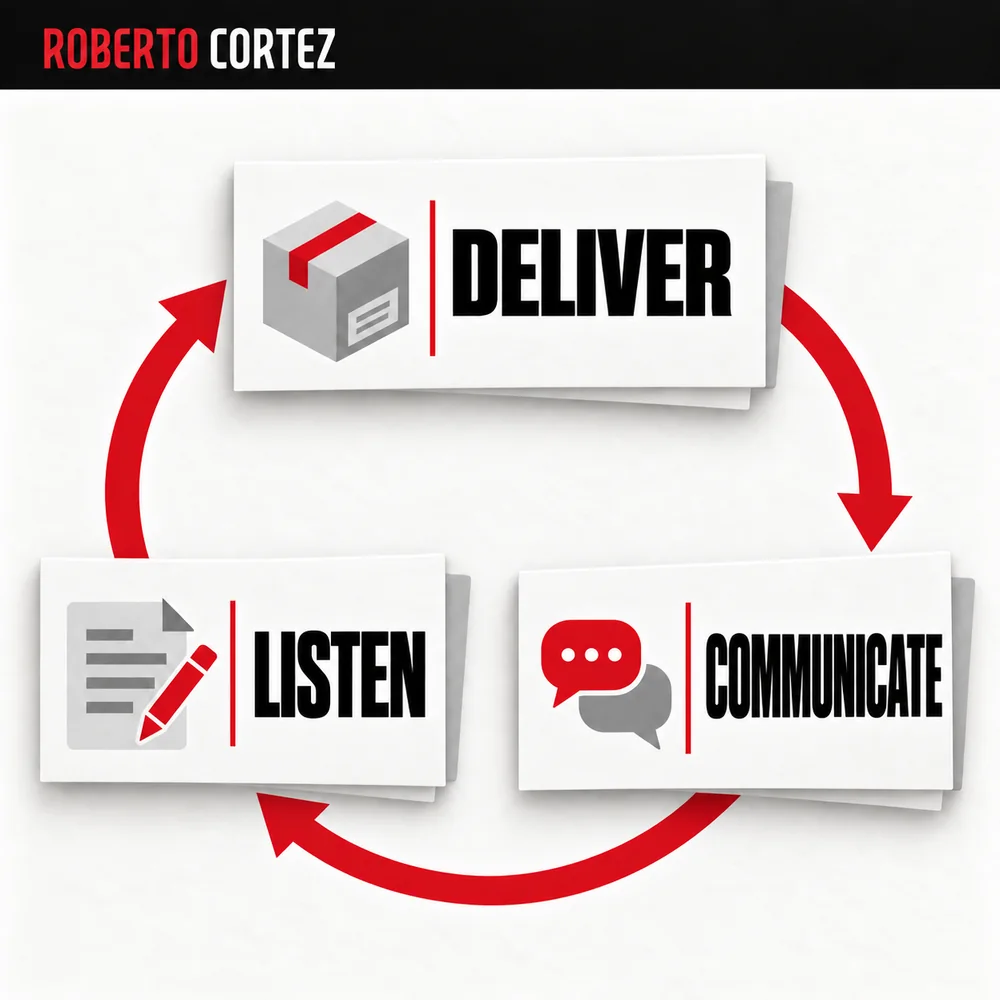
Listening does not mean sending questions with every message. I would ask for feedback once customers have enough experience to assess something specific. Frequency should fit the product and relationship, without turning every order into a sequence of requests for attention. A useful response deserves to be read and addressed.
A repeat purchase needs a current reason
A previous purchase provides information about the relationship, but does not prove that someone wants to buy again. The next offer needs to be useful when it appears. Replenishment, a complementary item and a new need are different possibilities, which should be assessed against the product and the behaviour actually observed.
A durable backpack does not follow the same replacement pattern as a consumable. Suggesting the same backpack shortly after delivery may have little relevance, while information about using it could be more useful. Even a compatible accessory only makes sense if it helps the customer and compatibility has been confirmed.
I would distinguish what the store knows from what it assumes. It knows that a particular product was purchased on a certain date; it may not know who uses it, whether it was a gift or whether it still serves its purpose. Treating an assumption as a fact creates artificial familiarity.
I would not assume that all previous customers are satisfied either. An absence of complaints does not confirm satisfaction, and a second order can have several explanations. Communication should use the available context without overstating knowledge of the person. When the reason for making contact is weak, reviewing the offer makes sense.
Reports should distinguish people from orders
To assess acquisition and repeat purchases, separate new customers, returning customers and the orders placed by each group. Then compare equivalent periods and establish the contribution from sales. An aggregate total can hide growth dependent on a few buyers or increased acquisition that has not yet had time to generate repeat purchases.
I would start by defining what counts as a new customer in the system being used. Someone ordering through another address may appear new, and a cancelled order should not be treated as a completed sale without explanation. Limitations in identification need to accompany the interpretation of the numbers.
To study repeat purchasing, I would compare groups whose first purchase fell within defined periods and who had equal observation time. Comparing longstanding customers, with months to return, against last week's buyers artificially favours the former. This discipline belongs to choosing indicators that show whether the business is improving.
Tools may attribute an order to a campaign, but that does not demonstrate that the person purchased solely because of it. Before reallocating investment, understand which sales a campaign is helping and where uncertainty remains. Acquisition, influence and repeat purchasing describe different dimensions of the same business.
Budgets should be supported by observed value
Budget allocation should consider the cost of acquiring customers, the contribution from orders and repeat purchasing actually observed. Expected future purchases can help build scenarios, but they are not equivalent to available cash. The less certain or more distant a repeat purchase is, the more carefully that assumption needs to be handled.
In a store selling products people buy infrequently, funding acquisition through imagined repeat orders can create financial difficulty. In another business, a consistent history of subsequent orders may justify a longer analysis. In both cases, revenue, variable costs, commercial investment and the timing of payments need to be considered separately.
I would not look for a universal percentage to divide acquisition and retention spending. I would identify a specific opportunity: explaining the first offer better, fixing delivery, proposing a relevant complementary item or improving the analysis of returning customers. Each intervention should have a hypothesis and a result the store can track.
Before the next campaign, I would write down two decisions: which question we will resolve for someone who has never bought, and what current reason we have to contact someone who has. Then I would choose an appropriate message and measurement for each. This separation clarifies the strategy and avoids asking for another purchase out of habit.