
Start with the promise the customer bought
The need for support depends on what you promised to deliver and the conditions under which the customer can use the product. A guide to understanding a subject requires a different response from an offer promising application to a specific situation. Review the sales page and identify which decisions legitimately remain the buyer's responsibility.
A low price does not remove the responsibility to fulfil the promise. Nor does it mean that every buyer is entitled to unlimited individual consulting. Explain the format before purchase, with examples of what is included and what would require a different kind of intervention.
Imagine a set of exercises for preparing a commercial proposal. If the promise is to help organise information, clear instructions and a completed example may be enough. If it includes validating whether the proposal suits a particular market, contextual analysis is involved that the document is unlikely to provide alone.
In this hypothetical example, the same file could belong to two very different offers. The difference lies in the commitment made to the buyer. Before discussing whether to open a group, schedule calls or answer emails, establish which of those two deliverables you are actually selling.
To prepare your next step, explore Build and grow an online training business.
Separate recurring questions from individual decisions
Recurring questions often justify improvements to the product, while decisions that depend on context may require human intervention. Record requests and identify their origin: access, understanding, application or choice. This distinction lets you address common weaknesses without turning every question into an individual conversation that the operation cannot sustainably support as sales grow.
Someone who cannot find the material needs help accessing it. Someone who does not understand an instruction may need a clearer example. Someone deciding between two business options is asking for a different level of analysis, even if all three write “I have a question”.
Start by answering actual requests and observing patterns. When several people stumble at the same step, review that step before hiring someone to repeat the explanation. An extra video or a more precise instruction may reduce work, provided it resolves the difficulty rather than merely adding more material to consult.
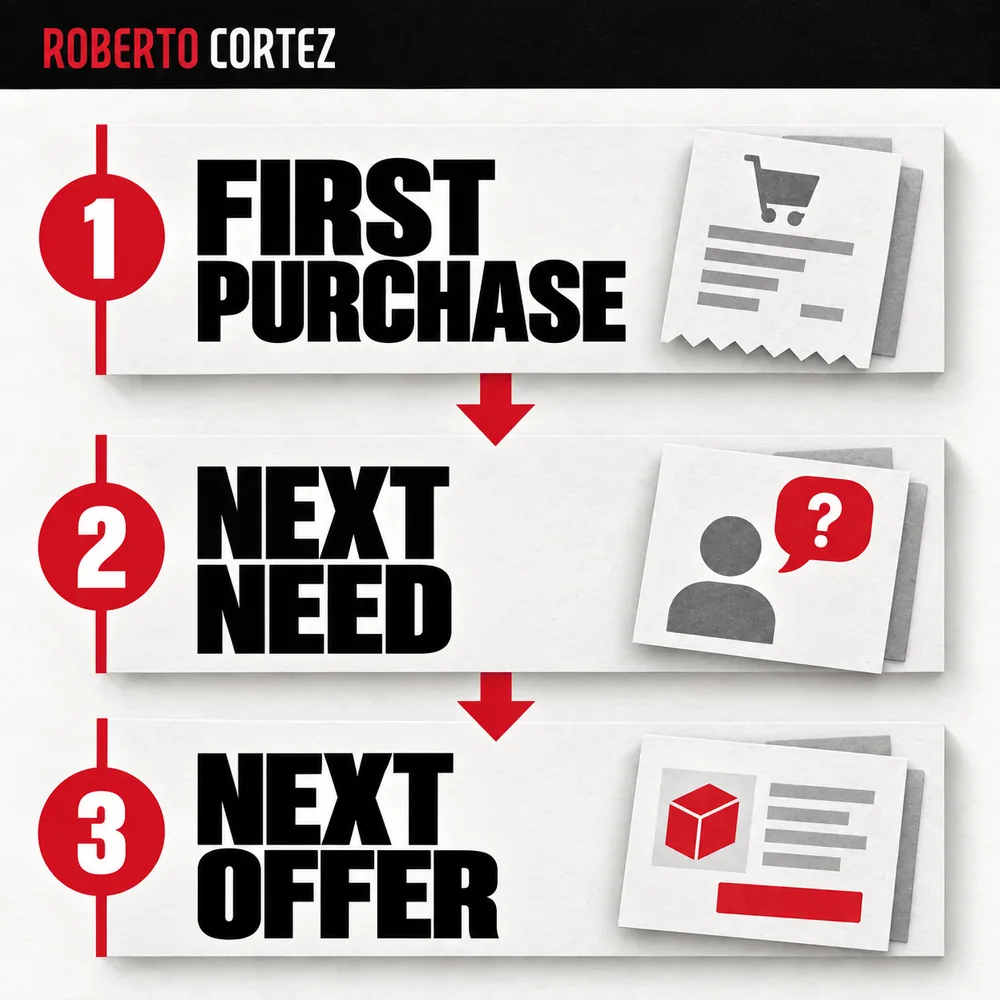
Individual decisions deserve another question: are they necessary to achieve the promised result? If so, support should fit within the design and price of the offer. If they represent a later development, explain that boundary and present a suitable option without using the customer's difficulty to pressure another purchase.
Include support in the economics of the offer
Assess support alongside acquisition, delivery and commercial continuity. Estimate time per buyer, the cost of the person responding and how requests concentrate after each sale. An offer may accept a reduced margin for a strategic reason, but that choice needs limits and evidence about what happens afterwards, beyond the initial product purchase.
An entry product can build trust and lead to higher-value services. I have seen that transition happen following a low-value purchase. It demonstrates a possibility; it does not mean that every buyer will follow the same route or that any support cost will eventually be recovered.
Record product revenue, delivery costs and observed subsequent purchases separately. If someone buys another service, include the cost and time of delivering that service too. Expected future revenue should not conceal an operation that loses capacity with every new customer entering the business.
The reasoning used to decide how much you can pay for a lead helps connect acquisition with potential economic value. Add another question here: how much of that available value is consumed by support before an ongoing commercial relationship exists?
Choose the support format to match the difficulty
The support format should match the type of difficulty and the level of context needed to answer it. Common questions may suit a group session; specific situations may require bounded individual analysis. Define the channel, scope and response time before selling so that both the buyer and the team know what to expect.
A group session can clarify a question shared by several people. To work well, it needs a theme or questions collected beforehand, preventing one case from taking up all the available time. Buyers should understand whether they can raise a question and how much depth the answer can offer.
Asynchronous support can make work easier to organise, but it also requires clear limits. Requesting context in a simple structure helps reduce exchanges that lack enough information. A well-presented question does not remove the need for judgement; it gives the responsible person better information with which to exercise it.
An individual call may be appropriate when the decision depends on information that cannot fit into a short answer. Define what will be analysed and what the customer should prepare. Avoid selling indefinite access to someone when you can actually deliver a specific intervention with a limited duration.
Distinguish product support from selling a service
Included support should help customers use what they bought without requiring them to accept a subsequent offer. A sales conversation may happen when a different, recognised need emerges. Keep that transition clear so that support is not presented as delivery while being used solely as an opportunity to sell something else to the buyer.
If a buyer needs an explanation that was already promised, that answer belongs to the product. If they want the company to perform all the work for them, another service may be appropriate. Explaining the difference preserves the usefulness of the initial product and makes the next decision understandable.
It also helps to assess the campaigns bringing in these buyers. Understanding which sales a campaign is helping to generate may reveal relationships that are not visible in the first purchase. Include time and costs in that analysis, keeping observed sales separate from expectations.
When execution changes, the support model may need to change too. When rethinking a service with AI, assess which decisions still require human context. Reducing repetitive work may free up time for that intervention, but it does not automatically define the format you should promise.
Review the first completed deliveries
Review support using the requests received, difficulties resolved and work actually performed. Compare these observations with the original promise and planned capacity, looking for specific deviations. Depending on the need observed in each case, you may improve materials, adjust limits, include support or create a separate offer dedicated to that additional assistance.
Do not use message volume alone as a measure of quality. Few questions could mean clarity, lack of use or difficulty finding the support channel. Find out whether buyers managed to do what the product was intended to help them do and where they became unable to move forward.
The choice becomes simpler when you understand the difficulty, the responsibility accepted and the effort required to respond. Human support belongs where it improves delivery in a necessary and sustainable way. Adding it without that analysis can create a promise that is hard to fulfil; removing it without looking at customers can leave the product incomplete.