

A company can serve businesses across several sectors while solving the same problem with the same deliverable. It can also work with very similar companies that need different kinds of help. An audience label alone explains little about the information someone needs to choose a service and move towards making contact with the provider.
When I organise a message, I want to understand what situation leads someone to seek help and what they need to clarify before deciding. That preparation helps determine the page content. Only then does it make sense to ask whether everyone can use the same explanation or whether the reading combines decisions that need separate paths.
Consider a fictional example: a company helps organise sales enquiries. Some teams still need to define stages and responsibilities, while others already have a defined process and want help executing it. We will use these situations to understand when one shared page is enough, when sections are useful and when separation serves a specific purpose.
Compare buying situations before naming audiences
Describe what each person wants to resolve, what already exists in the business and which decision they need to make. Compare observable situations instead of starting only with sector, job title or company size. Two categories may share the same need, while people with the same role may require different answers to assess whether the offer fits.
In the fictional example, “small businesses” does not distinguish between someone who needs to design sales follow-up and someone who already knows how to work but cannot execute everything. That difference changes the questions the page must answer. The first situation calls for clarity about organisation; the second requires understanding what work can be taken on and with which responsibilities.
Start with conversations and enquiries already available in the company. Record the situation described, the difficulty that prompted contact and the help expected, removing unnecessary private details. Do not turn one observation into an established segment; keep the distinction as a hypothesis until you can understand whether it provides useful direction for the company's communication.
It also matters to distinguish the service user from people involved in the decision. A sales manager and a business owner may approach the same offer with complementary questions. That does not require one page per job title, especially when both need to understand the same intervention before discussing it within their company and deciding together.
Write a short description of each situation without starting with the audience label. For example, “enquiries already arrive, but nobody knows who makes the next contact”. If the description remains the same when you change sectors, the shared need may provide a better foundation for the page than a division based on business activity alone.
The briefing to prepare before asking AI to write a sales page helps gather this context. Here, the purpose is to compare those contexts before choosing a structure. AI can organise recorded differences, but a list of invented personas does not demonstrate that distinct buying decisions actually exist in your business and need separate explanations.
By the end of this preparation, you should be able to explain what connects the situations and what separates them. There may be a shared problem with different priorities or two needs requiring their own interventions. That distinction gives you concrete criteria for discussing the page without assuming that more visual personalisation automatically makes the explanation more useful.
Identify what changes in delivery, evidence and the next step
Compare the information needed to assess each situation: included work, customer participation, relevant evidence and the next action. Separation becomes more compelling when those differences change the decision, beyond the wording of the opening. Confirm the actual scope first so a specific page does not promise a service that the operation has not yet defined or agreed.
In the fictional example, designing a process may require understanding how enquiries move through the business and who makes internal decisions. Helping execute an existing process may require understanding tasks, access and availability. The company must confirm whether it provides both services and on what terms before presenting two paths as options that customers can actually choose.
Evidence can also serve different purposes. An authorised example of documentation helps explain an organisational deliverable; a verifiable account of ongoing support can clarify a continuing engagement. A generic testimonial should not appear on both pages as though it demonstrates experiences the person never had with those services or results they never described in their account.
Do not rely only on a different headline to decide that a new page exists. Imagine removing sector names and comparing the main texts. If scope, arguments, examples and the form remain practically identical, look for a concrete reason to maintain two paths instead of counting different words as proof that the offers themselves are different.
Conversely, small wording differences can represent important conditions. A company with a team available to execute needs to understand a different responsibility from one seeking external execution. The criterion is not how many sentences change, but how those conditions affect service suitability and the commitment the visitor is considering as they decide whether to proceed.
Checking whether the offer answers what the customer is looking for remains necessary for every path. Splitting a page does not resolve an undefined offer. If nobody can explain what changes in delivery, start with that decision before requesting new copy, images or forms from the team responsible for preparing the pages and their supporting materials.
Keep a simple record of confirmed differences and those still needing clarification. A question about scope should have someone responsible for resolving it. Writing can proceed using valid information, but it should not fill a gap with an imagined advantage merely to justify the existence of another page that the original proposal does not yet support.
Choose a shared page, sections or standalone pages
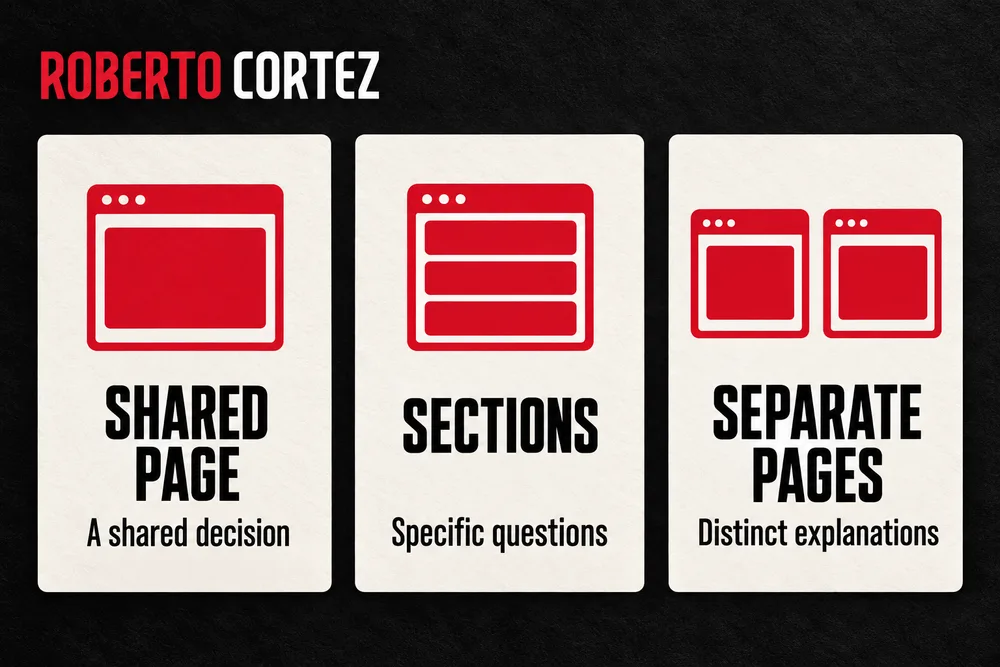
Keep a shared page when the decision and offer are common; use sections for localised differences; consider standalone pages when each situation needs its own explanation. Choose the simplest structure that preserves clarity. The number of audiences in your planning does not need to match the number of pages the company will create, publish and maintain afterwards.
A shared page can present the main problem and show examples of situations where the service helps. In the fictional case, that may be enough if the engagement always starts with the same assessment and differences are defined afterwards. The text should explain that initial evaluation without suggesting everyone receives an identical deliverable regardless of what they need.
Sections are useful when the essentials are shared but some information depends on the situation. You can explain what changes for someone with an existing process and someone who still needs to organise it. The person retains the overall context and finds the relevant condition without having to choose another address before understanding the service on offer.
Standalone pages become useful when each path has its own question, scope and explanation. If one presents process design and another ongoing execution, both need to make sense when someone arrives directly. A person should not have to read the other page first to discover what this particular offer includes or requires from them and their team.
A shared entry page can help present the options, provided it explains the distinction in recognisable language. This is particularly useful when visitors arrive without knowing the name of the service they need. The choice should come from the situation described, rather than internal categories that only the company's own team already understands and uses comfortably.
Avoid making everyone pass through an initial choice. A visitor arriving from a specific communication may already have enough context to open the relevant page directly. The journey should preserve that context and allow alternatives to be explored without turning navigation into a sequence of questions whose purpose nobody can explain clearly to the person using it.
Before deciding, sketch the reading journey with headings and short summaries. Compare the shared version, the version with sections and the separate paths using the same confirmed information. This exercise reveals where clarity improves and where you are merely distributing the same text across several places without helping the visitor make the decision they came to make.
Make the choice recognisable without trapping people in a label
Present paths through needs visitors can identify and explain what they will find in each one. Allow people to change paths when their situation combines elements from several audiences. The choice should guide reading without requiring perfect classification or hiding essential information behind categories that a person does not yet know how to interpret correctly for their case.
In the fictional example, “I need to organise the process” and “I want help executing an existing process” explain the distinction better than internal programme names. Even so, the company should test whether those expressions make sense to newcomers. A description that seems clear to the team may remain ambiguous to someone who has never worked with it.
There may be an intermediate situation: the business has defined some stages but does not know whether it needs redesign or operational help. Do not force it to claim certainty it does not yet have. A route for clarification can gather the context needed to assess suitability, provided it reflects the actual support or enquiry handling available.
Keep the option to explore the other situation visible when that helps explain the offer. A person may recognise part of their need in one path and clarify another part in the next. Moving between explanations should not mean losing what they have already understood or finding contradictory conditions attached to the same service in different places.
Path headings need to promise only what the page delivers. If a visitor chooses help organising responsibilities, that explanation should appear at the beginning. A page that returns to a generic company presentation makes the visitor repeat the search and leaves unanswered the reason they made the previous choice while trying to understand the available help.
Consider mobile reading too. An option hidden in something difficult to open can make the path less clear even with good copy. Test whether headings, summaries and links explain the choice without depending on a wide screen or a verbal explanation from whoever designed the page and already understands how its options are supposed to work.
If the team repeatedly needs to explain which button to choose, revisit the language before adding more paths. A concrete description may be missing, or the distinction may not be useful enough. Separation should remove interpretation work for visitors, and that usefulness needs to appear in the journey you observe rather than remaining an assumption in the plan.
Preserve context from the source to the page and enquiry
Connect each page with the message that brought the visitor and the information reaching the team after contact. The journey should preserve the need presented and the commitment requested. A specific page loses usefulness when everyone reaches a generic next step that requires explaining the context again without making use of information they have already supplied while choosing.
In the fictional case, communication about organising responsibilities should lead to an explanation of that intervention. The page may present other possibilities, but the initial reason for visiting needs to remain recognisable. People should be able to confirm they have arrived at the right place before assessing delivery details or related alternatives that might also be relevant.
The form should request information that helps decide the next step. For someone seeking execution, understanding the existing process may matter; for someone seeking organisation, describing where follow-up breaks down may help more. These are examples of possible questions, not compulsory fields for every service or permission to collect information without a clearly defined purpose for using it.
When someone selects a situation, preserve that information in the enquiry the team receives. Avoid making people repeat their choice because the page, form and enquiry handling were prepared separately. At the same time, allow the context to be corrected: an initial choice may have been provisional or based on a description the person interpreted differently from the team.
Organising a lead funnel the sales team can work with depends on this continuity. An enquiry should arrive with enough of its purpose to prepare a suitable response. Separate pages do not remove the need for shared follow-up criteria or automatically turn each form submission into an opportunity ready for a proposal and a commercial commitment.
Check that the text beside the button matches what happens next. Requesting an assessment should not look like purchasing a service, and selecting a path should not suggest the project has been accepted automatically. Explain only the confirmed process, using the appropriate internal form for personal contact and without inventing availability or response times the team has not established.
Test the journey as a whole: source, opening, conditions, action and context received. An inconsistency may lie outside the page body, such as a message promising execution when the offer provides guidance only. Correcting that transition may be more useful than creating another page to compensate for expectations formed before the visitor began reading the service explanation.
Confirm each page has distinct content and can be maintained
Before maintaining separate paths, check that each page has a distinct question, a complete answer and someone responsible for updating its information. Identify what is shared and what depends on that situation. Separation remains useful only while conditions stay consistent, without creating copies that diverge whenever the offer or the contact process changes for the business and customers.
In the fictional example, the introduction to the provider may be shared while scope and customer preparation differ. You do not need to invent a new story for every audience. You need to preserve the same identity and explain the relevant intervention without claiming specific experience in sectors or situations that the company cannot yet demonstrate with appropriate evidence.
Review claims of specialisation particularly carefully. Changing a sector name in a headline does not demonstrate knowledge of that sector. If process differences exist that the company understands and can address, explain them; if they do not, a shared page may reflect available capability more faithfully than a collection of promises adapted only on the surface of the text.
Record where shared information appears, such as contact arrangements or the description of a common component. When that information changes, the review should reach every relevant place. Editorial work must avoid leaving people with two incompatible descriptions of the same condition and forcing them to decide which version represents the current offer they are considering for their business.
Account for the effort of maintaining languages and related materials too. A difference introduced in one version must remain correct in the others. Splitting pages creates review responsibilities, and that capacity should inform the decision from the beginning instead of appearing as unexpected work after several paths have been published and already need to be kept consistent.
Do not make the number of addresses a growth objective. To justify a standalone page, show what someone can understand or decide there that remained confusing in the previous structure. Without that answer, increasing the inventory may simply spread the team's effort across content that continues competing to perform the same function for the same buying decision.
Keep a record of the decision and the conditions supporting it. If the services become more similar or the distinction loses relevance, reassess the structure before creating further variations. This review does not mean impulsively deleting or changing addresses; it requires analysing the existing journey and preparing any change with appropriate care for the people already using it.
Assess understanding and enquiry quality in each path
Check whether people in the intended situations can choose a path, explain the offer and recognise the next step. Then follow the enquiries received and remaining questions. Compare similar contexts and record other changes during the period so you do not attribute effects to page separation that may also come from visitor sources or the sales work performed afterwards.
Start with a concrete reading task without pointing to the option you expect the person to choose. Present the fictional situation and ask them to find suitable help. Observe hesitation and the information they use, because a correct choice made by chance does not demonstrate that the path labels are clear enough to support an informed decision.
Then ask for an explanation in their own words. What do they expect to receive, what work remains with their team and what do they expect after the enquiry? If the answer describes another offer, identify the wording that created that interpretation before adding more copy or concluding that the site needs an additional page to resolve it.
Include situations that span both paths and situations without a clear fit. The structure should help recognise these cases and seek clarification without promising every need will be served. A reading exercise helps identify concrete problems, but does not automatically represent the entire audience or prove a general commercial improvement attributable to the new arrangement of the pages.
After real use, review enquiries with the team following them up. More submissions may coexist with more incorrect expectations; fewer enquiries may require understanding why that changed. Connect volume, context and suitability, keeping limitations visible when there is still too little information to compare the paths fairly and decide what the observed difference actually means for the business.
The guide to positioning and value proposition helps revisit the broader choice behind these pages. Structure should serve the relationship between audience, problem and deliverable. If that relationship still changes from one conversation to another, clarifying it may be more useful than continuing to reorganise navigation without resolving the underlying question about what the company offers.
I would separate pages when I could show the distinction each one makes clearer and had the capacity to maintain that explanation. Where the decision is shared, I would keep one clear page; where the question is localised, I would start with sections. The final criterion is usefulness to the person choosing, grounded in what the company actually offers and can explain.