

A business owner may say they need money while still being unsure what work they want to fund. They may also look for another course when they already know the steps but have not reserved capacity to carry them out. A request for support becomes more useful when it describes the specific difficulty rather than choosing whichever resource seems easiest to request.
This does not mean there is always one need or that better organisation solves every limitation. Some projects need knowledge, people and financial resources at the same time. The question is what each contribution does and what sequence makes it usable, without assuming that bringing in one resource automatically resolves the other conditions necessary for progress.
I will use a fictional example: a company wants to test a new service for organising sales enquiry follow-up. It has collected some expressions of interest but has not yet demonstrated repeatable delivery. The founder is considering a partner, although it remains unclear whether the missing element is service design, test execution or covering the expenses of that execution.
Define the stalled work before choosing the resource
Describe an action the business needs to complete and the condition currently preventing progress. Use a concrete case with an expected result and known responsibilities instead of a broad ambition to grow. Then ask what the requested resource would change and what work would remain blocked even if that support were already available to the business tomorrow.
In the fictional example, “launch the service” combines very different decisions. The company may still need to define the problem it solves, prepare a working process or make someone available for the first test. If everyone interprets the launch differently, the request for support starts without a shared understanding of what actually needs to happen next.
Choose an observable point in the process. For example, the company wants to prepare a test proposal, but nobody can explain the included tasks or how delivery will be checked. Hiring execution at this stage may add capacity without direction; the first task is to clarify scope, with expertise and input from whoever understands the customer.
Ask what already exists and can be used. The team may have experience with a similar service, useful documentation or partial availability that has not been considered. This inventory is not about pretending the business can progress without new resources; it distinguishes what is missing from what has not yet been mobilised for the work in question.
The diagnosis before proposing a marketing plan begins with the same care to understand context before choosing an intervention. Apply that care to the request for support itself. A statement such as “we need a team” must lead to tasks, conditions and work outcomes that make the contribution understandable and allow someone to assess what is being requested.
Keep the description separate from your preferred solution. “The proposal cannot progress because scope has not been decided” is different from “we need a commercial partner”. The first opens a discussion of alternatives; the second has already chosen a relationship before demonstrating that the relationship is necessary to resolve the difficulty identified in the current work.
By the end, you should be able to complete a simple sentence: we need to do this work, this condition is missing and the requested resource would let us advance in this way. If you cannot complete it yet, the next task may be clarifying the need itself. That diagnosis is valuable when it ends in a usable decision rather than extending preparation indefinitely.
Seek knowledge to answer a question that changes the decision
Knowledge is needed when you cannot assess options, define criteria or recognise suitable execution. Identify the question requiring an answer and the decision that answer will enable. Before seeking more information, check what you already know how to apply and reserve the conditions to turn learning into observable work, with someone responsible for making that transition within the business.
In the fictional service, the founder may need to understand how to define an initial deliverable without promising to organise the customer's entire operation. That is a concrete question which may benefit from guidance. A general request to learn selling or growth leaves unclear what choice will follow and how the conversation will help unblock the proposed test.
Knowledge does not necessarily mean enrolling someone on a course. It may come through mentoring, specialist review, research or work undertaken with guidance. The format should match the question and the capacity to apply the learning, rather than being selected only for the amount of material, the presenter's reputation or the enthusiasm the experience creates at the time.
It is also useful to distinguish missing information from a postponed decision. The team may know the alternatives and still be waiting for someone to choose the scope. More research may not change that waiting point; you need to identify who decides, what information they consider sufficient and what uncertainty remains acceptable for the next bounded step.
I place importance on applying existing knowledge before looking for the next learning opportunity. That does not mean executing without preparation when essential expertise is missing. It means asking which available knowledge has not been used and whether the stated need comes from a real question or from the absence of room to work on what is already understood.
Define the outcome of knowledge support in a verifiable way. In the example, it could be an initial scope the team understands, with criteria for recognising what belongs inside and outside delivery. A meeting held or document received demonstrates activity; the useful result appears when someone can use those criteria to prepare a coherent proposal for the test.
Agree who will apply that knowledge too. A mentor can help discuss options without taking over service execution, and a specialist can clarify a question without managing the business. Making this boundary clear allows you to seek knowledge with appropriate expectations and avoids confusing a good explanation with work that someone else has agreed to perform for you.
Check whether the team needs expertise, availability or authority
Seek team capacity when defined work requires people who are capable and available to perform it. Distinguish missing expertise, insufficient time and limited authority, because adding someone does not automatically resolve all three. Check the internal support required too, so you do not count on a new person while essential decisions still have no owner or remain unanswered.
In the fictional example, once the test is defined, someone may be needed to prepare the configuration and support initial use. If nobody knows how to implement it, there is a need for expertise. If the expertise already exists but everyone has incompatible delivery commitments, the question concerns availability and how capacity can realistically be organised for this work.
Authority is another condition. Someone may know how to execute and have time, but still need permission for every small choice. Before concluding that the team needs reinforcement, identify decisions that could be governed by criteria and exceptions; otherwise, the new person may simply join the queue waiting for the founder before work can continue moving forward.
Describe the work someone would receive at the start. What context would be available, what access would be needed and how would delivery quality be confirmed? If the answer depends on information nobody has prepared, that preparation belongs in the sequence. An available person cannot make a request executable when its meaning changes according to who explains it.
The care involved in growing with margin, a team and processes helps frame the choice. Additional capacity should correspond to work the business can guide and sustain. Adding people to a plan is insufficient if you assume coordination, learning and verification will appear without taking any time from those already responsible for running the operation and completing existing commitments.
If the work is bounded, describe the deliverable and necessary handover. If it is recurring, identify frequency, responsibilities and continuity conditions. This analysis does not yet select a contractual arrangement; it clarifies the operational need so alternatives can be discussed against the same work, without confusing a limited test with an ongoing responsibility that continues afterwards.
Finish with a realistic allocation: who executes, who decides and who confirms that delivery serves the objective. Once these roles are clear, you can assess the contribution to add. If they all remain concentrated in one unavailable person, the request for a team must include reorganising that dependency as well as looking for additional skills elsewhere.
Connect capital to specific expenses and timing
Financial capital deserves discussion when identified work requires expenses that available resources cannot cover under the planned conditions. Explain the purpose, timing and assumptions of the request, distinguishing confirmed amounts from estimates. Before choosing how to obtain resources, show what execution would become possible and which conditions would still be needed to put those resources to meaningful use.
In the fictional example, a test may require paying for technical preparation and tools before generating any revenue. That need can exist even without customers. The founder should explain which part of the test will be performed, what they want to learn and how the expenditure relates to that work, without presenting initial interest as money already secured.
Organise expenses by purpose and expected timing. Distinguish starting the test from the work continuing afterwards, so the request does not cover preparation alone and leave actual use unaccounted for. If amounts depend on quotes not yet received, preserve that uncertainty and identify what must be confirmed to determine the resource need with a sufficiently clear basis.
Expected results and available cash are not equivalent. A project may incur expenses before receiving money, so the timing of inflows and outflows matters. A favourable forecast does not remove that analysis, which should distinguish confirmed information from expected receipts and the conditions that may change when or whether those receipts become available.
Ask what would happen if the amount requested were available tomorrow. Is delivery defined sufficiently, are capable people available to execute it and are decisions ready to allow work to start? If not, the request may still make sense, but it needs to include those preceding steps rather than stating only the financial amount you would like to obtain.
Do not reduce the analysis to seeking the lowest possible amount. An underestimated need can leave work unfinished, while a request without a clear purpose makes the contribution difficult to assess. The aim is to explain the connection between resources and execution, keep assumptions visible and prepare the appropriate analysis before taking on any specific financial commitment.
A participation proposal and a service engagement are different relationships too. Explain whether you want resources to execute defined work or someone to participate in developing the business, potentially with several contributions. Any participation terms must be discussed later; this diagnosis does not predefine ownership percentages, amounts or another person's availability before those matters have actually been agreed.
Sequence support around the conditions that make it usable
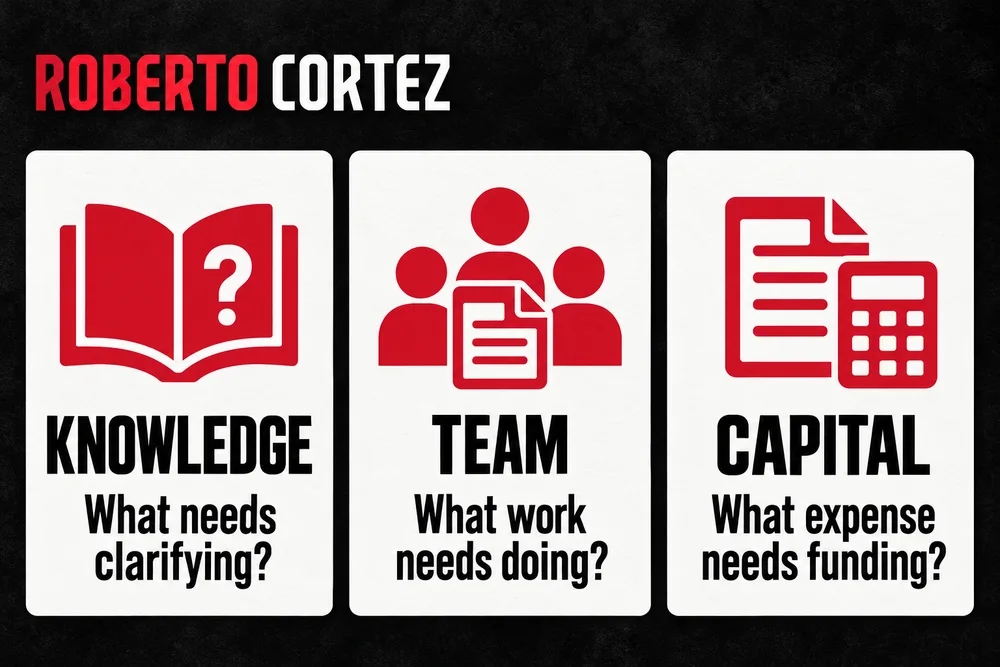
When you need more than one resource, identify the dependencies between them and organise the work sequence. Some contributions can progress together; others become useful only after a decision or preparation. The plan should show these relationships so knowledge, people and capital meet when they can contribute to the next verifiable outcome rather than simply appearing together on paper.
In the fictional service, it may be necessary to clarify scope with guidance while gathering information about implementation effort. Once the test is confirmed, it makes sense to assess who will execute it and which expenses it requires. The sequence need not be rigid, but each early action should have a purpose those involved can understand and explain.
A specialist can contribute before a complete definition exists by helping discover limitations or options. In that case, the first task is diagnosis or design and should be presented that way. Do not confuse it with a fully specified implementation whose result has already been defined, because that changes expectations about what can be accepted at the end of the stage.
It may also be necessary to discuss financial resources while some conditions remain open. The conversation should distinguish estimated need from unresolved decisions and explain how missing information will be obtained. That distinction lets you explore a possibility without incorporating capital, a team or participation into the plan as though someone had already committed to providing them.
Write what each stage supplies to the next one. A scope decision may allow a technical proposal to be requested; a proposal may allow effort and timing to be assessed; a test may allow the offer to be revised. If you cannot explain that connection, you may be grouping interesting activities without showing how they develop the business.
Identify the work that remains with the founder. Seeking support does not remove the need to understand the customer, prepare context and make decisions about the project's direction. External contribution needs real participation, with availability proportionate to the request, rather than depending on answers the founder can provide only when some time happens to be left over.
Reserve a review point between significant commitments. Learning from defining delivery may change the expertise required or show that the test should have a different scope. Reviewing the resource combination then lets you adjust the request to the actual work instead of defending an allocation chosen before the conditions now visible had been understood by the people involved.
Define evidence that support resolved the original need
Before seeking a resource, describe what you will observe to determine whether it enabled progress. Connect assessment with the question, task or expense that justified the request, keeping external conditions visible. Receiving advice, bringing someone in or obtaining resources demonstrates availability; the effect must appear in completed work and information that enables the next decision about the business.
In the fictional example, knowledge support can be assessed through the ability to explain scope and choose enquiries suitable for the test. Execution support can be observed in usable delivery and an understood handover. Capital should be followed through its intended use and the work it made possible, without turning that use into a guarantee of commercial success.
Choose signals close to the need. If the problem was not knowing how to define delivery, counting meetings does not show the uncertainty has been resolved. If execution capacity was missing, adding a name to a list does not demonstrate progress. Observe decisions made, work completed and conditions verified according to why each contribution was originally sought.
Keep a record of what remained stalled too. An initial need may have been resolved well while another dependency became visible afterwards. That does not make the support useless; it helps explain the next stage. The care needed is to avoid making the new resource responsible for resolving work that was never included in the request or agreed scope.
If the hypothesis was wrong, revisit it using examples. A team may have received capacity and still be unable to progress because scope changes in every conversation. That observation calls for a decision about the service rather than immediately concluding that another person must be hired or more resources supplied to the same continuing uncertainty about the work.
Distinguish learning from confirmation. A test showing poor fit can provide useful information for reducing or changing an initiative. The next decision should consider what was observed, without treating time and resources already invested as sufficient reason to continue exactly with the original plan that the test was supposed to help assess before a further commitment was made.
Record the result, interpretation and next choice separately. The result describes what happened; interpretation seeks to explain why; the choice states what you will do with that information. This separation helps conversations with potential partners without turning a convenient hypothesis into a conclusion that the completed work does not yet support or establish with sufficient evidence.
Make a request that allows the contribution to be assessed
Present the business, the work needing progress and the contribution you want to make that possible. Explain what you have already put into the project and what you will continue taking responsibility for. If several resources are needed, show how they relate so the other party can assess the context rather than receiving only a general request for help.
In the fictional scenario, the founder can explain that they want support to define a test and assess the execution required. That is more precise than announcing a need for knowledge, a team and money to grow. The request can remain open to discussion while already making clear the first question and what work exists to help clarify it.
Show the commitment already made without reducing it to a monetary amount. Time, work, research, development and a team can all help explain the project's stage. If you do not yet have customers, state that and explain what you have done to understand the need; do not invent demand to make the business appear further advanced than it is.
The guide to a strategic partner for businesses and startups helps distinguish a specific contribution from possible ongoing participation. Not every need for knowledge requires a partner, and not every execution need requires sharing the business. Clarify the contribution first, then discuss the suitable relationship, with responsibilities compatible with the work and with what both parties expect from it.
If you want to present a project to me, use the internal investment form and indicate whether you seek knowledge, a team, financial capital or a combination. Explain what you have already built and where that contribution would fit. Customers are not required, nor is there a mandatory minimum previous monetary investment; submitting allows assessment of context without confirming participation or funding.
I want to understand the work that would make a difference and the involvement of those developing the business. A clear request makes it possible to discuss both the desired support and the conditions needed to use it. It also allows recognition that the first need may be different, before commitments are created that the project is not ready to assume.
I would start with the question that opened this exercise: if the resource were available tomorrow, what could we do and what would remain unresolved? The answer helps seek the right contribution for a specific stage. Execution and learning then show whether the hypothesis was correct or whether the request needs revising before the business proceeds further.