

Compare revenue growth with the structure it requires
A larger team should bring useful capacity to the business, and that capacity involves execution, coordination and learning costs. The comparison needs to include changes on both sides. If revenue grows while commitments increase even more, the additional volume may leave the operation with less room to make decisions and absorb difficulties.
In my businesses, there were phases when I prioritised growth and others when I paid more attention to profitability. I also had to recognise that not every hire addressed a sufficiently clear need. That lesson changed how I viewed the structure: each addition needs to make sense for the work and the project's current stage.
I do not draw an automatic preference for small teams from that experience. A hire can improve delivery, reduce dependencies or enable work we could not previously do. To evaluate the decision, I need to explain what capacity it adds, who will provide direction and how I will establish whether that capacity is being used.
This builds on what I learned about growing with attention to margin, the team and AI. Size follows from the choices a business requires. When it becomes an objective in itself, it is easy to celebrate a larger structure without checking whether that structure brings us closer to the outcome we actually want to achieve.
To prepare your next step, explore Service pricing and profitability.
Use comparable figures before celebrating volume
Comparing two moments requires equivalent periods and the same approach to recognising costs and revenue. Include the work needed for delivery alongside customer acquisition and operational support. An analysis that leaves out some costs can present attractive growth while hiding the pressure that growth has created within the business and its supporting structure.
Consider a simplified hypothetical example using monthly amounts excluding VAT. In the first scenario, revenue is €40,000 and the costs included total €30,000. In the second, with a larger team, revenue rises to €60,000 and the same categories of costs total €53,000. Both scenarios use the same basis for the costs being compared.
The difference between revenue and those costs falls from €10,000 to €7,000 despite higher revenue. We are not calculating net profit: tax and financing effects, for example, have not been included. The example only shows that a higher volume can leave less value after the structure considered in this comparison has been accounted for.
The second scenario could also create more value, or represent a temporary preparation phase. Deciding requires knowing delivery quality, team utilisation and expectations for the capacity created. This is why indicators of business improvement need to put revenue in context rather than treating it as a complete answer to whether the business is becoming stronger.
Include coordination work and dependence on the founder
A team can grow without autonomy increasing proportionally. If every decision still goes through the same person, each new project adds requests, reviews and competing priorities to resolve. Real capacity depends on clear responsibilities, working criteria and conditions that allow other people to make decisions within their scope, rather than merely adding more hands.
During my own journey, I began separating marketing and sales work more clearly from operational and people management. Recognising where I could contribute best was important to that change. Dividing responsibilities helped me see management as a function that needed to be carried out well, regardless of the title I personally happened to use.
When assessing a larger team, I look for where work gets stuck. People may be available to execute tasks while a decision, approval or sufficient information is missing. Hiring more execution capacity under those conditions does not necessarily resolve the constraint on delivery and may increase the amount of work waiting for the same unresolved input.
Integration time also belongs in the decision. A new person needs context, guidance and conditions for taking ownership, even when experienced. If that effort has not been planned, the team may feel more pressure initially, precisely when the hire was presented as a way to relieve the existing operation and reduce the burden on its people.
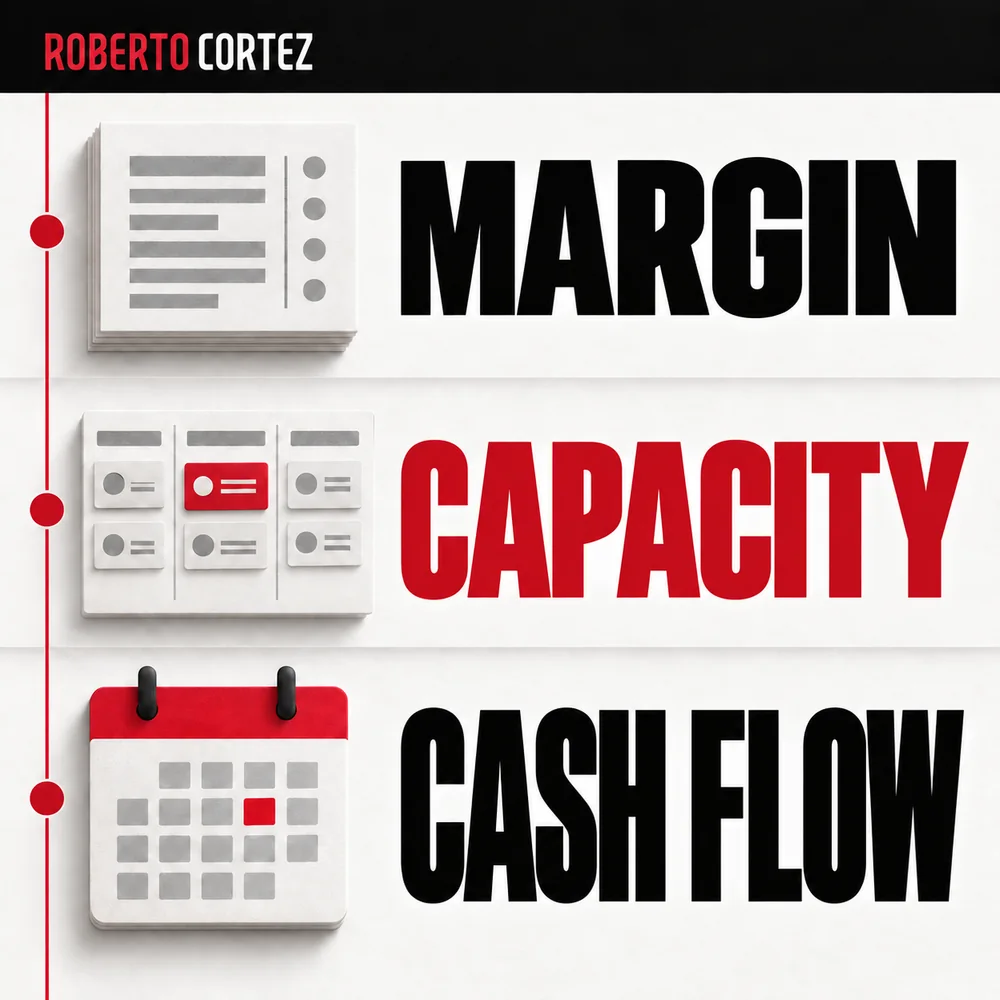
Review resource use before adding more structure
Before expanding the team, examine where current resources are used and where avoidable work exists. Repeated processes, unused tools and unclear handovers can consume capacity without improving delivery. This review helps establish the real need without assuming that every limitation has the same solution or that every busy team automatically requires additional people.
There was a phase when we increased revenue without expanding team resources, through process improvements and the use of AI. That was an experience in my business within its own context, without a percentage I can transfer to every company. The useful question to recover concerns which work could be organised differently before assuming another hire is required.
We also began paying closer attention to subscriptions that renewed without clear use. Confirming who uses a tool and what it serves became part of cost control. That practice does not mean removing everything that looks secondary: a tool may fulfil an important function even if only a small number of people use it.
The same discipline applies to commercial effort. Before increasing advertising spend in pursuit of more profit, I need to connect acquisition with contribution and delivery capacity. More demand may reveal an opportunity, but it may also put pressure on an operation that cannot yet fulfil the work it has already sold to its existing customers.
Define what you want to improve and when to review it
A better business needs a concrete definition for its current stage. It may mean a better result, more consistent delivery, less dependence or capacity for a new offer. Choose the effects that justify the structure and a review date, distinguishing temporary investment from a difficulty that continues without a clear explanation or useful progress.
If the team grew to prepare a new line of work, identify the conditions required to put it to use. There may be learning and costs before revenue arrives. That decision deserves its own monitoring, with an affordable limit and signs of progress, instead of relying only on an expectation that growth will eventually appear.
Cash also belongs in this assessment. Invoicing and receiving payment do not necessarily happen together, while salaries and other commitments have due dates. An operation can show more sales and need more available money to support them; monitoring receipts and payments therefore helps establish the actual room available to maintain the structure through that period.
Putting these elements together lets me discuss team size more precisely. I want to know whether people have useful work, whether delivery maintains quality and whether the operation's economics support its commitments. Higher revenue becomes one part of that assessment, connected to the kind of business I am actually building and the responsibilities it creates.