
It is possible to spend a long time choosing features without presenting the product to anyone willing to pay for it. The catalogue grows, more pages appear and the integration list gets longer. Meanwhile, the question that should guide those decisions remains unanswered: is there an offer a customer wants to buy on these terms?
I prefer to make that question specific before increasing investment. A first version can be simple and carefully prepared, with a scope that lets you keep track of orders. The test should produce information for deciding the next step, including the possibility of changing the offer or choosing not to proceed.
Define the offer you will actually test
A demand test needs to identify the product, likely buyer, practical use and purchase conditions. Otherwise, everyone imagines a different offer and their responses become difficult to interpret. The first decision is to choose a proposal specific enough to support a real commercial assessment of what you intend to sell.
As a hypothetical example, imagine you want to sell organisers for small desks. Saying that you will create an office accessories brand leaves many possibilities open. Choosing an organiser with defined dimensions, materials, price and delivery time makes it possible to understand the option you are presenting to a buyer.
The situation in which it will be used also matters. Someone who needs to free up working space may assess dimensions and storage differently from someone looking for a decorative object. The offer should provide information that helps people recognise its usefulness, without assigning benefits to the product that you have not demonstrated.
This resembles the diagnosis I carry out before proposing a marketing plan: understanding the offer, audience and available resources before choosing an intervention. A list of store features does not replace these decisions. It can even make discovering that the original offer needed changing more expensive.
To prepare your next step, explore Validating business ideas.
Build what is necessary for an informed purchase
The first version should let people understand the offer, make a purchase and receive what was promised. Simplifying can mean reducing products, customisation and integrations. Essential information, a functioning payment process and the ability to deliver need to be present for the test to provide a valid commercial experience.
For the organiser example, I would start with accurate photographs, dimensions and an explanation of what is included. I would make the price, availability and delivery conditions understandable. If the product cannot yet be purchased, I would state that clearly and treat collected contacts as expressions of interest, without counting them as sales.
Manually confirming a step may be enough for a small test, provided it does not cause errors or promises you cannot keep. I would record the work each order requires. That information helps determine whether a task should be automated as volume grows, instead of purchasing integrations in advance.
When starting a business with AI support, the speed of creating text and pages can help prepare this version. However, descriptions still need to match the actual product. Being able to produce a presentation easily does not demonstrate demand for the offer or show that operations are ready.
Distinguish an opinion from a buying decision
Positive comments, clicks, requests for information and orders represent different signals. They can all support learning, but should not be added together as though they meant the same thing. To assess commercial demand, track how many people reach a purchase decision on the terms presented and what happens afterwards.
Someone may praise the organiser without having a desk to use it on. Another person might click out of curiosity and discover that the dimensions do not suit them. A question about delivery reveals a specific doubt, but remains different from a confirmed order. Recording those distinctions improves the interpretation of the test.
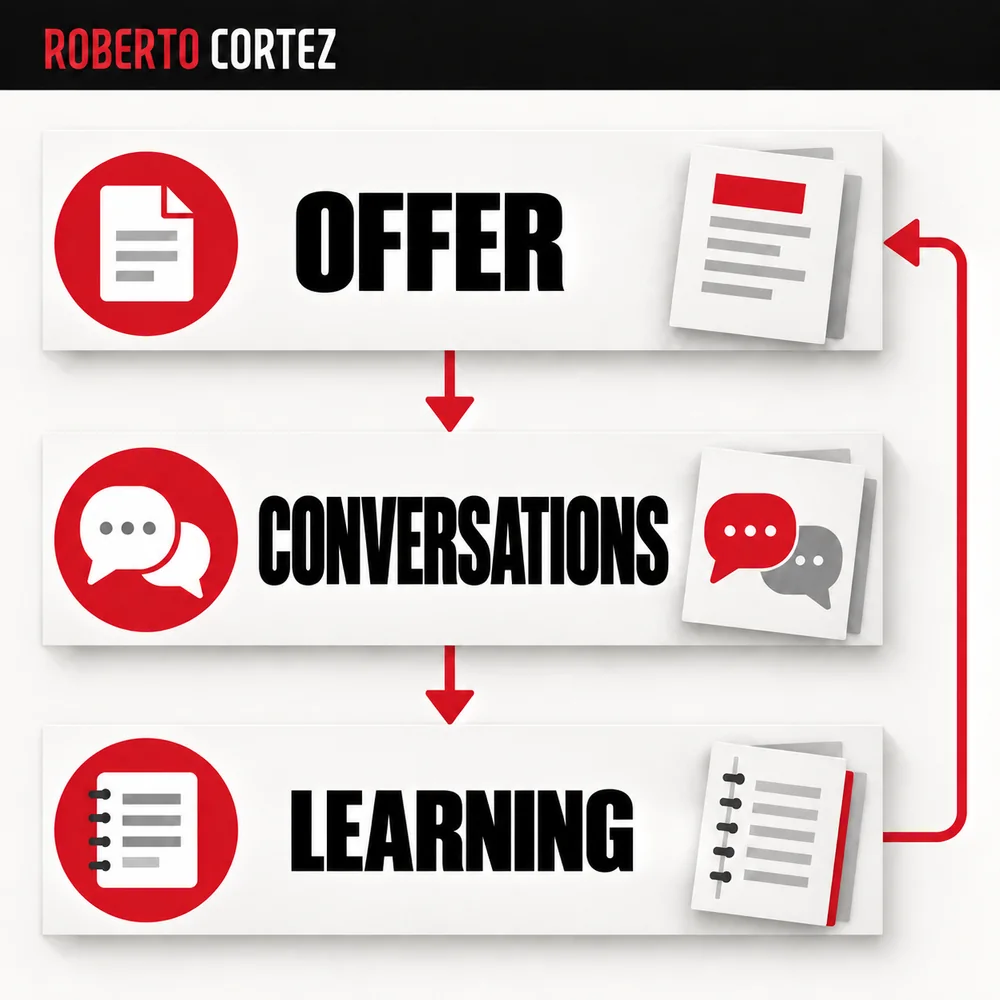
In conversations, I would try to understand the context without leading the answer. I would ask how people currently organise their space and what information they need to decide. Their words can help improve the page, but the conversation does not justify inventing demand, testimonials or results to make the presentation more convincing.
Even a purchase needs context. An order from someone close to the founder may have a different motivation from one placed by a buyer who discovered the offer independently. That does not invalidate the sale, but limits the conclusion. Validation becomes more useful when we can explain where the observed signals came from.
Give the test conditions that support a useful answer
Before starting, define what you want to learn, which resources you will commit and when you will review the information. The test needs to reach plausibly interested people and present the offer clearly. A poorly executed attempt may leave demand unresolved, even if it ends without producing any orders.
I would first check that the page opens, the product can be purchased and orders are recorded correctly. A payment error changes how the result should be interpreted. Likewise, a campaign aimed at the wrong usage situation may assess the selected message without clarifying the potential of a different offer.
When advertising is involved, establish whether the advertisement had the conditions and budget to be tested. No universal number of clicks validates every product. Purchase value, the decision process and traffic quality influence what the test allows you to conclude about the particular offer being presented.
I would avoid changing the product, price, audience and page simultaneously without recording the changes. If orders appear, understanding what contributed to the difference will be difficult. At each review, I would separate what we observed, the explanation we are considering and the next test needed to clarify it.
Base the next investment on what you learned
After the test, assess observed demand alongside the ability to deliver and the contribution from orders. Selling a product does not, by itself, demonstrate that expanding the store is worthwhile. The next investment should address an identified need and be proportionate to the evidence that is actually available.
I would account for the product, packaging, shipping paid by the store, payment costs and relevant operational work. The money spent acquiring those orders also belongs in the analysis. A price that attracts interest may leave little contribution for acquisition or support; discovering this early lets you revise the offer before increasing commitments.
I would consider three paths: keep testing the same offer, change it in response to an identified difficulty or suspend the project. An inconclusive response is also information, provided it is not presented as validation. The cost of continuing needs to be compared with what we can still learn.
I would only add complexity when I could explain its purpose. If manual management is causing errors, an integration may address a real need; if buyers do not understand the product, the offer may remain the priority. Store growth is better informed when each investment responds to a decision that has already been clarified.