

Start with the question you need to answer
Before opening a library, choose the communication question you want to explore. You might look for ways to explain a complex service, address an objection or present a demonstration. That question guides your collection and prevents you from ending up with dozens of attractive images without knowing what to use.
If you sell a service your audience does not yet understand, research can focus on advertisements that make a process visible. If people understand the offer but delay deciding, look at how other businesses explain conditions, the effort involved or next steps. These searches may find similar formats while leading to very different decisions.
Write down your question in a sentence before starting and set a limit for collecting references. That might mean a short session or a small set of sufficiently different examples. The aim is to find material to think with, not to complete a collection that keeps expanding whenever another interesting advertisement appears.
Understanding the market also helps you choose where to look. Thinking about selling services through an understanding of the market and competition should come before choosing a visual style. Communication that appeals to an occasional buyer may be unsuitable for someone who needs to justify a purchase within a company.
To prepare your next step, explore Artificial intelligence in digital marketing.
Record what you see and separate what you imagine
In an advertisement you can observe the message, format, offer and requested next step. You can form hypotheses about its audience or campaign purpose, but you should identify them as hypotheses. The apparent lifespan of a piece, on its own, does not reveal costs, sales, contribution or incremental results.
Save the reference with a date and a brief description of the element you observed. For example, “opens with the difficulty of comparing proposals and shows three selection criteria” describes something verifiable. “This advertisement sells a lot because it has appeared for weeks” adds a conclusion for which you do not yet have evidence.
Even when a tool provides additional data, ask what those figures actually measure. Exposure, interactions or a continuing presence do not replace the business accounts. The advertisement alone also cannot tell you whether its owner is testing an approach, supporting another campaign or maintaining communication they have not yet evaluated.
Apply the same care when examples are absent. Failing to find a particular approach in your research does not prove that nobody uses it or that it fails. Record the limits of your collection, including markets, brands and message types examined, so that a small selection does not become a description of an entire sector.
Read the advertisement through the audience's knowledge
The same piece can make sense to someone familiar with a brand and leave a first-time viewer confused. During research, consider what knowledge the advertisement appears to assume. Record what it explains, what it leaves out and what a new person would need to understand before taking the next step.
An advertisement focused on an expert's name may be enough for someone who follows their work. A person who has never seen them may need the subject, its usefulness or a reason to spend time on the offer. This supports a communication hypothesis without claiming knowledge of the advertiser's actual targeting.
Also consider the commitment being requested. A free registration, a conversation and an immediate purchase involve different decisions. A short message leading to a fuller explanation should not be assessed as though it needs to resolve every possible question within the advertisement itself.
When the destination page is publicly accessible, read how the message continues. Check whether the advertisement starts an argument the page develops or whether the transition becomes difficult to follow. Save the relationship between both pieces, because copying only an opening may remove the context that made it meaningful.
Look for mechanisms you can adapt honestly
A useful reference offers a way of explaining an idea that you can rebuild using your own arguments. Look for mechanisms such as demonstration, comparison between options, answering a question or organising information. Any adaptation should preserve the truth of your offer and use evidence that actually belongs to you.
Consider a hypothetical advertisement for equipment that shows assembly in a few steps. A service business might borrow the idea of making a process understandable by explaining what happens after the first enquiry. That does not require reproducing the original advertisement's sentences, images, identity or promises.
Researching other markets and sectors can help you move beyond familiar visual habits. However, an interesting idea from another context still needs to fit your audience, offer and delivery conditions. A demonstration is useful only when it represents an experience you can actually provide to the people who respond.
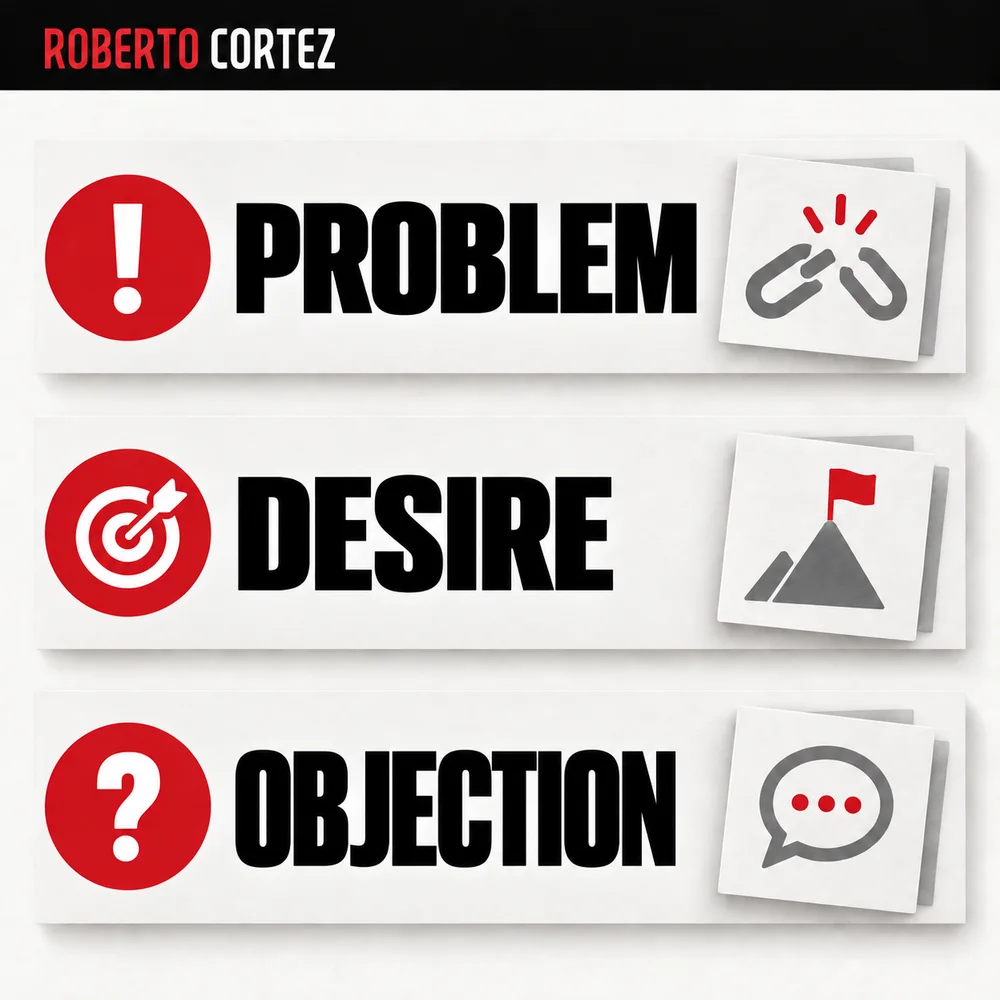
Organising examples by problem, desire and objection makes it easier to retrieve an idea when you need it. A folder divided only into video, image or carousel can hide the most important reasoning. Format follows what you need to make clear to the right person.
Turn the reference into your own hypothesis
After observing, write down what you intend to test in your context and why you expect it to help. Connect a specific audience difficulty to a message change and an observable signal. Research then ends in a decision you can assess, rather than becoming a matter of visual preference alone.
One possible hypothesis would be to explain the service stages to reduce enquiries from people expecting immediate delivery. The new piece would show a real process while keeping the offer's conditions clear. Evaluation would consider the suitability of enquiries and the questions received, alongside clicks.
Also define what you will not import from the reference. This might be an excessive promise, evidence you do not have or a tone that does not suit the brand. Recording those limits encourages deliberate adaptation and helps whoever produces the piece understand the boundaries of the work.
Only then does it make sense to develop ad variations with AI. Give the tool your hypothesis, verified information and offer restrictions instead of asking for an imitation. Review every version to ensure generation has not added figures, testimonials or conditions that do not exist.
Maintain a library that helps you decide
A useful library connects each reference to a question, an interpretation and a possible application. When you test an idea, add what happened and what remains unclear. Linking research to learning makes the archive more useful than storing pieces without any context about why they were selected in the first place.
You can use a simple record containing the source, date, observed element, hypothesis and completed test. If the idea has not yet been used, mark it as an available reference. If it has been tried, record the conditions and avoid permanently classifying it as good or bad after a single attempt.
Periodically reviewing the library helps you give less prominence to references that no longer answer current questions. It also reveals whether you repeatedly choose the same type of argument. A varied collection should expand relevant options while keeping criteria clear enough for the team to use them.
When research produces no convincing hypothesis, return to the diagnosis before proposing a marketing plan. You may need a better understanding of the offer, the buying decision or customers' actual questions. A library can help communicate what you know more effectively; it does not replace that knowledge.