
On Sextas Ímpares #135, I talked about this topic using a specific services business as an example in the lesson. The diagnosis always starts with the data you have (or don't have) about the path between the first contact and the closed sale.
The mistake of confusing a lack of contacts with a lack of process
Managers often blame low lead volume when the real issue is unclear process. Before adding budget, confirm whether stages and data are properly recorded. Without that visibility, you cannot tell if opportunities are truly missing or just being lost internally, and rushed spending only raises costs without fixing anything.
A services business grows in three ways: it brings in new clients, it increases the average value per client, or it extends the relationship with people who already buy. All three matter, but acquisition can never stop, because there will always be clients who leave for reasons outside your control. If you rely only on retaining the ones you already have, the business shrinks over time.
Today's buyer has more alternatives than a few years ago and informs themselves quickly before deciding. If your initial message is confusing, they'll look for another supplier within minutes. That's why it's worth mapping out, even in a simple way, the flow of handling requests from first contact to close, so that no request gets forgotten in a digital drawer somewhere.
If you need to build that foundation from scratch, here's how to set up a lead funnel that the sales team can actually work with. Having a minimum process in place doesn't guarantee results, but without it, it becomes much harder to know where the real problem lies.
Mapping the stages where sales usually get stuck
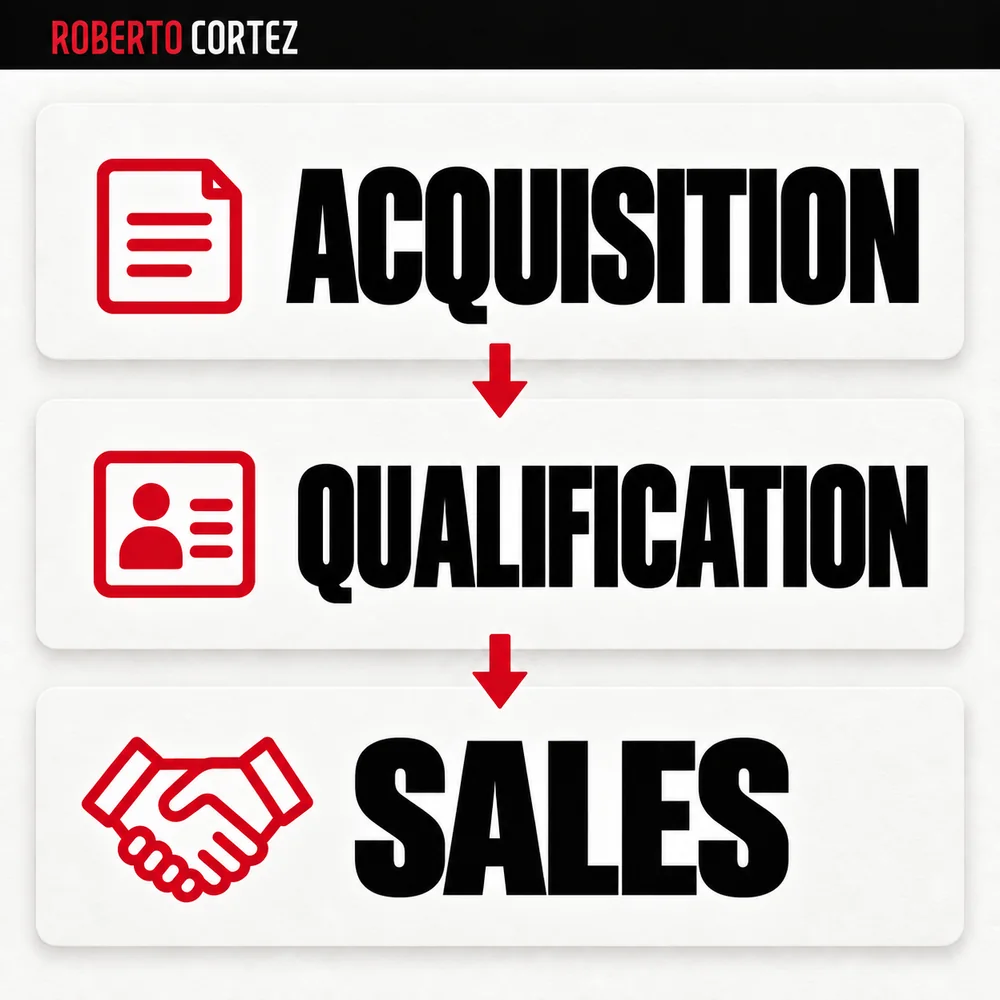
To diagnose where sales are stalling, it helps to break the commercial journey into distinct stages, each with its own particular risks. Treating everything as a single block prevents any specific correction. In the Sextas Ímpares lesson, I used this breakdown, applied to a hypothetical services business example:
- Pre-lead: knowing how much revenue you need, how many contacts that requires, and having a minimal record, even if it's just a spreadsheet.
- Traffic acquisition: volume of visits, alignment between what you promise and what you deliver, and not depending on a single channel.
- Initial conversion: clarity of the page, ease of the form, loading speed.
- Qualification and contact: speed of response, channel used, persistence in follow-up.
- Conversion into sale: how you present value, how you break down objections, how you follow up on pending proposals.
When you look at each stage separately, the problems stop being vague. You can tell whether there aren't enough people entering the funnel, or whether the team isn't managing to qualify the people who already entered.
Insufficient traffic or a misaligned message
Generating too few contacts can have two distinct origins: a low volume of visits, or an audience that doesn't match the client you're actually looking for. A small budget isn't going to generate hundreds of qualified contacts, that's basic math. At the same time, attracting a lot of the wrong people overloads the team without generating sales.
If an ad promises one thing and the page talks about something else, people leave within seconds. The same thing happens when you depend on a single channel and that channel changes its rules overnight, something I've seen happen with clients who put everything into one specific social network.
Imagine, as a hypothetical example, a company that gets a lot of visits but almost no contacts: the problem is probably on the page or in the form, not in the advertising spend. A company with few visits and few conversions, on the other hand, needs more traffic first, and only then should it optimize the rest. Testing the message before increasing investment avoids burning money on an offer that isn't clear yet.
The cost of slowness in first contact
One of the most common difficulties in services businesses is the delay between a contact request and the human response. Someone asking for a quote is most receptive in the first minutes after asking; if the response takes hours or days, interest cools down and competitors show up first. This matters especially for higher-value services.
Responding with a single generic message and waiting for the person to write back rarely works for high-ticket sales. In those cases, picking up the phone and having a direct conversation clears up doubts on the spot and builds trust that a written message doesn't create as easily.
To think about how to use support tools without losing the consultative side of contact, it's worth checking out how to use AI in your business beyond chatbot questions. Automating initial triage can free up team time, but the person who decides to close the deal is still a person talking to another person.
When someone misses a scheduled meeting, it's worth not giving up right away. Everyone has forgotten a commitment out of distraction at some point; a simple rescheduling process sometimes recovers proposals that seemed lost, without spending more on advertising to replace them.
Perceived value in the closing conversation
When a client says a service costs too much or asks for time to think, that often signals a value communication gap, not a pricing issue. Without felt urgency, people prefer keeping their money. Salespeople must demonstrate, using concrete examples, the real cost of leaving the problem unresolved, making that cost tangible and urgent enough to justify action now.
In the lesson, I also covered the relationship between cost per lead and value generated. The isolated price of a contact tells you nothing about whether that contact was a good deal.
For example, hypothetically, paying fifty euros for a contact that generates a margin of a few thousand euros could be an excellent deal. Paying very little for contacts that will never buy, on the other hand, is money badly spent, even if it looks cheap at first glance. What matters is tracking how much revenue each contact tends to generate, not just how much it cost to get them.
To go deeper into the techniques for guiding these conversations, it's worth checking out how to turn more leads into clients in a services business. Closing more depends a lot on steering the conversation toward the real impact your solution has on the life or business of the person making the decision.
Having a process doesn't eliminate uncertainty, but it helps reduce it
Running a business without any daily commercial indicator creates a heavy dependence on luck. Fixed expenses arrive every month on a set date, but revenue doesn't always follow that same rhythm. Without closely tracking what's happening in the funnel, a bad month can quickly turn into a cash flow problem.
At our agency, we track commercial indicators regularly, cross-referencing revenue, break-even point, and number of closed deals, so we can correct course before deviations pile up. That doesn't mean planning avoids every problem; planning reduces surprises, it doesn't eliminate them completely.
Before investing in expensive tools, a well-organized spreadsheet already lets you track the essentials. What makes the difference is the habit of recording data regularly and sticking with discipline to your contact routines, whatever tool you're using.
If you want to review your business's acquisition structure, check out our services for online business and sales. As a practical next step, pick just one stage of the funnel today where you feel the most uncertainty, and gather the numbers for that stage over the next two weeks before deciding what to change.