
When a task becomes automated, the team's attention can shift towards decisions that previously received too little time. That change requires understanding what each person continues to contribute to the process. Removing clicks from an operation and removing responsibility from a decision are different choices, with different consequences for the business.
An important part of the context resides with the people who know the customer. Recent conversations, priorities not yet written down and constraints may never have reached the system. The boundary between automatic execution and human intervention should reflect that information rather than depend solely on what the tool is technically capable of doing.
Keep people involved when relevant information is missing
A person should intervene when a decision depends on information the system has not received or cannot confirm. Automation should make the gap explicit and organise what it already knows. Requesting a human decision with sufficient context is more useful than producing a confident answer that depends on an assumption nobody has checked.
Imagine a proposal request referring to an earlier conversation with the sales team. If that conversation is unavailable, the system can identify the request and collect existing documents. It cannot know whether a different condition, an exceptional deadline or a change to the usual service was agreed during that conversation.
The handover can therefore request confirmation of the missing condition alone. The owner does not need to repeat data collection or classify the request again. They receive a specific question, accompanied by the original information, and decide what would allow the process to continue with the required context.
This separation helps establish when rules are enough and when automation needs AI. More sophisticated interpretation may improve how a message is understood, but it does not provide access to a conversation that was never supplied. Missing context still requires an operational response from someone able to obtain it.
To prepare your next step, explore Automating administrative tasks.
Reserve approval for actions with significant consequences
Define human approval for actions whose errors could affect money, commercial conditions or relationships the business values. Approval needs depend on the impact and the possibility of correcting the action. Automation should present the proposal, the rule applied and the expected effect before asking for permission to proceed with the external action.
Preparing a draft and sending a proposal to a customer are different stages. The draft can be revised without creating an external commitment. Sending it places information in another person's hands and can create expectations that subsequently need explanation, even if the document itself can be corrected quickly and easily.
Write the boundaries in a form the team can apply. There may be permission to prepare proposals within an approved offer, while changes to scope or special conditions need validation. The system should stop at the defined boundary and explain why a person needs to review that particular case.
The same reasoning appears in limits before automation changes advertising budgets. The ability to execute a change needs a decision about how much may change, under which conditions and with what supervision. Technical capability alone does not establish the appropriate level of authority for the task.
Preserve human contact when understanding the person matters
Retain human involvement when understanding expectations, negotiating priorities or handling a sensitive situation forms part of the service. Automation can prepare the context and reduce administrative work. The responsible person uses that preparation to conduct the conversation, clarify missing information and make commitments appropriate to the particular circumstances of the customer and business.
A potential customer may request one solution and reveal a different need during the conversation. They may feel urgency, fear repeating an earlier experience or remain uncertain about their own decision. Initial classification helps organise the contact, but it does not replace attention to that new information as it emerges.
Automatic preparation can collect the original request, earlier contacts and unresolved points. That allows the person to begin with more context and avoid asking questions already answered. The benefit appears in the quality of the conversation and the capacity to listen, as well as in the administrative time saved.
When turning leads into customers in a service business, moving from interest to a decision requires understanding fit and expectations. Automating the organisation of that progression can help while leaving a person responsible for the conversation and for the consistency of what the company proposes to deliver.
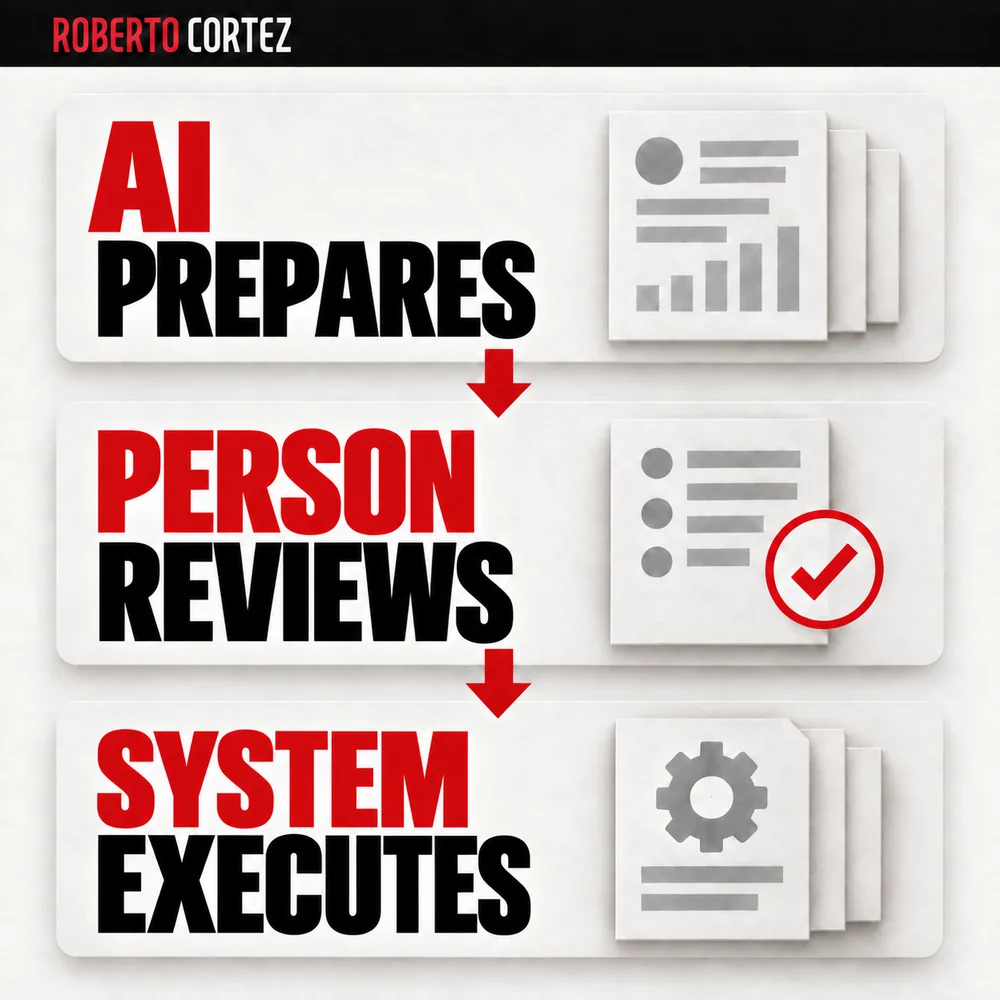
Give the reviewer a prepared decision
A review point should show the original request, the system's proposal, the reason for uncertainty and the action that approval would authorise. Identify the owner and any relevant deadline too. This preparation prevents human intervention from becoming a repetition of all the work the automation has already performed in reaching that point.
An alert saying there is a problem forces someone to investigate before understanding what they must decide. A useful handover might explain that the request is complete but the requested condition does not exist in the current offer. The person can then assess the exception or seek clarification from the customer.
Review should allow approval, correction or a return with a clear indication of what is missing. If approval is the only available option, the team will handle exceptions outside the process and lose the decision record. Corrections should remain associated with the case that prompted them, so later actions remain understandable.
Distinguish content validation from permission to execute. Someone may confirm that a summary is accurate without wanting the message sent at that moment. Giving the two decisions clear names helps prevent an editorial check from being interpreted as permission for an external action with consequences beyond the document itself.
Revisit the manual boundary using actual decisions
Review the boundary between manual and automatic work using the team's real decisions. Observe which exceptions repeat, which depend on context and which now have stable criteria. Some may support an explicit rule; others should remain human because their nature requires an assessment specific to each case and its implications for the business.
If a person repeatedly corrects the same field for the same reason, it may be possible to improve collection or write a rule that removes the repeated effort. If corrections depend on different conversations in each case, the system can keep preparing information while leaving the final interpretation to the owner.
Do not remove a review simply because several runs went well. First establish whether the observed cases represent the usual variety and whether someone can recognise a new exception. Experience should help justify any increase in autonomy, with a way to return to the earlier level when conditions change.
The objective is to make human intervention more useful and clearer. A team benefits when it can focus attention where understanding, choice and responsibility are needed. Automation can prepare that work and execute authorised decisions while keeping visible who is accountable for the outcome at each stage of the process.