

If you are willing to invest in finding clients, it makes sense to consider paying someone who introduces a suitable opportunity. They may reduce some of the initial approach work and provide useful context. However, an introduction does not automatically eliminate sales costs or guarantee an attractive contract for your business.
What are you paying for in a referral?
A referral can mean an introduction, a qualified opportunity or a sale already moving towards agreement, and those situations have different values. Define what the partner does and what remains your responsibility. Before discussing percentages, confirm the event that triggers commission and the revenue on which it will actually be calculated.
A name on a list is not equivalent to an agreed introduction to someone looking for your service. Nor is it equivalent to a client who has already decided to proceed. If these distinctions remain implicit, you may discuss payment while each party imagines a different contribution.
Clarify whether the partner only introduces people, helps understand the need or participates in the sales conversation. Your team should still confirm service suitability and the commitments it can make. Confidence in a partner does not replace responsibility for the agreement you are about to offer.
Qualifying opportunities before making contact provides useful criteria for this discussion. What matters is confirmed information about the enquiry, rather than an optimistic classification assigned simply because the contact came through somebody you already know and trust.
To prepare your next step, explore Lead generation for service businesses.
How do you compare commission with advertising?
Compare costs per acquired client and follow revenue over an equal window for both channels. For advertising, include acquisition expenses and relevant sales work. For referrals, include commissions and partnership administration. Recurring commission must be accumulated across the period rather than assessed only through the amount paid on the first transaction.
Imagine a hypothetical example: a campaign costs twelve hundred euros and generates four clients, with another three hundred euros of sales work. The included cost per client is three hundred and seventy-five euros. That calculation uses actual clients, rather than contacts who completed an enquiry form.
Now imagine a referred client generating four thousand euros of eligible revenue over four months. A hypothetical eight per cent commission amounts to three hundred and twenty euros; adding one hundred euros of sales and administrative work brings the included cost to four hundred and twenty euros.
In this example, the referral costs more within the selected window. That does not finish the analysis: retention, delivery requirements and payment reliability may differ. The comparison becomes useful when you preserve those differences instead of automatically declaring one channel the winner on acquisition cost alone.
What limit can the service support?
The commission limit depends on expected receipts, delivery cost and the contribution needed to sustain the business. A percentage that works for one contract can be excessive for another. Use observed data when available and identify estimates, particularly when payment to the partner follows future client revenue that remains uncertain today.
A ten per cent commission is simply ten per cent of its defined base. It does not tell you what remains after staffing, tools and additional work required to serve that client. Two services with the same selling price can support very different acquisition costs.
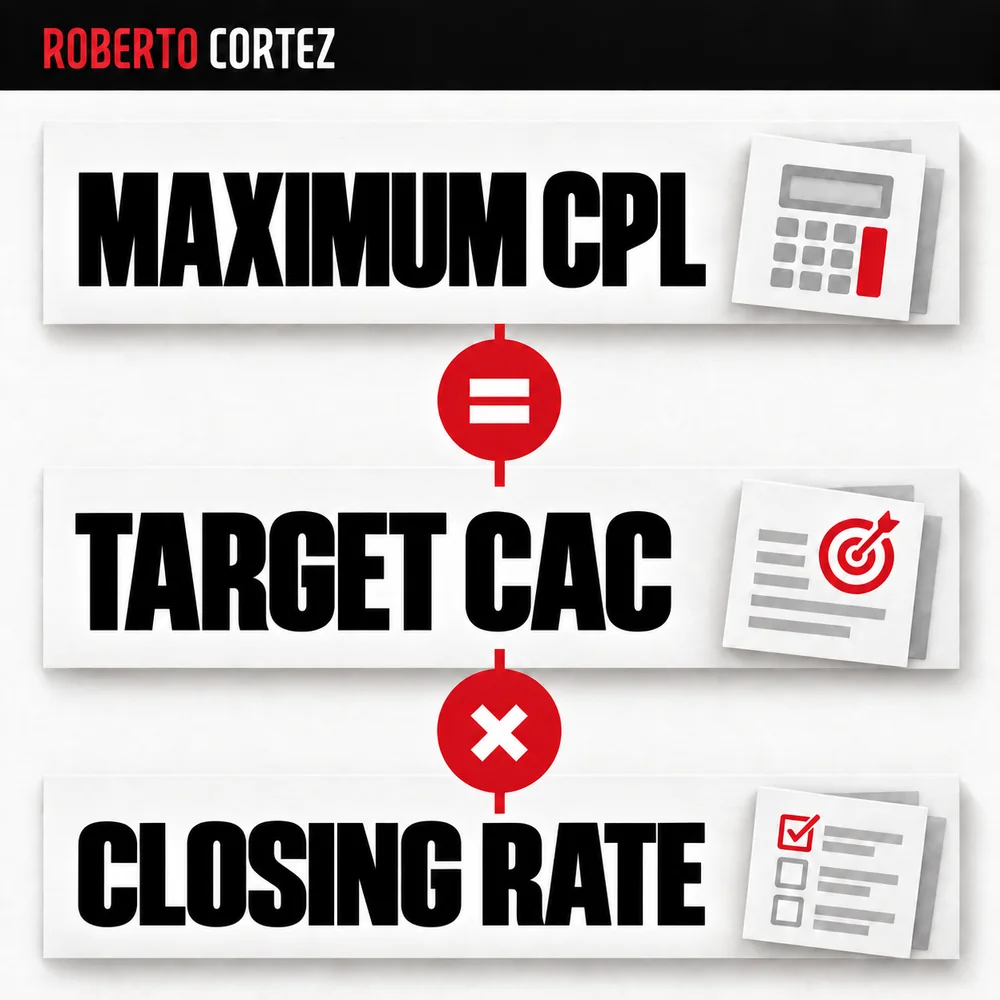
When calculating how much you can pay for a lead, the closing rate connects contacts with clients. If the limit per client were three hundred euros and one in five opportunities bought, the gross limit per opportunity would be sixty euros, before deducting other acquisition costs covered by that budget.
This reasoning also helps evaluate payments for introductions, but the rate must reflect opportunities from that channel. Do not transfer an advertising conversion rate to a partnership without observing what happens. With a small sample, work through scenarios and allow room for uncertainty rather than relying on a single figure.
What changes when commission is recurring?
Recurring commission grows with eligible revenue throughout the relationship, so its total cost only becomes known over time. Analyse scenarios for client retention and changes in scope. Understand how remuneration follows those events before accepting a commitment that will continue to affect the contribution each contract provides to your business.
In the four-thousand-euro example, commission was calculated for four months only. If the relationship continues, the accumulated amount can increase. Comparing that initial period with the entire acquisition cost of another channel would conceal part of the commitment made to your referral partner.
Define how discounts, refunds, late payments and added services will be handled operationally. The basis might be received revenue or another agreed basis, but both parties must understand it in the same way. What matters here is clarity of calculation rather than copying an arrangement without adapting it.
You should also be able to reconstruct each calculation. A simple record of client, period, eligible base and commission avoids relying on scattered messages. Any future change should be clear before it is applied, while respecting the terms already agreed between the parties.
How do you assess opportunity quality?
Assess quality through suitability, conversion into clients and what happens after the sale. A partnership producing many contacts can require disproportionate work or create expectations that are difficult to fulfil. Compare retention, delivery effort and reasons for losing opportunities too, without assigning all credit or blame to the acquisition channel alone.
A recommendation can bring trust, but also promises you never made. Ask what the potential client was told and explain the service under the same conditions used in other channels. Correcting expectations before presenting a proposal is preferable to managing a conflict after the purchase has happened.
Share clear suitability criteria and anonymous examples of requests you cannot serve with the partner. That information can improve future introductions without exposing unnecessary data. The partner does not need internal details of every conversation to understand the kind of client you are looking for.
Clear positioning in a competitive market also helps the person recommending you. The better they understand the problem you address, the less they need to invent arguments or present your business as a solution for every possible situation.
How do you test a partnership without depending on it?
Test the partnership with defined entry criteria, a follow-up process and a review point. Observe costs and quality over a period long enough to reveal actual decisions, while maintaining other acquisition channels. Referrals can be useful and irregular, so a promising start does not demonstrate a stable source of future demand.
Record introductions received, conversations held, sales and accumulated costs for each group of clients. Distinguish deals still being considered from lost opportunities. Comparing a recent group with another that has already had time to buy can produce a conclusion driven mainly by their different maturity.
At review, decide whether to improve selection, information passed between parties or remuneration under newly agreed conditions. A partnership deserves to continue when it serves clients and makes sense for both businesses. The commission amount should follow from that analysis, with calculations and responsibilities everyone can understand.