

You open the proposal list and find several projects that look promising. Some documents were sent recently, others await an internal client meeting, and some have no update at all. Adding their values is straightforward; understanding what the business can rely on requires a different kind of work.
The forecast becomes less useful when all those records receive the same interpretation. The sales manager sees possibilities, operations starts reserving people and the owner believes the following month is taking shape. Unless someone explains the difference between the statuses, the same list can support incompatible decisions within the business.
First define the decision the forecast should support
A sales forecast should support a concrete decision, such as preparing capacity, directing sales effort or assessing progress towards a target. Define the period and the type of commitment you are observing. A forecast of contracts, a forecast of project starts and an expectation of payments describe different moments in the business.
A client may choose your service now and want to start later. Another may agree with the scope but still depend on an internal decision. Putting both in the same group of projects starting next week makes the forecast appear more precise than the available information can reasonably support.
Explain what the report counts. If it tracks confirmed contracts, use that name; if it tracks proposals under negotiation, keep that distinction visible. A clear title and definition help the person receiving the information understand which decisions they can make from it and which still require more evidence from the buyer.
Avoid using the same forecast for every business commitment without revisiting the meaning of the data. One team may need to prepare likely availability, while another needs to know which deliveries have actually been contracted. Both can use the same records, but they need different criteria for interpreting them and acting on their contents.
Choose a reference date for the analysis too. Without it, a forecast updated after an important meeting may be compared with an earlier version as if both had been made with the same knowledge. Knowing what was available at each moment is necessary to learn from differences between expectations and subsequent outcomes.
Separate team actions from buyer confirmations
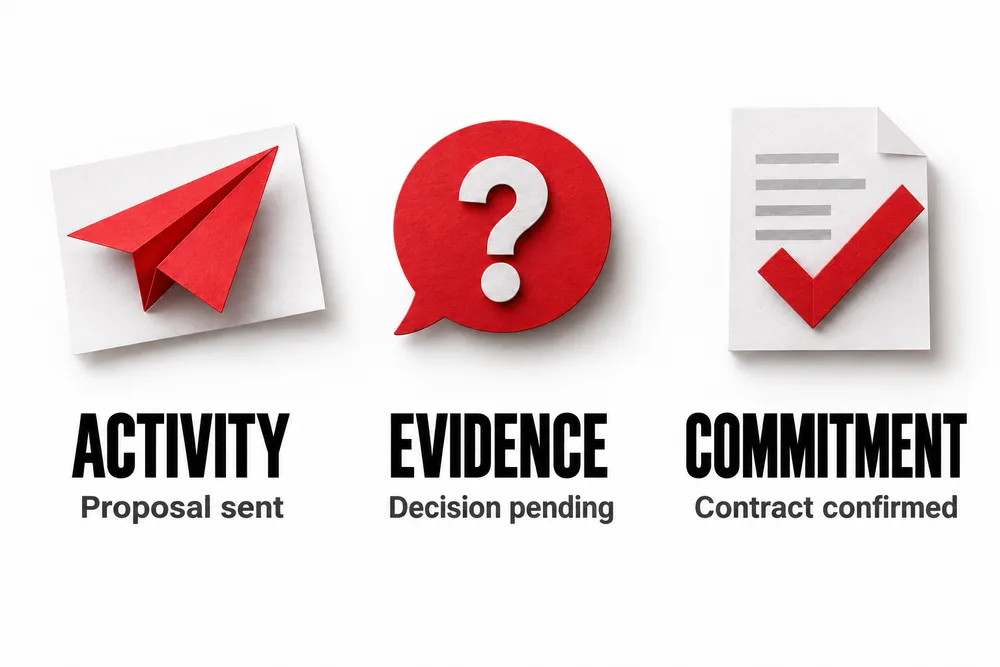
Sending a proposal, preparing a demonstration and holding a meeting are team actions. Confirming the need, explaining how the decision will be made and agreeing to a next step are buyer signals. Record these separately so the forecast does not turn sales effort into evidence that the client is closer to signing a contract.
A carefully prepared proposal may still have no recipient capable of approving it. A long meeting may clarify the problem and end without any commitment to continue. That does not make the work useless, but it limits what you can conclude about the likelihood and timing of a sale from that activity alone.
Look for signals that change your interpretation of the opportunity. The buyer may confirm that the project remains a priority, involve another decision-maker or arrange an assessment of the proposal. Each adds context; none should become a guarantee of a contract before the necessary confirmation has actually been obtained and recorded.
In the B2B sales process, stages should help explain what has been decided and what remains unresolved. If a stage advances only because the salesperson sent another document, the system may display movement without any progress in the client's decision or any new commitment from the people considering the purchase.
Review the language in the notes. “Interested client” says little without explaining the behaviour observed. “Confirmed they want to assess the project with management and identified the meeting where they will do so” makes the status easier to understand, without turning that intention into a purchase or filling in the outcome of a future meeting.
Identify the client's decision path
A proposal gains context when you know who assesses it, which questions remain and how the client intends to reach a decision. Record that path in the detail the project requires. The person requesting the document may participate in assessment without controlling the budget, priority or final authorisation to purchase the service.
In a hypothetical example, a marketing team requests a proposal to improve its lead-generation process. The manager understands the need and likes the approach, but management must choose between that work and another initiative. The proposal exists; priority is still under discussion, and that unresolved choice matters to the sales forecast.
Another buyer may already have established the priority and need to confirm technical conditions. These paths require different information to progress. The first opportunity depends on a business choice; the second may depend on clarifying an integration. A generic “proposal sent” label does not reveal that distinction or show what must happen next.
Ask about the process in a way that helps the buyer. What information needs to go into the internal conversation, and who should take part in assessment? The purpose is to prepare the decision and understand dependencies, without demanding information the person cannot share or treating every question as a way to pressure a close.
When the path remains unknown, keep that gap in the record. A forecast can include opportunities with incomplete information if it shows the limitation clearly. It should not automatically fill the decision date with the date your own business needed to reach its target, as though that were a commitment made by the buyer.
Give meaning to the dates in the forecast
A closing date should state where it came from and what is expected to happen then. It may reflect timing confirmed by the buyer or an internal estimate still awaiting validation. Keep that difference explicit and review the date when its underlying condition changes, rather than automatically moving it into the following month.
If the client identified a decision meeting, record that event. If the team estimated timing because similar projects tend to take that long, identify it as an estimate. Both can support planning, but they do not have the same meaning when assessing a particular opportunity and the evidence supporting its place in the forecast.
A date may also depend on work from your side. Perhaps a clarification or a correction to the scope is still needed before the client can assess the proposal. Waiting for a response without fulfilling your part then creates a misleading interpretation of the delay and of the work required to move forward.
When a date passes, ask what happened. Was the meeting postponed, did the project lose priority, or has the information simply not arrived? Update the forecast with what you can confirm. Moving the record into the following week without knowing the cause keeps the list full but makes its dates less useful.
Over time, observe which stages most often delay decisions. That learning can improve sales preparation and follow-through. It does not replace each buyer's context, but it helps identify forecasts that repeatedly depend on conditions the team does not yet know how to assess or verify before setting an expected closing date.
Treat a missing update as missing information
An opportunity without an update should not retain the same confidence indefinitely simply because nobody recorded a refusal. Identify which information has become old and arrange a review. If you cannot confirm that the decision remains active, show that uncertainty in the forecast without inventing either a loss reason or an expectation of purchase.
Silence alone does not explain what happened in the buyer's business. There may be a postponement, a change of owner or a decision that was not communicated. Choosing whichever explanation suits your forecast turns a hypothesis into apparently confirmed information and gives other teams a misleading basis for planning their own work.
Separate the commercial status from the task of updating it. The opportunity may be unconfirmed while the team's task is to check a previously agreed next step. That distinction helps organise follow-through without continuing to present the value as though the conversation were progressing normally and all the previous assumptions still held.
This review also helps diagnose whether leads are missing or sales are stalling. A long list of old proposals may conceal little recent activity with suitable buyers. Before concluding that the business merely needs to wait for decisions, check whether the records still describe current opportunities with a reason to remain active.
You do not need to erase history to clarify the forecast. Preserve the journey and distinguish active opportunities from those awaiting a condition for resumption or no longer being followed up. The history supports learning; its potential value does not need to remain mixed with decisions expected during the current reporting period.
Avoid assigning probabilities you cannot explain
A sales probability helps only when its meaning and the basis for estimating it are understood. Without comparable history, use evidence states and explicit scenarios instead of arbitrary percentages. A score that looks precise can conceal important differences between buyers and give excessive confidence to the people using the report to make decisions.
Assigning the same percentage to every sent proposal does not solve the lack of information. Some may have a confirmed need and a scheduled decision; others may have been sent for an initial comparison. The administrative stage is identical, but the available evidence about the purchase process differs and deserves to remain visible.
Where history exists, check whether the cases are comparable. A new offer, another acquisition channel or a change in audience can alter the sales journey. Previous experience may inform a hypothesis, but it needs review when the conditions that supported it no longer match the work the business is currently undertaking.
It also matters to distinguish an aggregate trend from an individual's decision. A pattern observed across earlier proposals does not establish that this particular buyer will sign. Preserve that difference in the report, especially when operations wants to reserve specific resources on the basis of an expected sale that has not been confirmed.
If the team does not yet have enough information, begin by improving the record. Define stages, confirm known reasons and track actual dates. Building a basis for later analysis is more useful than presenting a complex formula fed by classifications that each salesperson understands differently and applies to opportunities in inconsistent ways.
Show scenarios without adding incompatible possibilities
A forecast can present scenarios while decisions remain open, provided it makes each scenario's conditions explicit. Check whether the opportunities can happen simultaneously and whether capacity supports delivery. The potential value of every proposal does not automatically represent a feasible combination of sales within the same period of work or the same available resources.
In the hypothetical example, the business might have prepared two alternatives for the same need: a limited intervention and a broader project. These are decision paths, rather than independent sales. If both enter the total as separate opportunities, the report increases expectations without adding buyers or the capacity required to serve them.
Proposals may also compete for the same team availability. If all are accepted, their starting dates may need to fall at different times. The contracting forecast and the delivery-start plan need to inform each other, so commercial success does not turn into an operational promise that the team has no realistic ability to fulfil.
Describe scenario conditions in concrete language. One might depend on a particular internal approval; another might include only confirmed commitments. Avoid labels that conceal the content of the choice, because readers need to understand what would have to happen for that forecast to become reality and what uncertainty remains in the meantime.
Use scenarios to prepare reversible decisions where appropriate. It may be possible to organise information, clarify availability or prepare a project handover without immediately taking on a permanent cost. The business's level of commitment should reflect the quality of available evidence and the consequence of the forecast failing to materialise as expected.
Review the forecast with sales and the delivery team
The review should combine knowledge of the sales conversation with the conditions needed to deliver the service. Confirm decision status, dependencies and possible dates before using the forecast to reserve work. This connection helps prevent a promising opportunity from being presented as a project ready to start immediately without the necessary preparation.
The salesperson may know the client wants to proceed, while operations identifies an essential access permission or item of material still missing. Both pieces of information matter. A preference for the supplier does not remove the conditions for starting that need to be understood by the parties before work can realistically begin.
A useful review starts with changes since the previous version. Which buyer confirmed a step, which decision was deferred and which hypothesis lost support? The meeting then deals with new information and necessary decisions, instead of repeating a list of names accompanied by vague comments about how each opportunity seems to be progressing.
When building a lead funnel the sales team can actually work, responsibility transfers need to be clear. The same care should extend to the moment a proposal approaches a contract. Whoever receives the project needs to understand the commitments actually made and the points that remain conditional, rather than relying on an optimistic summary.
Close the review with specific responsibilities. If a decision needs confirmation, someone owns that check; if there is an operational dependency, identify who will clarify it. The updated forecast should reflect what is known at that moment, without presenting the tasks just assigned in the meeting as though they had already been resolved.
Learn from where the forecast was right and wrong
Compare earlier forecasts with known results, preserving the information available when each forecast was made. Look for error patterns in stages, dates and criteria. The aim is to improve commercial judgement without penalising people who update uncertainty or rewriting the history to make it appear that the eventual outcome had always been predicted.
An opportunity can close later than expected and still be a good sale. Another can be declined after a serious assessment. These situations teach different lessons: the first may reveal inadequate timing assumptions; the second may clarify a selection criterion that the proposal did not resolve and that deserves attention in future conversations.
Record only confirmed reasons as the buyer's reasons. When the cause remains unknown, retain that label. Automatically attributing a loss to price or a competitor may encourage unnecessary offer changes and conceal weaknesses in preparing the decision that the team itself can control through better questions, clearer information or more suitable proposed work.
Observe whether the team has incentives to keep opportunities overly optimistic. If changing a status is treated as missing the target, reporting may become less honest. Forecast quality improves when people can correct information and explain what changed, without having to defend an expectation that no longer has a sound basis in the available evidence.
This learning complements the work of turning leads into clients in a service business. Following results requires understanding the journey and the quality of commercial decisions. A proposal total shows part of the activity, but it needs context to guide improvements that make sense for the offer and its intended buyers.
Start with the proposals supporting the next planning period
Select the proposals the business is using to plan the next period and confirm the evidence for each. Identify the buyer's latest signal, the pending decision, the source of the expected date and the starting condition. Then present an updated view distinguishing confirmed commitments, supported negotiations and situations that still need clarification before further planning.
You do not need to review the entire sales archive to begin. Prioritise records already influencing capacity decisions, targets or the hiring of support. The greater the consequence of relying on a sale, the more important it becomes to understand what supports that expectation and what still depends on a decision from the buyer.
Where information is missing, define the action that can obtain it and the time for a new review. Until then, keep uncertainty in the report. The forecast should help the business prepare for what may happen without turning its wish to close a deal into a commitment the client has not yet made.
A good sales forecast can still be wrong. Its value lies in making the reasoning, conditions and decisions depending on them visible. When the team knows why a proposal is included and what would change that assessment, it can update the plan more rigorously and with less dependence on each individual's impressions.