
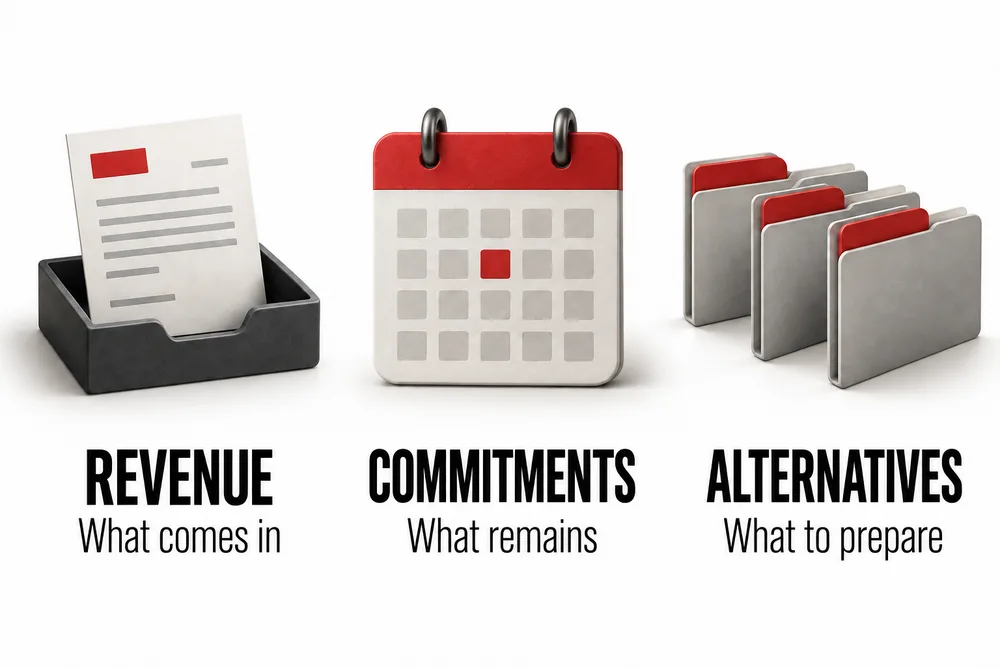
I have had to find alternatives so I could stop accepting commercial relationships that did not fit the way I want to work. That freedom takes preparation: being able to pay the bills while finding another route is part of the decision. A concentrated client base makes this work especially important, even when the largest client is satisfied and the relationship works well.

Measure dependence beyond the share of revenue
Start by understanding how much depends on that client in revenue, contribution, cash receipts and team utilisation. These dimensions answer different questions and may point to different exposures. An account generating substantial revenue may also consume substantial resources, while an apparently smaller account may cover an important share of the costs that continue after its work ends.
Choose a period that represents actual activity and compare the client with the business as a whole over that same interval. If you mix an exceptional project with other clients' usual revenue, you may interpret a temporary peak as permanent dependence. Also record what has already been contracted for the following period.
Revenue share helps locate concentration, but it does not describe the impact of a departure on its own. Identify the costs directly associated with delivery and the contribution left to support the business structure. Do not confuse that contribution with profit: shared costs and other commitments still need to be covered.
Then look at cash receipts. A client may account for a large share of sales and pay on a different schedule from the one on which you need to fund delivery. Working with monthly averages may hide that difference, particularly when the team is already working and payment depends on a later deliverable.
In a hypothetical example, a service business has an account that requires external specialists only during each project. Another account mainly uses permanent staff and tools already under contract. Losing the same amount of revenue from either account would not free the same resources or create the same pressure on subsequent payments.
The outcome of this analysis should be a verifiable description of the exposure. Instead of writing only “very important client”, identify which parts of activity, contribution and receipts depend on it. That description allows concrete alternatives to be discussed without turning an isolated percentage into a universal rule about what is acceptable.
Model a departure using the actual schedule of commitments
Build a scenario in which the contract ends on the earliest plausible date and examine what happens afterwards. Separate confirmed receipts, amounts still uncertain and payments that remain due. The exercise is useful because it locates decisions and needs in time, without assuming that all revenue disappears immediately or that all costs can end together when the relationship stops.
Start with what has actually been agreed: work in progress, outstanding deliverables, the invoicing schedule and payment terms. Check the assumptions with the people overseeing the contract and accounts. If an exit condition is open to interpretation, that uncertainty needs to be resolved before it supports an operational decision about the business.
Organise expected movements by the dates on which they may occur. An issued invoice is not money already available, and a proposal under negotiation does not replace a confirmed receipt. Identify separately what depends on collection, approval, renewal or completion of work so that possibilities are not presented as resources already secured.
In the fictional business, a departure might free up the external specialists' time while leaving payments for work already performed. Permanent staff would remain available and would continue to have costs. The useful question becomes when the gap between money coming in and going out appears, and what choices still exist before then.
Use explicitly different scenarios. You could compare an exit at the planned end date with a partial reduction in scope, provided each hypothesis has a plausible reason and clear assumptions. Do not assign invented probabilities merely to produce an average that looks rigorous; keep visible what changes from one scenario to another.
Review this exercise using actual financial information and with the people who understand it. The aim is to prepare decisions about capacity, expenses and acquisition, without choosing reserves or funding through a generic rule. Once you know which commitments remain, you can assess commercial alternatives with much greater precision and a clearer sense of timing.
Find out which resources you can reuse with other clients
Map the people, knowledge, tools and routines dedicated to the account and distinguish what could serve other projects. Released capacity becomes an alternative only when it matches work someone wants to buy and the team can deliver. Check dependencies, necessary preparation and limits on use before counting that capacity as future revenue that will be available to the business.
Start with the nature of the work. A team may know one client's specific process very well and need to adapt before serving another context. Recognising that difference lets you prepare the transition in advance, without diminishing the value of the people or assuming that every available hour can immediately be sold.
Separate general methods from materials belonging to the specific relationship. Experience gained may improve the organisation of future work; the client's documents, data, access credentials and content do not automatically become reusable sales material. Clarify those boundaries before building demonstrations, proposals or delivery examples for other businesses based on the current account.
In the hypothetical company, work for the largest client might have developed expertise in organising requests and approvals. That expertise may interest other businesses, but the proposal needs to address their own needs. Copying the entire process would also carry over decisions that made sense only inside the original organisation and its particular way of working.
Check internal dependencies too. If only one person knows the configuration required to deliver the service, losing the account does not resolve that weakness. Documenting the work and sharing knowledge may increase adaptability, provided time is reserved to do it while the current operation continues and existing delivery commitments still need attention.
The relationship between capacity and demand is part of growing an online business with attention to margins and the team. Before promising to replace the contract, define what you can sell, to whom and with what preparation. A list of free hours does not yet answer those questions about future work.
Look for alternatives that reduce shared exposure
Diversification requires understanding whether new clients bring different dependencies or repeat the same vulnerability. Examine who decides, where enquiries originate and which events could affect several accounts simultaneously. Increasing the number of contracts may spread revenue, but the business's autonomy also depends on the relationships and conditions supporting those contracts, rather than on the client count alone.
Imagine the fictional business wins several brands belonging to the same group. It starts issuing more invoices to different entities, but a central decision could affect every relationship. To assess concentration, it matters to understand that connection rather than simply count the names appearing in the client list as independent sources of business.
The same care applies to the commercial source. If every project arrives through a single partnership, that entry point creates dependence even when the end clients differ. Preparation might include developing another route to market, maintaining the existing partnership and respecting the commitments already in place between the parties involved in the relationship.
You do not need to enter every sector to find alternatives. Moving too broadly may force the team to learn several contexts at once and weaken delivery. Start with needs close to existing expertise, checking whether demand exists and whether the team can respond without rebuilding the entire operation for each new prospect.
Choose alternatives using complete commercial criteria: a recognised need, delivery capacity, expected contribution and conditions for working together. Accepting any work to reduce the largest client's relative share may add revenue while also increasing effort and fragility. The distribution of the client base needs to improve how the business works, not merely change a percentage.
Record why each alternative reduces exposure. It may diversify the decision maker, the type of need or the source of enquiries. That explanation makes it possible to revisit the choice later and prevents “having more clients” from replacing analysis of how those relationships actually behave together when a relevant circumstance changes in the market.
Keep acquisition active while the main account is working well
Reserve commercial capacity to create alternatives before you urgently need to replace revenue. Define who seeks opportunities, who responds and how you assess progress, without compromising delivery to the current client. The work should produce qualified conversations and proposals, with evidence of interest and realistic conditions for moving forward, rather than depending on vague intentions to sell more.
Recurrence is a business characteristic I value because it reduces the need to start acquisition again with every delivery. That does not mean a recurring relationship will renew forever. Taking care of continuity and maintaining commercial activity are responsibilities that need to coexist when managing a client base and deciding where to direct attention.
Decide how much commercial work the operation can support and protect that space. If the main account absorbs all availability, diversification is always postponed until a quieter week. You may need to review internal priorities or the way requests are handled, while preserving what has been agreed with the client and keeping delivery properly supported.
A service business lead funnel should distinguish contacts, opportunities and proposals with confirmed next steps. This separation matters particularly when you are trying to reduce concentration. A long list of names is not the same alternative as conversations where the need, decision maker and possibility of proceeding have already been discussed and understood.
Do not count a proposal as replacement revenue merely because the meeting went well. Record what still needs to happen, who takes part in the decision and when an agreed next step exists. If that information is not yet available, continue following the opportunity without using it to justify commitments that cannot readily be reversed.
Acquisition also needs to respect onboarding capacity. Selling several projects that begin at the same time can create a different difficulty from the original concentration. Prepare how you receive new clients, what information you need from them and which work can begin, so the commercial alternative remains compatible with careful delivery of the services sold.
Monitor the relationship without turning preparation into distrust
Continue working well with the main client and try to understand changes in its needs, priorities and decisions. Preparing alternatives is an internal management responsibility compatible with a professional relationship of trust. Use observable signals to guide conversations and plan updates, distinguishing temporary difficulties, changes under consideration and continuity decisions the client has already communicated to your team.
A postponed meeting does not, on its own, prove that the contract is at risk. Seek context before interpreting it: there may be a reorganisation, temporary unavailability or a more urgent priority. What matters is understanding whether a relevant condition for the work has changed and whether any decisions need to be made as a result.
Ask what the client expects from the next phase and who participates in that assessment. The answers help align delivery and identify real needs without seeking guarantees the other party cannot give. If continuity depends on a pending decision, record that condition clearly in planning so that it remains visible rather than becoming an assumption.
Monitoring should also make the value delivered visible. In service client retention, communication helps interpret the work and correct difficulties. Use that proximity to improve collaboration, keeping it separate from the internal analysis of the company's exposure to each account. Both activities matter, but they answer different questions about the relationship and the business.
Avoid trying to secure permanence through concessions you cannot sustain. When an additional request appears, assess scope, capacity and conditions before responding. A client's financial importance makes the decision more demanding; it does not automatically turn every request into an obligation that the team must absorb without discussion about the work and resources required.
When a change is confirmed, update the scenario with the available facts. A reduction in scope may release different resources from a complete departure, and a renewal may include new conditions. The plan needs to follow that reality, preserving the relationship and responsibility for everything you still have to deliver under the agreement in place.
Define actions and responsibilities before urgency arrives
Turn the analysis into a short set of actions with owners, conditions for execution and review dates. Distinguish what should start now from what makes sense only after a confirmed change. This preparation reduces improvised decisions and helps the team respond in a coordinated way, without treating a possible departure as an event that has already happened.
Some actions may be useful in any scenario: updating the record of commitments, organising knowledge and keeping opportunities under review. Others depend on additional information or a commercial decision. Separating them lets you move ahead with work that improves preparedness without creating unnecessary disruption in the operation or in the relationship with the current client.
Define who maintains the financial information, who manages the account and who develops alternatives. These roles may be concentrated among a few people, but they need to be explicit. If each assumes somebody else is handling the issue, having a document does not translate into effective preparation or work that anyone is accountable for completing.
Also establish conditions for deciding again. A communicated change in scope, a relevant delay or a concrete new opportunity may justify revisiting the plan. Each condition should lead to a proportionate assessment, avoiding automatic responses that treat different events as if they always had the same meaning for the account and the wider business.
The team needs enough information to work, presented with context. You can explain the intention to distribute the client base more evenly and prepare capacity without announcing a loss that has not happened. When a confirmed decision affects the work, communication should follow the plan and the responsibilities for carrying it out with the people involved.
Keep preparation simple enough to be used. A record of exposure, commitments, alternatives and next steps may be more useful than an extensive presentation with no owner. The final question at each review should be concrete: which decision has become clearer, and what work will happen because of it before the next review takes place?
Review whether the business is actually gaining autonomy
Assess progress through the ability to keep operating when circumstances change, as well as the percentage distribution of revenue. Check for stronger commercial alternatives, known commitments and resources usable on other work. Concentration may vary as the business grows; what matters is understanding that variation and deciding with current information while maintaining the quality of existing commercial relationships.
If the largest client's share falls because poorly profitable projects arrive, autonomy may not have improved. Look again at contribution, operational workload and the schedule of receipts. Revenue growth needs to be interpreted alongside the responsibilities it adds to the business and the team, including work that may make other commitments harder to fulfil.
The main account may also grow while you prepare alternatives. That does not automatically invalidate the work done, but it changes the exposure you are assessing. Update the information and decide whether commercial capacity, internal organisation and commitments remain appropriate to the relationship's new size and the demands it now places on the operation.
Look for evidence of actual preparedness: accessible knowledge, qualified opportunities, organised delivery and decisions supported by current information. These elements allow a better response even if no departure happens. The work has value because it improves business management, not only because it protects against a specific scenario you are worried might occur in the future.
The decision may benefit from a growth plan for the service business connecting acquisition, capacity and client management. The priority will differ depending on whether dependence is mainly in the commercial entry point, delivery or receipts. Identifying that difference helps select an intervention with a practical consequence for the way the company works.
An important client can remain a good relationship and a relevant part of the company's future. Preparing for continuity allows you to care for that relationship with greater clarity about your own limits and alternatives. The desired result is being able to decide responsibly before urgency restricts the choices available to you and your team.