

When someone says they need a bigger audience to sell, I want to understand what they are selling and to whom. A service requiring close support has different delivery capacity from a product distributed without that involvement. Reaching as many people as possible can distract attention from those for whom the offer makes sense.
What problem justifies a higher-value service?
A higher-value service must address a need important enough for the client to invest and participate in the work. Price also depends on scope, responsibility and available alternatives. Choosing a specific problem makes the proposal easier to explain, but it does not automatically turn any service into an expensive offer that people want.
Start by describing a situation the client recognises. A company with scattered enquiries, delayed replies and a team lacking information has a more concrete need than one simply saying it wants to use technology. You still need to understand the scale of the problem and whether there is willingness to address it.
Specialisation can also mean understanding a process, a business stage or a recurring difficulty. It does not require choosing a sector so narrow that you cannot find enough demand. The useful question is whether you can explain why your work suits that particular situation.
Differentiating services in a competitive market starts with that clarity. Adding words such as premium or exclusive to a proposal says little about what you will analyse, decide and support for the client throughout the work.
To prepare your next step, explore How to grow a service business.
How many clients do you need to serve?
The required number of clients should follow from delivery capacity and each contract's contribution to the business. Revenue, variable costs and time requirements need to be considered together. A small portfolio can support a specialised service, but also increases dependence on individual clients and exposure when one of them decides to leave.
Imagine an entirely hypothetical scenario: a team can support six clients and charges each two thousand euros per month. With the portfolio full, monthly revenue is twelve thousand euros before tax. That figure is not profit, because delivery, staffing, tools and other operating costs still have to be covered.
If one client leaves, the monthly reduction is two thousand euros in this example. That concentration deserves attention even when contracts appear stable. Understand how long a new sale takes, what capacity becomes available and how the business supports the interval between a departure and a replacement.
The exercise sizes the demand required rather than establishing a recommended price. Defending your price when execution becomes faster should connect value with the service and the responsibility involved, while accounting for its actual delivery cost.
How can a small audience create opportunities?
A small audience can create opportunities when its members face the problem you address and can understand your work. Specific content, existing relationships and recommendations can start that contact. Observe how many relevant conversations emerge and what prevents them from progressing, instead of assuming that reach itself proves demand for your offer.
Publish explanations that help someone recognise their situation and evaluate a decision. You could show how to distinguish a process failure from insufficient capacity, or what information is needed before proposing an intervention. This lets people see your judgement without requiring you to disclose client data.
You can also speak with people who already know your work and have a compatible need. Familiarity reduces some uncertainty, but an earlier purchase does not prove that the next offer is suitable. The problem, timing and ability to invest may have changed since the previous relationship.
You do not need to turn the whole audience into potential clients. Some people only want to learn and others require a different solution. Making that distinction explicit saves unproductive conversations and helps those with a suitable profile understand the next step.
How do you build trust before a larger commitment?
Trust develops when potential clients can evaluate your thinking, the quality of your work and the clarity of your commitments. This can happen through content, an earlier experience or a well-conducted conversation. It does not require everyone to buy an inexpensive product first or follow the same sequence before considering your service.
A limited diagnostic exercise can show how you organise information and separate facts from hypotheses. A demonstration can make a particular capability visible. In either case, explain what the person is seeing and what has not yet been evaluated in their own business context.
When presenting real examples, preserve permission and context. A result achieved in another project is not a promise for the next one. If you use a hypothetical example, identify it as such and show the assumptions supporting your explanation so that readers can follow the reasoning.
Trust also depends on refusing certainty you do not have. Acknowledging that you need to understand a process or confirm a dependency can make the proposal more credible. Clients can distinguish a reasoned decision from an answer given merely to keep the conversation pleasant.
What should happen during the sales conversation?
The sales conversation should explore the problem, its priority and the conditions required for the work to happen. Listening helps establish whether the offer serves that person and which proposal deserves to be presented. Automation can organise information and facilitate follow-up, but someone must remain accountable for the commitments made during the decision.
Ask what prompted the enquiry, how the situation is handled today and what would happen if it remained unchanged. Look for concrete examples instead of accepting vague answers about growth or efficiency. Confirm who participates in the decision and which resources must be made available for the project.
You do not need to devote a rigid percentage of the meeting to listening. You need enough information to connect the solution with the need. A polished presentation remains unsuitable if it addresses a problem the client does not actually have in the business.
At the end, agree on a clear next step: present a proposal, clarify a dependency or conclude that there is no fit. A prompt response helps maintain continuity, but does not justify persistent contact when the person does not want to proceed further.
How can you tell whether you need more reach?
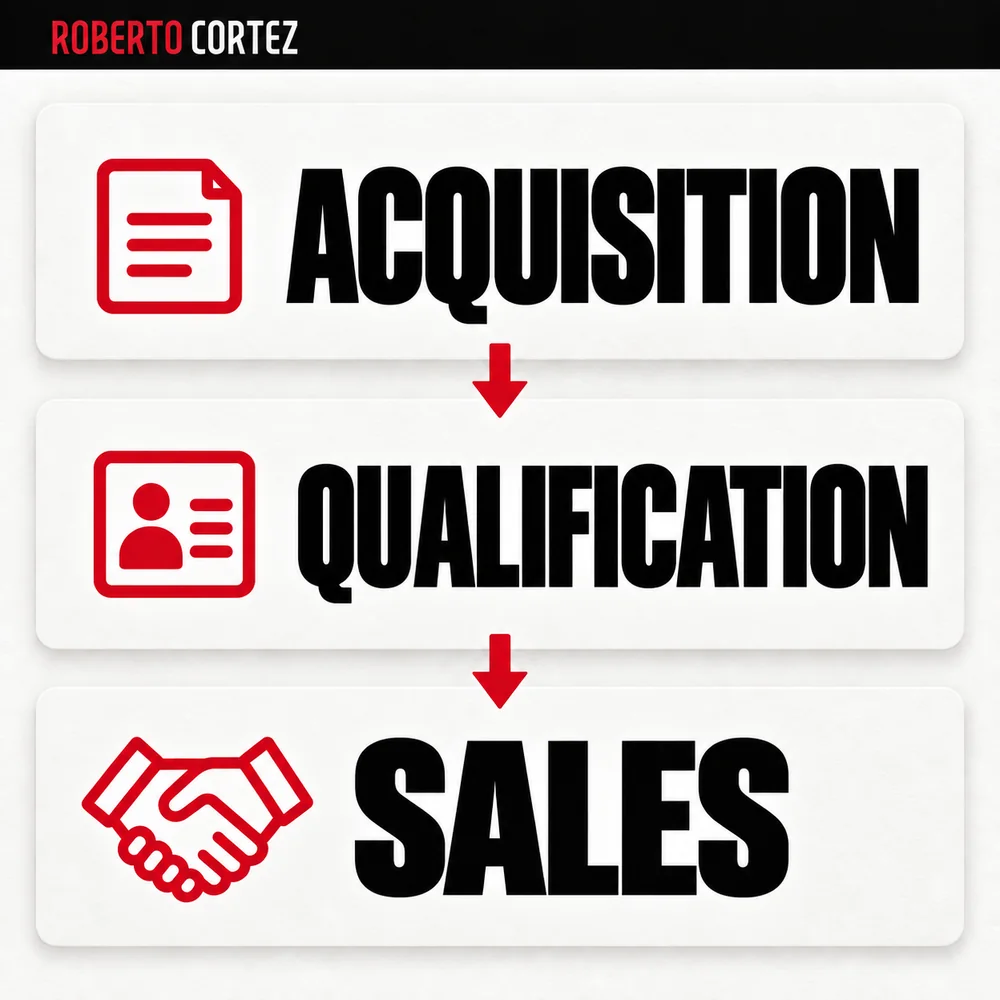
You need more reach when the offer and follow-up already generate suitable sales, but opportunities are insufficient for available capacity. Before that, identify where the process loses momentum: unsuitable contacts, conversations without diagnosis or proposals without decisions. Growing an audience without understanding that difference can increase wasted sales effort rather than useful demand.
Record where opportunities originate, how many reach a useful conversation, how many receive proposals and how many become clients. In a small portfolio, a few cases can change a rate considerably, so retain absolute numbers and reasons for losing opportunities. Do not interpret a good week as proof of a stable conversion rate.
Working out how much you can pay for a lead connects this observation with the economics of the service. Include the cost of following up contacts and avoid assuming that everyone interested will buy or remain a client for the same period.
If the diagnosis shows too few opportunities, choose a channel and message to test within defined limits. If it shows an unclear proposal, improve that clarity before increasing investment. The aim is to build a portfolio you can serve well and replenish over time.