
Imagine a fictional business whose client onboarding includes creating a project, preparing a folder and granting the team access. The project appears in the system, but the folder step stops working. Someone authorises the integration again and the dashboard turns green; that still does not explain what happened to requests received during the interruption or which tasks remain unfinished.
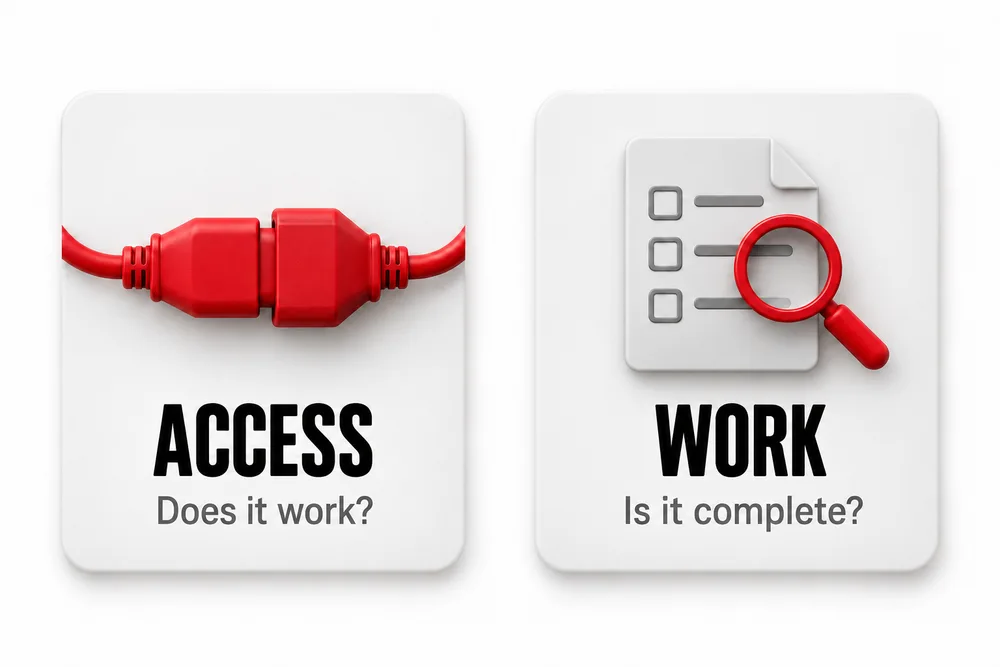
Recovery needs to answer two different questions: can the integration perform the right operation again, and have affected requests been handled correctly? The first is a condition for working. The second requires examining case status, including cases that progressed partially before the access problem appeared and those where the final outcome is still uncertain.

Locate the operation that lost access
Identify which operation failed, in which service and under which account it was running. Retain the relevant error message and observed time without copying credentials into the incident record. This information helps distinguish invalid authorisation from insufficient permission, an unavailable resource or another failure requiring a different investigation before the team can choose an appropriate action to take.
A “connection error” notice may group situations with different consequences. The account may remain authenticated while losing access to a specific folder. There may also be permission to read information but not to perform the change the flow intends. Knowing which action was refused helps formulate the right technical question instead of treating every warning as the same problem.
In the hypothetical scenario, check whether creating the folder, finding its parent folder or granting the team access failed. Do not assume the entire service stopped working merely because one operation was refused. Describe the failure's scope using what was observed and confirmed in the systems involved, keeping unverified possibilities separate from the established facts.
Record the execution reference and flow version so the investigator can find the same case. A partial screenshot of the warning may omit the step and account used. It is preferable to indicate where an authorised person can consult the full record, avoiding the spread of client data or access information through conversations and copied screenshots.
Also confirm the last operation known to have succeeded. This helps delimit the period to investigate, but does not prove that every subsequent case failed in the same way. There may be different paths through the flow or resources with different permissions; retain that possibility while checking the actual scope of the problem and its effects.
In business process automation, this distinction should be part of the handover. Whoever monitors operations needs to locate the step and responsible person without knowing the entire implementation. A useful alert indicates where to look and the known consequence, rather than forcing the team to guess what a colour on the dashboard means for their work.
Confirm who can restore the correct authorisation
Before authorising again, identify the account used by the integration and the person who can grant the necessary access. Confirm that the relationship with the service remains valid and whether permissions changed intentionally. Recovery should restore authorised work under the correct account, without switching identity simply because somebody else can sign in to the tool and reach its interface.
Distinguish your browser session from the identity used by the flow. Being able to open a folder manually does not demonstrate that the integration operates under the same account or has the same rights. The implementer should explain this connection and show how to verify the effective identity without exposing secrets in the operational document used by the team.
In systems using OAuth, access tokens and refresh tokens serve different functions. Expiry of the former may be handled automatically when a valid renewal mechanism exists; revoked authorisation may require intervention. Behaviour depends on the service and configuration, so the team should consult the applicable documentation rather than assume that every connection can be renewed in the same way.
If access was deliberately removed, do not restore it as a routine response. There may be a change of responsibility or a security decision that needs to be understood. The responsible person should confirm whether the flow remains authorised and under which conditions before any attempt to make it run again using the previous or a replacement connection.
Define who handles the technical side and who represents the account or business. Sometimes this will be the same person; elsewhere the implementation depends on an account holder or administrator. Explaining this division in advance prevents the incident moving between teams because each believes the other can complete authorisation alone without any further participation or decision.
The person responsible for the automation should know that path and have a named substitute. This does not mean sharing passwords or giving everybody identical privileges. It means knowing whom to contact, which operation needs authorisation and where the decision is recorded about the access that should exist after recovery has been completed and verified.
Validate the resource and permissions after reconnecting
After authorisation, verify that the integration points to the intended account, workspace and resource with the permissions required for the operation. An active connection does not demonstrate that all these conditions are correct. Perform a controlled check before releasing pending work, keeping the access scope limited to what the process actually needs to perform the task it was built for.
In the fictional example, reconnection may allow folders to be found while still pointing to a location different from the intended one. If you immediately start recovering requests, you may create results in the wrong place without receiving another access warning. Confirm the destination reference and its relationship to the process, rather than only its displayed name in the interface.
Ask for verification that matches the necessary action. Being able to read a resource does not prove the ability to change it or grant access. At the same time, resolving a specific operation does not require general administration rights; the implementer should justify permissions and demonstrate how they correspond to the work authorised within that particular flow.
Use an appropriate environment or test case without creating real messages or unexpected changes for clients. Define the expected result and where it will be observed beforehand. When validation requires an action with external effects, that action needs to be covered by the procedure and authorised by the person responsible for its consequences, rather than improvised during troubleshooting.
If several automations share the same connection, identify which ones depend on it before changing configuration. A correction may affect work beyond the process that triggered the alert. Review those known dependencies so recovering one flow does not leave others operating under a different context without monitoring or knowledge of the change that has been made.
Record the verification outcome in understandable terms: account confirmed, correct destination and necessary operation validated. Do not record the token or key value as evidence. The record should explain the decision to resume and locate the protected configuration, keeping access data in the places intended for its management rather than duplicating it into an incident report.
Reconstruct pending work before repeating it
Gather requests that may have been affected and check the status of each relevant step in both the source system and the destination. Distinguish work not started, partially completed work and outcomes still unconfirmed. Restoring access allows action again, but does not automatically determine which requests need execution or which effects have already occurred and should therefore be preserved.
In the hypothetical business, some projects may have been created before folder preparation failed. Other requests may have waited without starting any step. Running everything again from the beginning risks repeating project creation to resolve a difficulty that existed only in the next operation, adding new work for the team instead of simply recovering what was missing.
Use each request's original reference to connect the records. Look for the corresponding result and retain information about what still needs doing. Nearby dates or similar names may help an investigation, but should not replace the relationship between the request that authorised the work and the object that exists at the destination where the effect happened.
Include manual interventions performed during the interruption. Somebody may have prepared a folder or granted access to avoid delaying the team. That work needs to be associated with the request before resuming so the automation does not continue treating an action already completed by a person as pending and try to perform the same task again.
When you cannot confirm the result, keep a separate status and define who will decide. A missing response is not proof that no effect occurred. If the destination remains unavailable or records are insufficient, you may need to wait for information or escalate the case rather than repeat it merely to reduce the number of unresolved requests.
The recovery list should end with a next step for each case. Some need to continue at a specific stage, others are already complete and others require investigation. This organisation makes resumption verifiable and separates the number of affected requests from the number of actions still necessary to complete them, which may differ depending on how far they progressed.
Resume in stages with a clear condition for stopping
Choose a controlled group of requests whose status is understood and confirm the result of each necessary operation before expanding recovery. Define who monitors it and which signal requires suspension again. Restored authorisation should allow observable execution, without automatically releasing the entire history simply because the connection test no longer displays the initial error that interrupted the process.
Start with cases that help verify recovery without adding unnecessary uncertainty. A request with its project already created and folder missing can test continuation at the correct step. Another that never started can verify the complete path, provided the environment and effects are covered by the validation plan and everyone understands what should happen in each case.
Observe the destination after each execution. Confirm that the correct folder exists, in the right location, with the intended access for that case. A local success record may be insufficient if it is not connected to the object created; the team needs to verify the result that will actually be used in the next stage of work.
Also confirm how new requests coexist with recovery of older ones. If they enter through the same flow, there should be an understandable rule for handling and responsibility. Urgency around the backlog should not make new work disappear, and incoming requests should not hide older cases still waiting for a decision about how they will be completed.
The ability to stop an automation when it no longer makes sense remains necessary during recovery. Define what to suspend if an unexpected destination, another access failure or a duplicate result appears. The person monitoring should know that path before starting, including what happens to executions already underway when suspension is requested and how that effect is checked.
Increase recovered work only when evidence supports that step. Group size depends on the consequences and behaviour of the process, without a universal quantity suitable for every situation. Keep a record of what was handled and what remains open so another person can continue without repeating decisions already executed or assuming that an unresolved case has been completed.
Monitor connection status and work status separately
Show separately whether authorisation is valid and whether requests are finishing with the expected result. These states can differ: an active connection may coexist with pending work, while a recent failure may affect only part of the flow. Monitoring should make that difference understandable and guide the necessary action, rather than present recovery as a single condition covering everything.
In the fictional scenario, the dashboard may show restored access while folders still await preparation. If the team receives only a resolution message, it may assume every new client already has the necessary materials. Communication should explain which part is functioning again and which work remains under recovery or investigation, so people know what they can rely on.
Use indicators connected to the process. The last operation confirmed at the destination and the list of requests still incomplete say more about delivery than generic connection status. Retain the authorisation alert too, because it helps locate a class of failures requiring a particular person or procedure to intervene and restore the access needed by the affected operation.
Define when a warning needs escalation. Repetition of the same error after reconnection may indicate that the cause remains unclear, rather than justify successive manual authorisations. Whoever monitors needs to know when to stop repeating that intervention and request technical analysis, preserving information about the actions taken and the outcome of each attempt to recover the connection.
Avoid making flow health depend on somebody opening the dashboard by chance. Identify where relevant signals appear and who monitors them, with a substitute when necessary. The notification method should fit the operation and the consequences of failure, without creating a sequence of alerts the team can no longer interpret or distinguish from warnings that require no action.
Close the operational incident when agreed criteria are met and outstanding cases have explicit treatment. Analysis of the cause or improvements to the design may continue. Distinguishing these activities lets you communicate what was recovered without hiding what remains unfinished, or keeping the entire operation marked as stopped when it has already returned to working as expected.
Prepare for changes in people and permissions
Keep the connection's owner, administrator and dependent automations identified before changes occur in the team or service. Review that map when a responsibility changes. Continuity should be prepared through supported mechanisms and appropriate authorisations, avoiding dependence on a personal account whose role in the process nobody can clearly explain when the usual person is no longer available to help.
Someone leaving or changing role may change who has access to resources used by the automation. That possibility needs to be included in operational preparation for the change. The aim is to know which dependencies need review and who decides the next configuration, without keeping old access for convenience or preventing normal management of permissions across the organisation.
Not every service supports the same form of technical identity. Ask the implementation team to explain which option suits the service and intended work. A service account may be relevant in some contexts and unsuitable in others; the solution's name does not remove the need to check what the provider actually supports for that operation and configuration.
The dependency record should state the connection's purpose, resources used and responsible person, keeping secrets outside the document. Somebody preparing a change can then locate what needs review without receiving a copy of credentials. Operational information and the data granting access serve different functions and require different handling, even when both concern the same integration and its continuity.
When a change is planned, define the validation sequence and treatment of work in progress. You may need to confirm a new authorisation and verify the destination before using it in the flow. Consider the change complete only when the relevant process works under the intended conditions, without relying on assumptions about previous sessions or credentials that may no longer apply.
Preparation should include the account holder whenever the platform requires personal action. That requirement cannot be resolved by asking somebody to copy codes or passwords into a conversation. Organise the intervention through the official route and make clear what needs approval, so the person can complete their part with enough context about the operation and the access being requested.
Test recovery and update the procedure
Include an access-loss scenario when validating the automation, using a controlled environment and conditions that do not affect real work. Verify detection, contact with the responsible person, recovery and handling of pending requests. The procedure should reflect observed behaviour, with known limits and instructions the team can apply when the situation occurs and the usual flow cannot continue normally.
Prepare the exercise with the implementer and operator. Define which permission or connection will be simulated as unavailable and which effect you expect to observe. Do not remove access from an integration used by other teams merely to experiment; the test design must respect dependencies and the environment chosen for validation before any such change is made.
When testing an automation before handing it to the team, include cases stopped at different stages. Confirm that recovering the connection does not trigger indiscriminate repetition. Verification should cover both the ability to perform the operation again and the decision about which requests still need it, rather than treating restored access as permission to rerun everything.
Observe whether the responsible person finds the necessary information without improvised help. Do they know the account, who can authorise, where the destination is and how to consult affected requests? If those answers depend only on the builder's memory, the exercise has revealed documentation and knowledge-transfer work that still needs completing before the team can recover the process independently.
Record differences between expected and observed behaviour. An unclear message, an unknown dependency or an unrecorded manual step provides an opportunity to improve the process. Update the procedure with those findings and confirm the change in another controlled case, preserving the information necessary to understand what changed and why the updated instructions now match the way recovery works.
I want automation recovery to end with confirmed work as well as an active connection. The correct account, appropriate permission, verified destination and monitored requests make that conclusion observable. With those parts prepared, the team can respond to access loss through a clear sequence, without promising that any reconnection will resolve the entire interruption by itself or complete every pending task.