

Look at behaviour as well as the name
To choose an appropriate level of autonomy, describe what the system actually does: consult, interpret, prepare, change or send. Product terminology varies and does not establish the reach of an integration. The company needs to know where a proposal ends and an action with practical consequences begins in its processes.
I use the distinction between assistant and agent to make this operational difference clearer. Preparing an analysis for someone to read has a different effect from consulting information, choosing the next step and making a change. However, do not assume that every product called an assistant cannot act, or that every agent operates without supervision.
One workflow may follow predefined steps and use AI only to interpret a message. Another may let the model choose tools and reorganise work according to the results. That difference helps clarify when automation needs AI and when rules are sufficient, without making maximum autonomy a requirement for every project.
In a hypothetical sales support example, the system could summarise an enquiry, prepare a reply and save it as a draft. None of those steps requires permission to send it to the customer. Separating them lets you benefit from preparation and assess quality before deciding whether another action deserves to be delegated.
To prepare your next step, explore AI agents for businesses.
Define permission for each type of action
Translate the overall objective into specific permissions for data, tools and recipients. Distinguish reading from writing and preparation from sending, including the conditions requiring approval. An instruction to help the sales team is too broad to establish whether the system may change an opportunity, promise a deadline or contact a customer.
Begin with the work you want to delegate and list the access required to perform it. An opportunity summary may need to consult particular fields without changing prices or exporting every contact. Restricting access to the purpose reduces the gap between the business request and what the integration is technically able to do.
Instructions to the model should be accompanied by permissions and checks in the application. Writing that an action is prohibited does not replace restricting the tool that performs it. Ask the technical team to demonstrate the effective limits with authorised cases and cases that should be refused by the system.
Also define what counts as approval. Approving a specific draft for one recipient should not become permanent permission for future messages. If the content, destination or commitment changes, the previous decision may no longer cover the action about to happen, even when it looks similar to an earlier task.
Increase autonomy through observable stages
Start with a level of autonomy whose results you can follow and compare with the expected work. Move from preparation to limited execution when tests show sufficient quality and restrictions are implemented. Each increase should address a specific need, with acceptance criteria and a practical way to interrupt the execution.
In the sales example, the first stage could simply produce drafts from selected enquiries. The responsible person checks whether they are complete, preserve commercial conditions and identify missing information. Correcting these problems before adding sending avoids automating replies that still require frequent rewriting before they can be used.
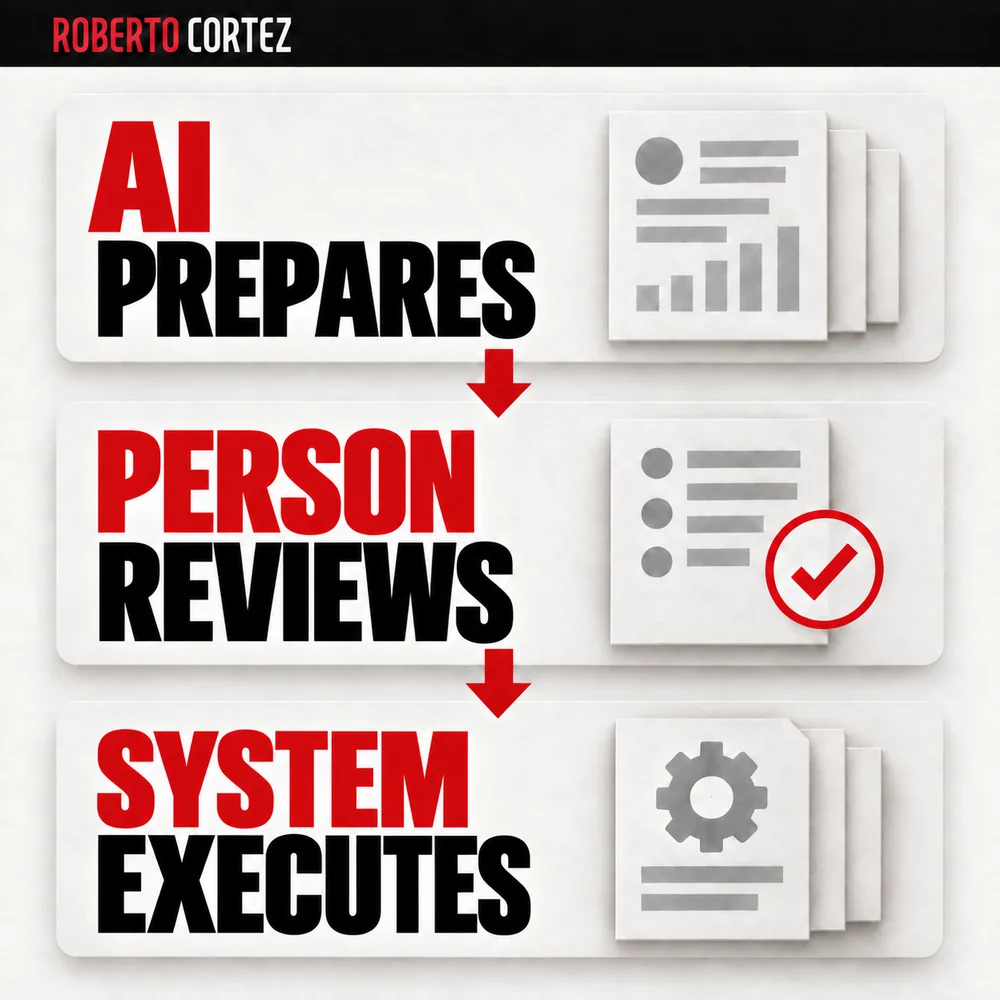
A later stage might permit a limited internal action, such as saving the draft against the right record. Check that the system selects the correct customer, preserves earlier content and identifies what it did. Only then consider actions involving other recipients or effects that are more difficult to reverse.
The limits set before automation changes advertising budgets illustrate the same reasoning: execution capability requires its own boundaries. Good performance when explaining campaigns does not, by itself, demonstrate an ability to manage spending changes within the conditions the company has accepted for that work.
Decide in advance when it should stop
An autonomous system needs clear conditions for pausing work and requesting intervention. Include missing information, contradictory results, tool errors and actions beyond the approved scope. Stopping should leave an understandable status showing what has happened and what remains unresolved, rather than starting repeated attempts without a reason to expect improvement.
If a sales enquiry does not identify the required service, the system can prepare a clarification question instead of choosing an offer by assumption. If it finds conflicting prices in documents, it should flag the discrepancy and show the sources to the responsible person. These responses keep the process useful without inventing certainty.
Distinguish a failed action from one whose outcome is unknown. If an interruption occurred after an attempt to send a message, immediately repeating it could produce a duplicate. The procedure should seek confirmation of the status before deciding the next step, with technical support appropriate to the system being used.
Limit the duration and volume of delegated work as well. A task can become stuck in repeated reviews or keep searching for information without improving the decision. Defining completion, when to return a partial result and whom to ask for help makes supervision more predictable for the people receiving the work.
Judge autonomy by the work it actually improves
Autonomy deserves to continue when it reduces useful effort without introducing errors, review or uncertainty beyond what the company can accept. Assess the complete process, including corrections and supervision. The number of automatic actions says little if the team must reconstruct every decision before it can trust the final result.
Choose representative cases and observe correct results, cases referred to a person and inappropriate actions separately. Referring an incomplete enquiry can be the intended behaviour, even if it lowers the proportion of tasks completed without intervention. Measurement should recognise that difference so that it does not reward premature decisions.
Record what the system consulted and did in enough detail to investigate problems, while respecting access restrictions and protected information. The team needs to explain a specific change. A convincing description of the intention does not prove that the system acted on the right record or respected the limits it was given.
Exploring AI beyond questions to a chatbot creates opportunities for execution, but the choice remains a management decision. You may conclude that preparation and recommendations already provide the value required. You may also authorise limited actions, provided you know why, under which conditions and how you will confirm what actually happened.