
What answer should a customer receive if they ask ChatGPT whether you deliver a desk to an island? “Yes” sounds promising until someone pays for an order and discovers the website only offers mainland delivery. “It depends” is hardly helpful either if your company already has a clear rule. This is the kind of question that makes claiming your brand worthwhile.
I will use two fictional businesses to show where the decisions differ. One sells furniture online and has a showroom in Braga, Portugal. The other audits the accessibility of online shops, takes enquiries through its website and delivers its work remotely. Both have a brand that a buyer can search for. Only the first has prices by variant, inventory and carriers to reconcile.
Who can claim a business in Portugal?
You can start a claim if you own or are authorised to represent an eligible business. OpenAI supports ecommerce and online services, subject to verification. For local physical stores and restaurants, the help centre currently limits claims to existing listings in the United States. That distinction changes the first step for many Portuguese businesses.
The furniture business should start with the activity it already conducts online. The main address to verify is the storefront where customers choose a product and read the purchase terms. The team can explain on its website that it has a showroom in Braga. Gaining access to the online brand profile does not automatically give it control of a local listing for the showroom’s street address.
The audit firm should be able to explain its service without inventing a catalogue. It receives an enquiry, assesses the scope, submits a proposal and delivers a report. The entire process can take place online even when pricing depends on the size of the project. If the portal offers the relevant option, the company can apply with its domain. The platform still reviews the application.
For a Portuguese restaurant that only serves customers in person, there is different work to do right away. Check that the website clearly presents the address, kitchen hours and booking channel. If an answer cites an old menu, open that page and identify who can update it. Choosing another country or an inaccurate business category would introduce false information without fixing the error the customer found.
How do you submit the claim in Business Hub?
Start from the official business claim page, sign in and search for the brand in Business Hub. Select the listing that corresponds to your domain, confirm the managing account and choose an available verification method. If an eligible online brand is missing, the portal may offer the option to add it.
Start with the name customers use when they look for the business. The desk brand may differ from the retailer that sells it. If you resell products from five manufacturers, the business you can manage on that basis is your retail operation. Displaying another brand in your shop does not authorise you to represent its manufacturer. Compare the domain and activity whenever you find similar names.
There is a continuity decision hidden in this step. If the company hires an agency to help, who will be able to manage the listing when the contract ends? Submit the claim through an authorised representative and identify who will look after the profile. The administrator can use the available options to grant individual access to colleagues and the agency. That makes it possible to remove one person’s access without recovering a shared account.
When the right listing already has an owner, open the profile menu and look for the ownership dispute option. If the portal says the listing is locked and directs you to support, follow that route. If you received a personal invitation, use the account with the exact email address it was sent to. Opening successive claims under different addresses makes it harder to tell which one is under review.
What evidence do you need, and when?
Business Hub asks you to demonstrate your connection to the business using a method available for that listing. The options may include a phone number, business email, domain or Shopify. Identity verification with Persona is a separate step. Prepare identification and the official business details for submission through the verification process shown.
If you choose the domain method, ask whoever manages DNS to add the TXT record displayed. Copy the name and value exactly as the portal shows them. The person who hosts the website may differ from the person managing the DNS zone. If verification is still pending, first check where the record was published and whether its final name matches the request. Then return to the claim and verify it.
With a phone, check that the team can receive the code by the method offered. A switchboard with an automated greeting may not receive texts. A call may be an option if the portal offers it. For a Shopify connection, verify the shop name and permissions before confirming. A test shop and a live shop can belong to the same administrator.
For Persona, distinguish the trading name from the registered company name. The shop may present itself to customers with two words and issue invoices under a much longer legal name. Check the registered address and the identifiers requested. Use the designated field for each piece of information. A document identifying a person may not, by itself, establish their authority to represent the company.
Look for approval at each stage. An email confirming receipt of the request helps you track it. To see whether you can edit details, connect the catalogue or consult metrics, return to the brand profile and check the Persona status. For a new profile created through this route, approval can publish the listing automatically. Review the details intended for the public before submitting that application.
What information belongs in the listing?
Choose details that change a purchase or contact decision. Explain what you sell, who you serve, where you deliver or work, and what happens when someone wants to proceed. Check each statement against the website and with the people who deliver the service. Give priority to conditions a customer could easily misunderstand.
Return to the desk. The retailer ships small parcels to the islands and large furniture only to mainland Portugal. “We deliver nationwide” may sound true to the person writing the profile and be useless to someone choosing a desk in the Azores. A description distinguishing the two conditions helps a customer see when to open the delivery page to check the available options for their order.
For the audit firm, the question that changes the decision may be “Do you also fix what you find?” If the team delivers a report and a technical meeting but implementation is a separate engagement, say so on the service page. A brand that only describes itself as a “specialist in integrated solutions” leaves buyers guessing whether they will receive an assessment or a fully repaired shop.
Use questions the sales team receives before a purchase. Ask each person for a question that made them confirm a rule with operations. Look for the answer on the page you send customers to. If it exists only in an internal email, someone needs to decide whether it is a general policy, a negotiated exception or outdated information before turning it into a public statement about the business.
A saved change goes through review and can take time to appear in a listing or an answer. Keep the date, previous wording and replacement. When someone shows you outdated information, ask for the question and cited address. If the assistant found an old page on your own website, correct that page too. This investigation is a concrete part of applying AI to business processes.
When is it worth connecting a product feed?
Connect a feed when customers need to distinguish between products, variants, prices and availability, and you have a reliable source to keep them current. Start by testing a product family you know well. Check what the portal received, what it processed and which offer customers see when they open the page.
Imagine the same desk comes in oak and walnut, in two lengths. That gives you four combinations. If you export them as one row called “wooden desk”, the lowest price might correspond to the short oak top while the image shows the long walnut one. The buyer sees a visual promise and a commercial offer that the shop has never actually sold together.
In OpenAI’s product specification, each variant has an identifier that should remain stable even if the price or photograph changes. Variants in the same family can share a group identifier distinct from the item identifier. In operational terms, this lets you correct the price of the 140-centimetre walnut desk without treating it as a new product in every subsequent export.
Open a product link in a browser without previously saved selections. Compare the finish, length, currency, availability and purchase button. Test an item that has just sold out and another whose discount has ended. If the import succeeds but every link opens the cheapest variant, the file may be correctly formatted while still sending the buyer to the wrong item.
A connected Shopify shop can use its existing catalogue. Businesses maintaining an independent catalogue can use a CSV or an address that serves the file directly, following the portal’s formats. Decide who investigates processing errors and who corrects the source. Manually uploading a corrected sheet only fixes things until the next export if the system producing it still provides the old value.
At the audit company, a public “from” price should correspond to an offer the team can explain and deliver. If every project requires assessment and a proposal, describe the criteria that determine the quotation. Inventing a product price to fill a field sets the wrong starting point for the next sales conversation and leaves the team having to undo the expectation it created.
Will claiming the business help ChatGPT recommend it?
Claiming gives you a channel for supplying current information. ChatGPT continues to make its own comparisons and draw on other sources. A page of yours can appear in search before a verified listing exists. An approved profile can also be absent from a comparison that matters to your business.
Try two questions with different intentions. “What is shop X’s delivery policy?” helps investigate the accuracy of a fact about an identified business. “Where can I buy a narrow desk for delivery to the Azores?” asks for alternatives that meet specific conditions. If the retailer delivers furniture only to the mainland, its absence from the second answer is consistent with its offer. Counting both answers as successes or failures of the same strategy would lead to a poor commercial decision.
Ask your website team to check whether the public pages you want available to search allow access by OAI-SearchBot. Your preference for GPTBot, associated with collection for potential training, is a separate decision. Keep private areas protected. The team can run a simple test without changing settings: open the delivery policy while signed out and check whether a buyer can read the condition applying to the item in question.
Record the question, language, market and cited sources. If you change the wording, keep it as a separate observation. A comparison that adds the brand to the request no longer tests whether the brand would be discovered spontaneously. It makes sense to use both questions, provided you know which one is for discovering suppliers and which is for checking what is said about a known supplier.
How do you distinguish presence, recommendations and business results?
Start by defining the event you want to observe. Business Hub lets you check aggregate activity, including references and clicks, when the account has access to Insights. Your website allows you to observe some visits. The sales team knows which enquiries became opportunities. Connect these observations through consistent periods and definitions.
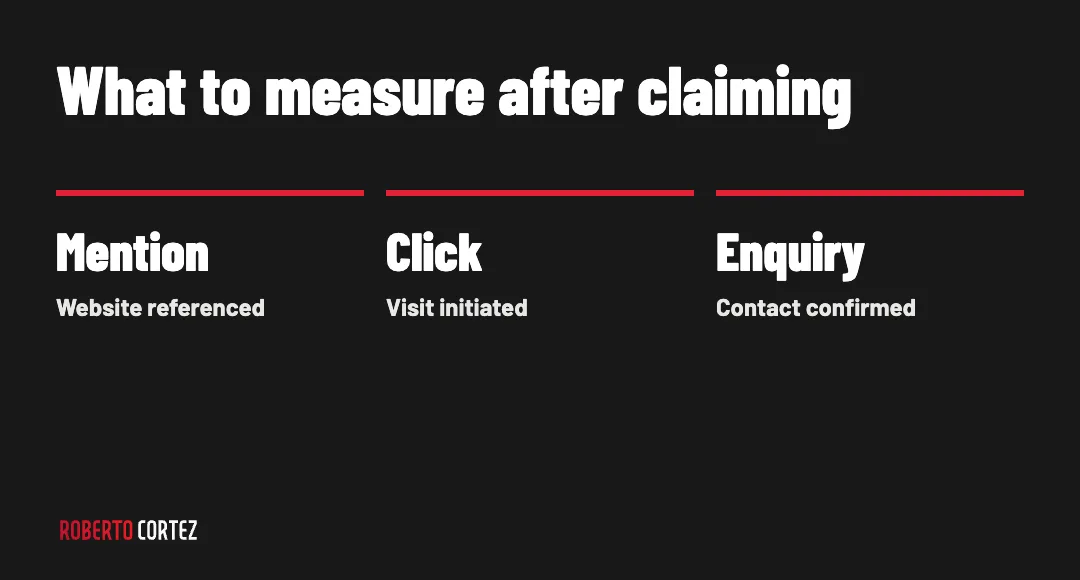
For an online brand, a mention counted in Insights involves a reference to its website. An answer can name the company without meeting that condition. For a local business, displaying a location result can count even without a website visit. This is why two reports with a column headed “mentions” can be measuring different events despite using the same word.
Discovery topics can suggest a worthwhile question to investigate. If a topic about furniture for small rooms appears, open the shop pages that help people measure a room, choose dimensions and check assembly requirements. The dashboard does not give you an individual customer’s question or conversation. It would be a leap to conclude from an aggregate theme that a particular person wanted to buy a particular product.
In a hypothetical example, the dashboard records twelve clicks and the website analytics identify eight sessions from ChatGPT. Two people request proposals during that period and only one mentions the assistant when speaking to the team. You lack the evidence to divide two proposals by twelve clicks and call the result the channel’s conversion rate. The systems count different units and the connection between those events is only partly observable.
Compare complete 28-day windows once you have comparable records. Keep the absolute values, the offer that was active and relevant website changes. If the dashboard leaves a metric blank, record it as missing. A reporting threshold or ongoing collection may explain the empty field. For the commercial side, see how to investigate enquiry quality when traffic grows.
When does it make sense to publish a Business Agent?
Consider an agent once you have consistent commercial information and a person responsible for reviewing it. OpenAI treats publishing an agent as a separate option with its own business, location and verification requirements. Announced agent availability is narrower. Check whether the option appears in the approved profile for your own business.
In its service overview, OpenAI describes agents as available to eligible ecommerce and online service businesses in the United States. A Portuguese company should confirm current coverage before budgeting for a launch. If the profile is available but the agent is not, the business can still work on the description, catalogue and measurements its particular profile offers.
If you have access, rehearse three conversations in preview. In the first, the buyer supplies all the details and asks about delivery for a specific desk. In the second, the buyer simply asks “Can you deliver tomorrow?” without identifying a product or address. In the third, they request an exception the business has never approved. Write down in advance the facts you expect, the clarification required and the promise that would be inappropriate.
For the audit firm, the best rehearsal might be a customer asking whether the website will be fixed when the report arrives. If the answer is ambiguous, review the service page first. When an agent claims a booking has been made, check what operation actually occurred. In the documented experience it explains the offer and links to the website, where the customer completes the action. A confident statement about a nonexistent booking would need correction before publishing.
My first review in a business like this would finish with three questions for the team. Who can recover the profile if the person in charge changes? Who updates the delivery policy on the day the carrier changes? What evidence would show that a customer found the correct answer and was able to proceed? If you can answer all three, you have a practical way to maintain your business presence on ChatGPT beyond the day you claim it.