
Throughout my work, teaching has been connected to studying and practising. Thinking about other people's questions also makes me look again at subjects I thought I understood. Preparing an answer can reveal that I know how to carry out a sequence, but have not yet explained the reason behind each choice clearly.
That distinction matters when you provide training, support a colleague or document a process. You do not need to turn every task into a lesson. You need opportunities for knowledge to stop depending solely on your memory and become something you can discuss with another person.

Start with a task someone can observe
Choose a concrete task and define what the person should be able to do after your explanation. This helps distinguish an enjoyable presentation from useful guidance. Instead of trying to teach an entire subject, identify the decision, the information required and the result you will use to judge whether the explanation was sufficient.
Imagine, as a hypothetical example, that you need to show a colleague how to assess a sales enquiry. Telling them to recognise a good opportunity leaves much unexplained. Showing the enquiry, identifying missing information and explaining the next question makes your reasoning more visible to the person learning.
While preparing that example, you may discover that two criteria you use conflict. Perhaps you value urgency but also require information an urgent enquiry does not yet contain. Preparation has already produced a useful question before you begin teaching: under which conditions should each criterion take priority?
The same discipline helps you give AI context without overwhelming it with information. Organising an instruction requires deciding what matters and what can be left out. The generated response still needs checking; a clear instruction does not, by itself, demonstrate that your criterion is correct.
To prepare your next step, explore Talks on business and entrepreneurship.
Explain the choices you make without thinking about them
When a task becomes familiar, you may skip stages that no longer seem important. Someone learning it still needs those connections. Ask the person to identify where they stopped following and revisit that point, separating the prior knowledge required from details you omitted through habit or because your explanation was unclear.
An instruction often begins at a point where several decisions have already been made. “Choose the right report” assumes the person can distinguish reports, knows the business question and understands the analysis period. If any of those conditions are missing, the difficulty starts before the step you intended to teach.
In a hypothetical example, someone knows how to build a table but does not understand why one column was excluded. Repeating the clicks does not resolve that question. You need to explain what the column represents, which decision you are supporting and why those data are unnecessary in that particular case.
That conversation may also reveal a limitation in your understanding. Perhaps you learned a sequence that worked on one project and keep repeating it without knowing its boundaries. Recognising this lets you seek the justification, test another case and stop presenting a preference as though it were a mandatory rule.
Use questions to locate the missing connection
A difficult question can reveal a poorly explained concept, a forgotten condition or an uncertainty you have not resolved. Before answering, work out which situation applies. If you do not know, identify what you need to check and return with a supported answer, rather than filling the silence with an explanation that merely sounds convincing.
I value asking questions when I am unsure and reflecting on other people's questions. That does not require an immediate answer to everything. A productive conversation can end with a clearly defined question and a next step, particularly when the information needed to decide is not yet available.
Ask for a concrete example of where the person lost track. “I did not understand any of it” may hide an unfamiliar word, an omitted stage or a difference between the example and actual work. Understanding the cause helps you correct the necessary part without repeating the entire presentation.
It also helps not to treat every question as proof that the explanation failed. People bring different experience and may be exploring a new application. Distinguish clarifying the current example from investigating another situation, so that a limited answer does not become a promise to resolve every possible case.
Return to execution before considering the explanation finished
After explaining, try the task and observe whether the steps produce the expected result under the defined conditions. Where possible, ask the person to complete a similar case and explain their choices. Repeating your words shows they followed the wording; applying the guidance helps reveal what they could use and where support is needed.
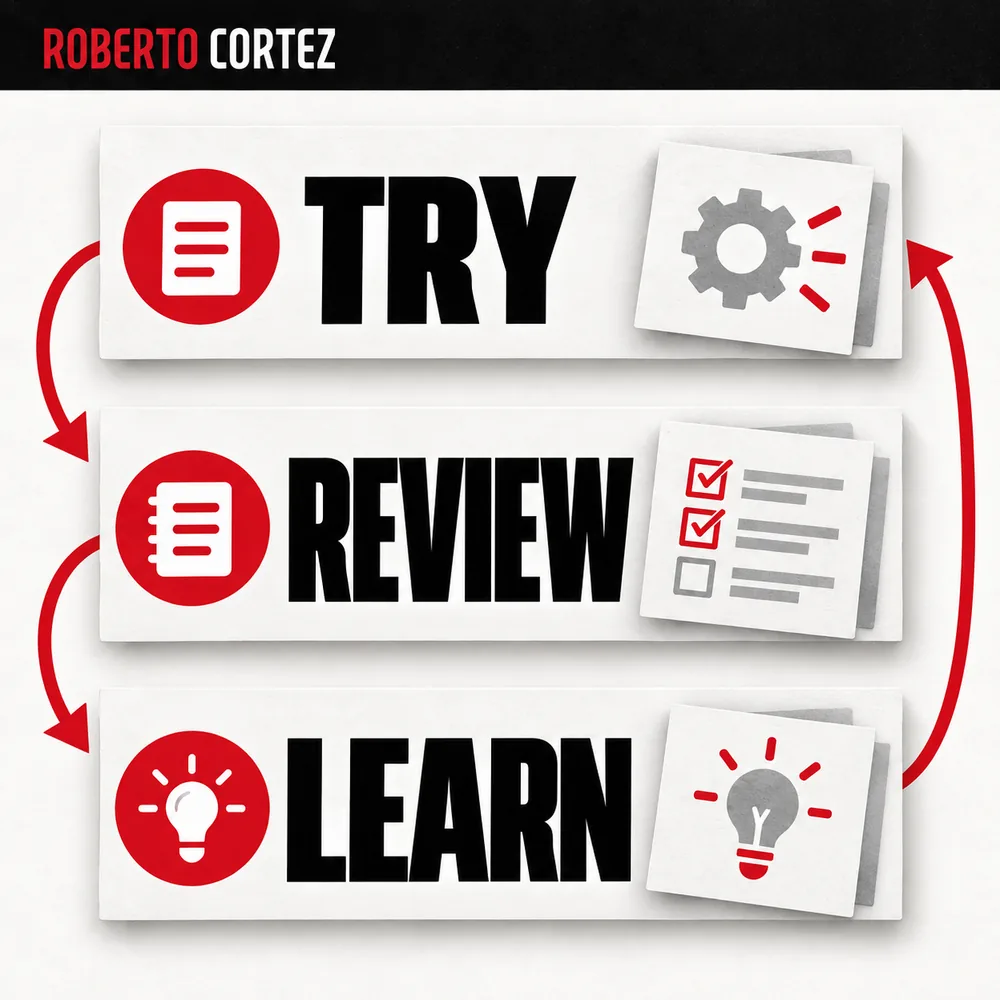
The next case should retain the objective, but can change one relevant detail. In a hypothetical sales assessment exercise, remove a piece of information that was available in the first enquiry. Observe whether the person asks for clarification or makes a decision as though the missing information were still present.
If you use AI to prepare questions or examples, check that they match the process and have a defensible answer. An example invented by a tool can seem clear while relying on an impossible condition. This care is part of using AI in business beyond the chatbot: usefulness depends on its connection to actual work and on validation.
Keep the exercise proportionate to the risk. To learn a process, you can use fictional information clearly identified as such and a test environment. You do not need to send a real message, change a customer's data or make a commercial commitment to check whether an explanation makes sense.
Save the correction so the same mistake is not taught again
When a question changes your understanding, update the example, instruction or document the team uses. Record what changed and the conditions under which the guidance applies. This makes the learning available to the next person and helps distinguish an improved explanation from a change in the work process itself or its underlying requirements.
A useful document does not need to preserve the entire conversation. It can contain the objective, the steps, a worked example and the situations that require confirmation. If you add an exception, explain how to recognise it and who decides what to do, rather than leaving only a general warning to be careful.
In my work, I value documenting processes and lessons so that another person can continue what has already been built. That documentation also allows earlier decisions to be reviewed. Reading an instruction again may reveal that the context has changed or that its explanation depended on you more than you realised.
For someone starting a business with AI, explaining a small task to another person can be a practical way to review their own plan. Choose something you can already demonstrate, identify the questions and check what is missing. Learning has a concrete consequence when it improves the next decision or execution.
Teaching does not automatically confirm mastery of a subject. It can, however, create an opportunity to examine your reasoning more carefully. Its value lies in accepting the question, returning to practice and correcting what you discovered, while keeping a clear distinction between what you have checked and what you still need to understand.